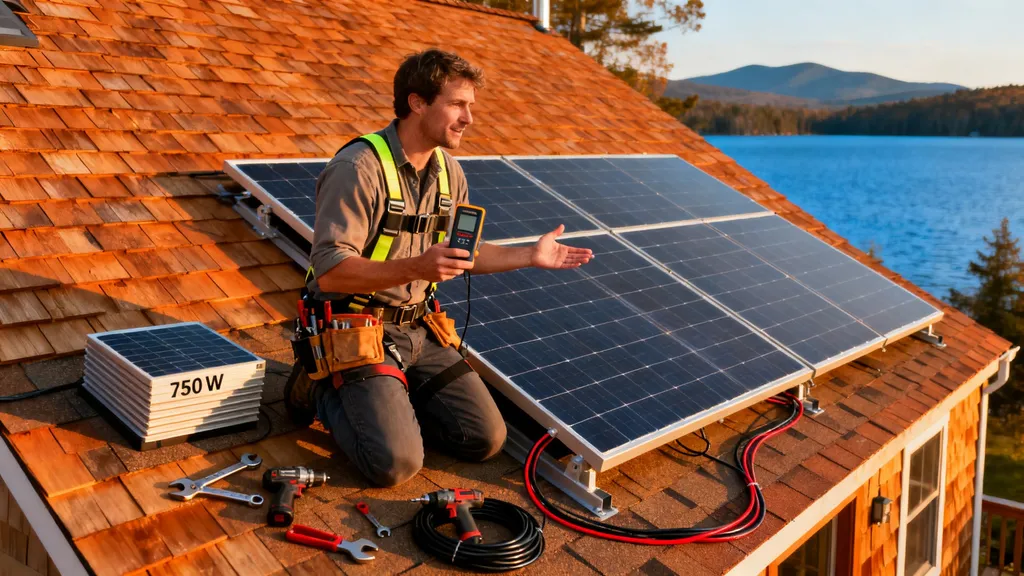
Step-by-step guide to sizing solar for cabins: calculate daily loads, array size, battery bank, and inverter needs with example builds and budget tips.
Cabin Solar System Sizing: How Much Do You Need?
Sizing a cabin solar system is a practical mix of math, local weather, and honest decisions about which loads matter. This guide on cabin solar system sizing walks through how to estimate real daily energy needs, convert those loads into panel array size, pick a battery bank and inverter, and adapt the plan for off-grid, grid-tied, or hybrid setups. Read on for worked examples, concrete formulas, and budget tips to plan a system that fits a tiny weekend shelter or a year-round off-grid cabin.
TL;DR:
- Calculate real loads first: measure or list appliances to get daily kWh; add 20–30% for inefficiencies and growth.
- For panels: array (W) = (daily kWh × 1000) / peak sun hours / system derate (0.7–0.85); for batteries: Ah = (daily Wh × days of autonomy) / (battery V × DoD × round-trip efficiency).
- Prioritize efficiency (LEDs, efficient fridge, DC loads), start with an expandable array, and size the inverter with 1.5–3× surge margin for motors.
How to Estimate Your Cabin's Real Energy Needs
Start by building a load spreadsheet listing every device, its wattage, and expected runtime. The primary goal is daily kilowatt-hours (kWh) — this drives panel and battery sizing.
Create an Appliance Inventory (what to List and Typical Wattages)
- Lighting: LED bulbs, 5–10 W each. Count bulbs × hours.
- Refrigerator (12V DC or 120V AC): Average cycling load 40–150 W; use manufacturer's average or monitor for cycling pattern.
- Chest freezer: 40–120 W average depending on size and ambient temperature.
- Water pump: Running 750–1,500 W for AC pumps; DC pumps often 50–300 W continuous but check start currents.
- Phone/tablet chargers: 5–10 W each.
- Laptop: 30–80 W while charging/working.
- Resistive space heater: 1,000–1,500 W (adds large loads; consider propane or wood instead).
- Ventilation (HRV/ERV): 20–80 W depending on unit size.
- Miscellaneous: Microwave (700–1,200 W), power tools (1,000–2,500 W peak), TV (30–150 W).
Industry references show whole-house median systems around 7.2 kW for U.S. residences, but cabins commonly range much lower depending on usage patterns (Statista median system size 2024).
Convert Watts to Daily Kilowatt-hours (simple Worked Example)
- For each device: Daily Wh = Wattage × Hours per day.
Example: 4 LED bulbs at 8 W each, 5 hours/day → 4 × 8 W × 5 h = 160 Wh/day.
- Sum device Wh values to get total daily Wh, then divide by 1,000 for kWh.
Example total = 1,800 Wh → 1.8 kWh/day.
- Apply a derating factor of 1.2–1.3 (20–30%) to cover inefficiencies, unexpected use, and future growth.
1.8 kWh × 1.25 = 2.25 kWh/day design target.
Measure with a plug-in energy monitor or a clamp meter for appliances hardwired to a panel. For accuracy, run measurements for a week to capture variability. See our guide on energy monitor calibration for best practice.
Adjust for Seasonal and Weekend/occupancy Patterns
- Weekend-only cabin: Expect higher peak loads per day but fewer days. Design for weekend peak and lower average annual energy.
- Full-time use: Size to cover daily average and worst-case low-sun periods.
- Seasonal heating: Resistive electric heat doubles or triples daily kWh; consider passive improvements (see passive design strategies) and insulation measures (insulating slab tips).
- Water systems: Pump run-time varies with tank size and plumbing layout — consult the off-grid water systems guide when estimating pump energy.
Add the seasonal high as a planning alert. For off-grid cabins, many designers size for the worst-case blackout or winter overcast period; others accept generator backup for extremes.
System Types and How Sizing Differs: Off-grid vs Grid-tied vs Hybrid
Choosing system type changes priorities. The same daily kWh leads to different array and battery sizing depending on whether the cabin is off-grid, grid-tied with backup, or hybrid.
Off-grid: Why Batteries Dominate Sizing Decisions
Off-grid systems must store enough energy for the longest expected low-production stretch. Common practice is 2–5 days of autonomy:
- 2 days for frequent generator backup or predictable weather.
- 4–5 days for remote cabins with no backup.
Battery bank size rises quickly with days of autonomy. Design must also account for worst-case charging rates: panels must recharge batteries after cloudy stretches.
IEA research on system sizing highlights load size, operation time, and location as key inputs when designing off-grid systems (see the IEA SHC system sizing guide: https://task16.iea-shc.org/Data/Sites/1/publications/task16-photovoltaics_in_buildings-p3.pdf).
Grid-tied (with Backup): Smaller Battery Needs, Different Priorities
With a reliable grid, batteries mainly cover outages and peak shaving. This keeps battery capacity low (hours to a day rather than multiple days). Array sizing can aim to offset annual usage, since the grid fills shortfall. In this configuration, priority shifts to maximizing production when panels perform best and using smart metering.
Hybrid Systems and When to Choose AC vs DC Coupling
Hybrid systems mix solar, batteries, and grid or generator backup. The choice between AC and DC coupling affects component sizing:
- DC-coupled systems send panel power directly to the battery via MPPT charge controller — efficient for battery charging.
- AC-coupled systems feed panels to an inverter, which can then send AC to loads and to a battery inverter/charger for storage.
For detailed coupling tradeoffs, see the AC/DC coupling guide. Cost tradeoffs are covered in our hybrid systems cost breakdown.
Practical rule: off-grid cabins typically require larger batteries and arrays sized to worst-case days; grid-tied cabins can get away with smaller batteries and arrays sized to annual production goals.
Step-by-step: Sizing Solar Panels, Batteries, and Inverter
This section gives the core formulas with worked examples so you can plug numbers into your spreadsheet. The Department of Energy's homeowner's guide to solar is a useful reference for general PV performance expectations.
Calculate Required Array Wattage From Daily Kwh and Peak Sun Hours
Formula:
- Required array (W) = (daily kWh × 1000) / peak sun hours / system derate
- Typical system derate: 0.7–0.85 (includes inverter loss, wiring, soiling, temperature)
Worked example:
- Daily need: 2.25 kWh (after derating for loads)
- Location peak sun: 4 peak sun hours/day
- System derate: 0.75
- Array = (2.25 × 1000) / 4 / 0.75 = 750 W
If panels are 350 W each: Number of panels = 750 / 350 ≈ 2.14 → round up to 3 panels (1,050 W) to provide margin and future-proofing.
Battery Bank Sizing: Amp-hours, Depth-of-discharge, and Round-trip Efficiency
Formula:
- Required Ah = (daily Wh × days of autonomy) / (battery voltage × DoD × round-trip efficiency)
Common assumptions:
- Lead-acid usable DoD: 50%
- LiFePO4 usable DoD: 80–90%
- Round-trip efficiency: Lead-acid ~80–85%; LiFePO4 ~90–95%
Example for 2 days autonomy, 12 V LiFePO4:
- Daily Wh: 2,250 Wh
- Days: 2 → 4,500 Wh required storage before accounting for DoD/efficiency
- DoD: 0.8, round-trip eff: 0.92
- Ah = 4,500 / (12 × 0.8 × 0.92) ≈ 509 Ah → choose a 12 V 500–600 Ah battery bank or a 24 V equivalent (divide Ah by 2 if increasing voltage).
Link to battery troubleshooting tips for maintenance and lifecycle considerations once you choose chemistry.
Inverter Sizing: Continuous vs Surge Rating and Selection Tips
- Continuous rating: match or exceed the highest steady AC load. For a cabin with fridge (150 W avg) and small loads, a 1,500 W inverter is common.
- Surge rating: many motors (pump, compressor) require 2–3× starting surge. For a 750 W pump, peak surge can be 2,250 W. Choose inverter with adequate surge capacity or use soft-start devices.
- Safety margin: size continuous rating 20–30% above expected peak continuous loads.
After choosing an inverter, follow the basic upkeep steps in the inverter maintenance checklist.
Watch this step-by-step guide on sizing your off grid solar power system: off grid solar calculation:
The video above demonstrates measuring loads, using peak sun hours, and converting that to panel and battery counts—use it alongside the formulas here.
Site and Climate Factors That Change How Much Solar You Need
Local conditions can change required array size dramatically. Use site-specific data to avoid oversizing or undersizing.
Peak Sun Hours, Tilt, and Orientation — Using Pvwatts or Local Solar Maps
Peak sun hours are the average equivalent full-sun hours per day. Values range roughly 2–6+ depending on latitude and climate. Use NREL's PVWatts calculator to get location-specific values and hourly production estimates: https://pvwatts.nrel.gov/. Plug that number into the array formula above to get accurate array wattage.
Shading, Micro-siting, and Seasonal Variations
- Partial shading can cut string production by large percentages; consider panel placement away from trees or use microinverters/string optimizers.
- Seasonal variation: winter production can be 10–50% lower than summer depending on latitude and snow cover — plan batteries and/or backup generation accordingly.
- Micro-siting: small shifts in tilt or azimuth can raise annual output by a few percent; on a small cabin system, every panel counts.
Temperature Effects and Panel Performance Derating
High temperatures lower panel voltage and power; panels lose about 0.3–0.5% power per °C above 25°C for many modules. In contrast, cold improves panel efficiency but brings snow/soiling issues. For mitigation tips see panel cooling solutions and review the solar off-grid topic for regional guidance.
Example System Builds: How Much Solar Do You Need for Common Cabin Types?
Below are three example builds with quick math. These are illustrative; always run your own load calculation first.
Tiny Cabin / Weekend Shelter — Ultra-lean 300–1,000 Wh/day Example
- Daily kWh target: 0.5 kWh/day (500 Wh)
- Peak sun: 4 hours, derate 0.75 → Array = (0.5×1000)/4/0.75 ≈ 167 W → one 200–350 W panel
- Battery: 12 V, 100 Ah LiFePO4 (1,200 Wh usable at 80% DoD ≈ 960 Wh) for one day autonomy
- Inverter: 300–600 W pure sine for small AC loads or use DC circuits to avoid inverter losses
- Notes: For lighting and phone charging, DC solutions and efficient fridge alternatives reduce needs. Consider a small generator for occasional heavy tool use.
Weekend Retreat — 1–3 Kwh/day with Basic Comforts
- Daily kWh target: 2 kWh/day
- Peak sun: 4 hours, derate 0.75 → Array ≈ 667 W → 2 × 350 W panels recommended
- Battery: 12 V, 300–400 Ah LiFePO4 (3,600–4,800 Wh gross) for 1–2 days autonomy
- Inverter: 1,500 W continuous with 3,000 W surge for refrigerator/pump starts
- Notes: If a fridge or small pump is present, ensure surge margin or soft-start. Consider solar motion light DIY for perimeter lighting.
Full-time Off-grid Cabin — 5–10+ Kwh/day with Fridge and Pump
- Daily need: 6 kWh/day
- Peak sun: 4 hours, derate 0.75 → Array ≈ 2,000 W → 6 × 350 W panels (2.1 kW)
- Battery: For 3 days autonomy at 12 V LiFePO4: Ah ≈ (6,000×3)/(12×0.8×0.92) ≈ 2,142 Ah → use 24 V or 48 V bank to reduce cable currents and cost (e.g., 24 V 1,070 Ah or 48 V 535 Ah modules)
- Inverter: 3,000–5,000 W continuous with high surge for pumps and tools
- Notes: For large heating loads, consider propane, wood, or efficient mini-split heat pumps sized separately. Micro-hydro can be an efficient supplement where available—see micro-hydro alternative.
Component Comparisons and a Specs Table to Help You Choose
Choosing panel type, battery chemistry, and controllers changes lifecycle, maintenance, and upfront cost. Below is a compact comparison table.
| Component | Typical capacity / cost range | Cycle life (typical) | Efficiency | Maintenance | Best use |
|---|---|---|---|---|---|
| Lead-acid flooded (12V 200Ah) | $150–$300 per 100 Ah | 300–800 cycles | 80–85% | Regular watering, equalization | Low upfront cost, short-term use |
| AGM / sealed lead-acid | $200–$400 per 100 Ah | 400–1,000 cycles | 80–85% | Low, sealed | Occasional use, moderate budgets |
| LiFePO4 (12V 100 Ah) | $600–$1,200 per 100 Ah | 2,000–5,000 cycles | 90–95% | Minimal | Long-term off-grid, high cycle use |
| Mono crystalline panel (350 W) | $120–$220 per panel | 25+ years warranty | 18–22% | Low | Most cabins: high efficiency per area |
| Polycrystalline (300 W) | $100–$180 | 20+ years | 15–18% | Low | Lower-cost arrays |
| Thin-film panel (varied) | $80–$200 | 10–20 years | 10–12% | Low, flexible mounts | Low light conditions, special mounts |
| MPPT charge controller (30–60 A) | $150–$600 | 10+ years | 95% | Low | Best charging efficiency |
| PWM charge controller | $20–$150 | 5–10 years | 70–85% | Low | Small arrays, budget installs |
| Pure sine inverter (1,500 W) | $250–$900 | 5–10 years | 90–95% | Moderate | Sensitive electronics, motors |
| Modified sine inverter | $100–$400 | 3–7 years | 80–90% | Low | Simple resistive loads only |
Key trade-offs:
- LiFePO4 costs more upfront but gives more usable Wh per kWh and longer life. It reduces required Ah and charging cycles.
- MPPT controllers recover more energy for charging batteries, especially when panel voltage is higher than battery voltage.
- Panel cost per watt varies with efficiency and brand; installation quality and tilt/orientation impact annual yield more than small panel price differences. For budget panel options see budget panel picks.
For technical background on PV system performance and homeowner planning, consult the Department of Energy's homeowner's guide to solar and the Solar Energy Industries Association's overview of how solar works: https://www.seia.org/initiatives/how-solar-works.
Costs, Scaling, and Budget-friendly Sizing Tips
Costs vary by region and choice of components. Ballpark hardware-only ranges:
- Tiny system (200–500 W panels, small battery): $800–$2,500
- Weekend retreat (1–2 kW array, medium battery): $3,000–$8,000
- Full-time off-grid (2–6 kW array, large battery bank): $8,000–$30,000+
These are rough ranges; wiring, mounting, permits, and labor add to totals. Use our solar cost calculator for a tailored estimate.
How to Prioritize Loads to Cut Array and Battery Size
- Use LED lighting and efficient appliances first.
- Prefer DC appliances (DC fridge, DC pumps) to avoid inverter losses.
- Stagger heavy loads (run pump when panels are producing).
- Use timers or simple controllers to limit non-essential loads during low-production periods.
- Improve building envelope: insulation and passive design reduce heating/cooling loads (see passive design strategies and insulating slab tips).
When to Oversize vs When to Save Money (practical Tradeoffs)
- Oversize array if expansion is likely or if you want to minimize generator use; arrays are modular and can be added later.
- Invest in larger battery bank if you need multi-day autonomy. Batteries are harder to scale cleanly later and may be a better upfront investment.
- Save on inverter size by shifting loads to DC or scheduling high-draw activities when panels charge.
Tools, DIY Steps, and Budget Calculators to Plan Costs
- Start with a load spreadsheet and measure real usage for a week.
- Use NREL PVWatts (https://pvwatts.nrel.gov/) for location production estimates.
- Use budget calculators like our solar cost calculator to estimate hardware+installation costs.
- Take advantage of community solar, rebates, or incentives where available.
For efficient ventilation that reduces winter heating loads while keeping fresh air, consider a balanced system guided by our HRV fresh air guide.
Key Points and a Quick Cabin Solar Sizing Checklist
One-page Checklist You Can Use While Planning
- Measure real loads: Run an energy monitor for a week and build a device-by-device spreadsheet.
- Calculate daily kWh and add 20–30% for inefficiencies and growth.
- Choose days of autonomy (2–5) based on backup plans and location.
- Get local peak sun hours from NREL PVWatts and adjust array math.
- Array formula: (daily kWh × 1000) / peak sun hours / derate (0.7–0.85).
- Battery formula: (daily Wh × autonomy days) / (battery V × DoD × round-trip eff).
- Select inverter with continuous rating above steady loads and surge 1.5–3× for motors.
- Prioritize efficient appliances and DC loads to reduce array and battery size.
- Plan wiring, mounting, fuses, and a maintenance schedule; include permitting where required.
- Leave room in the design to add panels or batteries later.
Follow the checklist on-site and save the spreadsheet — it’s the single most useful asset for future upgrades.
The Bottom Line
Sizing a cabin solar system starts with accurate daily kWh and local peak sun hours; batteries and array size follow from those numbers. Reduce loads first, then pick batteries with higher usable DoD (LiFePO4) if you need long autonomy. Practical next step: measure your loads for a week, run PVWatts for your site, and plug numbers into the formulas above to get a first-pass system design.
Frequently Asked Questions
How many solar panels does a cabin need?
It depends on daily kWh and local peak sun hours. Use the formula: array (W) = (daily kWh × 1000) / peak sun hours / derate (0.7–0.85). For example, a 2 kWh/day cabin in a 4 peak-hour location needs about 667 W of panels; that’s two 350 W panels. Measure your real loads first to avoid guessing.
How big should my battery bank be for weekend use?
For a weekend-only cabin with low loads (0.5–1 kWh/day), a 12 V 100–200 Ah LiFePO4 bank often suffices for 1–2 days autonomy. Use the Ah formula: (daily Wh × days) / (battery V × DoD × round-trip eff). LiFePO4 with 80–90% DoD and ~90% efficiency reduces required Ah compared with lead-acid.
Can I run a fridge and pump on a small off-grid system?
Yes, but plan for startup surges and continuous energy. Fridges have cycling averages (40–150 W) but compressors can surge 2–3×. Pumps especially can have high start currents. Size the inverter with appropriate surge capacity or use soft-starts, and include enough array wattage so batteries recharge after run cycles.
Consider DC fridges or timed pumping to cut inverter losses and reduce battery draw.
What happens if I undersize my battery or panels?
If panels are undersized, you’ll rely on the grid or a generator more and experience longer charging times after low-sun stretches. Undersized batteries will cause deep discharges, reducing battery life, and may force load shedding. Include a 20–30% buffer in planning to prevent chronic shortages.
How do I plan for winter or cloudy stretches?
Design for the worst reasonable stretch (2–5 days of autonomy) or plan a generator backup. Use winter production estimates from NREL PVWatts, factor in snow cover and tilt, and increase battery capacity or array size accordingly. Passive improvements and efficient heating reduce winter energy needs dramatically.