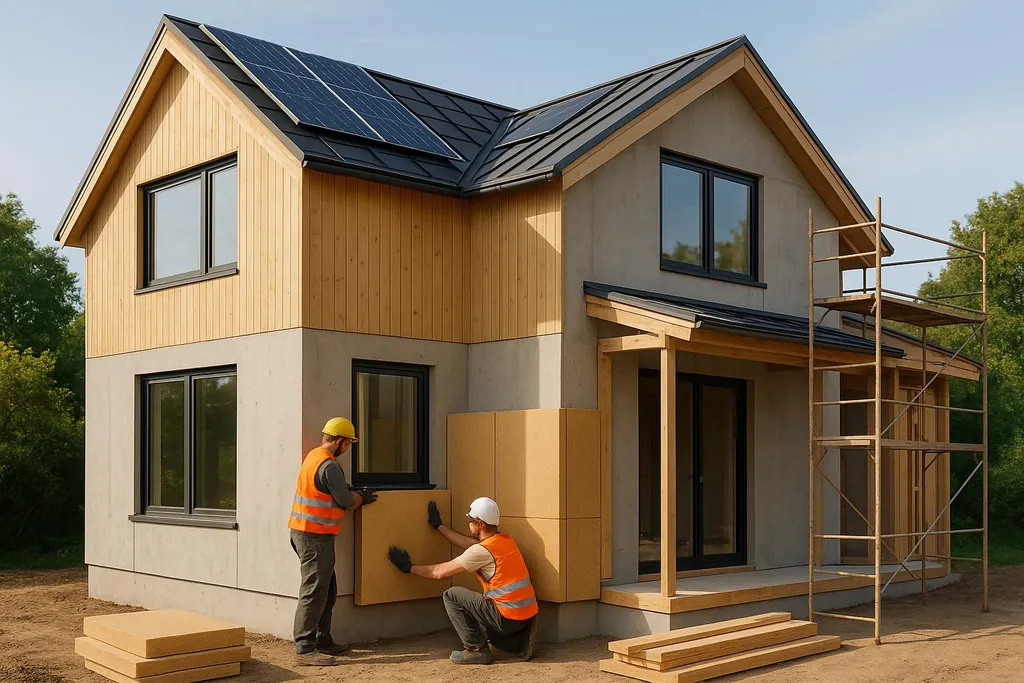
Passive house cost breakdown: materials, labor, certification, and how to cut expenses while meeting energy performance targets.
Cost Breakdown for Passive House Construction
Use the Passive House Feasibility Quiz to gauge how close your current design is to certifiable performance — and where the cheapest gaps to close are — before pricing premium components.
Building a Passive House costs 10-30% more upfront but saves up to 90% on energy use for heating and cooling. Over 30 years, homeowners can save up to $170,000 in energy costs compared to standard homes. Here's a quick breakdown:
- Passive House Costs: $325-$400 per square foot for single-family homes.
- Standard Home Costs: $250-$300 per square foot.
- Energy Savings: Passive Houses reduce heating/cooling energy by 75-90%, with minimal utility bills (~$50/month for a 2,000-sq-ft home).
- Long-Term Value: Lower energy bills, healthier indoor air, and reduced environmental impact.
Key Factors Affecting Costs:
- Design Simplicity: Simple shapes and roofs reduce costs.
- Windows: High-performance North American windows are now affordable.
- Heating Systems: Point-source heating cuts costs by 4-5%.
- Material Choices: Sustainable options like recycled materials can save money.
- Location and Climate: Colder climates require thicker insulation and better air sealing, increasing costs.
- Labor: Specialized skills like air sealing can add $3,000-$7,000 to your budget.
Quick Comparison:
| Aspect | Passive House | Standard Home |
|---|---|---|
| Initial Cost | 10-30% higher upfront | Lower upfront |
| Energy Use | 10% of standard heating energy | Higher energy consumption |
| Annual Savings | ~$1,400 for a 1,500-sq-ft home | Higher energy bills |
| 30-Year Savings | Up to $170,000 | Minimal long-term savings |
| Indoor Air Quality | Superior, filtered fresh air | Basic ventilation systems |
| Environmental Impact | 70% lower emissions | Higher emissions |
For your own assumptions, run the Passive House Cost Calculator to compare code-minimum cost, Passive House premium, DIY discount, and 30-year operating savings.
Bottom Line: Passive Houses are a smart investment for long-term savings, energy efficiency, and healthier living, while standard homes are more affordable upfront but costlier to maintain.
Does Passive House Cost The World? | Passive House Live
1. Passive House Construction Costs
Building a Passive House does come with higher initial costs compared to standard construction, but as the industry evolves, the gap is shrinking. Knowing where your money goes and how to manage costs can help you make smarter decisions about this energy-efficient option.
Initial Construction Costs
The cost difference between Passive House construction and traditional builds depends on factors like location, design complexity, and available incentives. For context, traditional homes built to code generally cost between $250-$300 per square foot, while certified Passive Houses range from $325-$400 per square foot[[10]](https://grammerheist.com/how-much-does-a-passive-house-cost). Prefabricated Passive Houses often fall in between, costing $275-$350 per square foot[[10]](https://grammerheist.com/how-much-does-a-passive-house-cost).
For example, a 2,000-square-foot conventional home in Ontario might cost about $550,000 to build, with monthly utility bills of around $300. A certified Passive House of the same size could cost $700,000 to construct, but the monthly utility bills would drop to just $50[[10]](https://grammerheist.com/how-much-does-a-passive-house-cost). While the upfront investment is $150,000 higher, the energy savings of roughly $250 per month can help offset the difference over time.
For multifamily buildings, the cost increase for Passive House standards is much smaller - only about 3.5% higher on average compared to standard construction before incentives[[7]](https://www.multifamilydive.com/news/report-passive-house-nears-cost-parity-with-traditional-construction-multifamily/690575). In some regions, like Pennsylvania, local incentives can even eliminate or reverse the cost gap[[9]](https://www.phius.org/resources/policy-work/cost-data).
Careful design and material choices can further reduce costs.
Main Factors That Affect Costs
When planning a passive house, several factors can significantly influence your budget. Being aware of these variables early on can help you make smarter decisions and avoid unexpected expenses.
Design Complexity and Size: The size and complexity of your home's design play a major role in determining costs. Larger homes naturally require more materials and labor, but design complexity can tip the scales even more.
Simple shapes save money. Homes with compact, rectangular designs are much more cost-effective than those with intricate geometries. This is closely tied to the Heat Loss Form Factor (HLFF), which compares the exterior envelope area to the interior floor area. For instance, in a 2,150-square-foot home, increasing the HLFF from three to four results in a 33% increase in the exterior envelope area. That means 33% more cladding, insulation, membranes, windows, and doors are needed, driving up costs.
Windows can quickly inflate your budget. Large window areas, especially floor-to-ceiling glass walls, may look stunning, but they're expensive. Windows are the costliest part of a home's thermal envelope and provide the least thermal resistance. A high glazing-to-floor area ratio not only raises costs but also makes it harder to meet passive house energy standards — though smart window orientation for passive solar gains can offset some of that thermal penalty with free winter heating.
Homes with complex architectural designs often see thermal envelope costs rise from the usual 30% to as much as 35-40% of total construction costs.
Location and Climate: Your home's location and climate are key factors in determining costs. The Passive House Institute United States (PHIUS) sets specific energy standards that vary by climate zone, directly affecting material and system requirements. A passive house in a region like Minnesota will need thicker insulation and better air sealing than one in Southern California. Rural areas often have lower labor costs compared to urban markets, where expenses tend to be higher.
Material and Design Choices
Making smart decisions during the design phase can significantly impact your budget. For instance, upgrading the building envelope may add 5% to 10% to the overall construction cost for a single-family home[[8]](https://www.probuilder.com/business-management/financing/blog/55195791/can-building-a-passive-house-cost-the-same-as-a-code-built-home). However, strategic planning can help keep these expenses in check.
Simplicity in design is key. Complex shapes, intricate rooflines, and unusual angles can drive up construction costs, while straightforward, rectangular designs with simple roofs can achieve the same energy efficiency at a lower cost[[11]](https://zeroenergyproject.com/2018/07/20/passive-house-busts-high-cost-myth-2).
Windows are another major factor. Typically, windows and doors account for 5-7% of the total construction cost when the glazing ratio is around 25%[[12]](https://www.altereco.net.au/blog-post/passive-house-cost). Fortunately, high-performance windows made by North American manufacturers now rival the energy efficiency of pricier European products, offering a budget-friendly alternative without compromising quality[[8]](https://www.probuilder.com/business-management/financing/blog/55195791/can-building-a-passive-house-cost-the-same-as-a-code-built-home).
Heating systems provide another area for savings. Passive Houses require minimal heating, so eliminating a central heating system in favor of point-source heating can reduce costs by 4% to 5%[[8]](https://www.probuilder.com/business-management/financing/blog/55195791/can-building-a-passive-house-cost-the-same-as-a-code-built-home). Natalie Leonard, P. Eng. and Founding Partner of Passive Design Solutions, highlights this cost-effective strategy:
> "With Passive design we calculate the point where further building improvements will cost more than adding renewable technologies to achieve Net-Zero. This consideration is the key energy strategy in balancing the design of the house and driving affordability in construction."[[8]](https://www.probuilder.com/business-management/financing/blog/55195791/can-building-a-passive-house-cost-the-same-as-a-code-built-home)
Material sourcing also matters. For instance, in Gorham, New Hampshire, Maine Passive House replaced 8 inches of EPS foam sub-slab insulation with 14 inches of Glavel, a recycled glass aggregate. This switch not only aligned with sustainable practices but also saved $265.81 compared to the original foam estimate[[13]](https://www.mainepassivehouse.com/buildforthefutureblog/2023/5/8/cost-and-carbon-material-selection). For more on the foundation side of this trade-off, see our guide to a Passive House-grade slab.
While upfront costs may be higher, the savings on energy make a compelling case.
Detailed Cost Breakdown by Category
Building a passive house involves three main expense categories: materials, labor, and mechanical systems. Each plays a distinct role in achieving the energy efficiency and comfort these homes are known for.
Material Costs: Materials often make up the largest share of the budget. Advanced insulation systems — typically continuous exterior rigid foam over the sheathing plus a cavity fill like mineral wool or dense-pack fiberglass — passive house-certified windows, specialized tapes, membranes, and sealants for airtightness, and structural elements with thermal bridge-free connections all contribute to higher material costs. However, these high-performance components deliver long-term energy savings that offset the initial investment.
Labor Costs: Labor costs can add up quickly, especially since building a passive house demands specialized skills and meticulous attention to detail. Proper air sealing can add $3,000 to $7,000 to your budget, depending on the home's size and complexity. Eliminating thermal bridges might add another $5,000. Regular blower door tests conducted throughout construction ensure airtightness but also increase labor demands. Regional variations in labor rates can further influence costs.
Mechanical Systems and Energy Modeling: A high-quality heat recovery ventilation system is essential for maintaining indoor air quality. Heating needs are minimal, so efficient solutions like modern mini-split heat pumps are often sufficient. Professional energy modeling, while it comes with a fee, ensures the design meets performance goals and can help qualify the project for potential incentives. Electrical and plumbing costs are generally similar to conventional construction.
Energy Efficiency and Long-Term Savings
The higher initial investment in Passive House construction pays off through dramatically reduced energy usage. Passive Houses use only about 10% of the energy required for space heating compared to standard code-compliant homes[[4]](https://www.opalarch.us/the-financial-benefits-of-investing-in-a-passive-house-2). For a 1,500-square-foot home, this translates to annual heating savings of approximately $1,400[[4]](https://www.opalarch.us/the-financial-benefits-of-investing-in-a-passive-house-2), with total energy savings potentially reaching $170,000 over 30 years[[4]](https://www.opalarch.us/the-financial-benefits-of-investing-in-a-passive-house-2).
This energy efficiency also shields homeowners from rising utility rates. While traditional homes become more expensive to operate as energy prices climb, Passive Houses maintain their low energy consumption, offering a buffer against market volatility. Certified Passive Houses consume about 75% less energy than standard builds[[14]](https://acarchitects.biz/self-build-blog/ph-benefits-ph-cat).
Beyond energy savings, the durability of Passive House construction adds long-term value. Features like superior materials, tight air sealing, and advanced mechanical systems often require less maintenance and last longer than those in conventional homes.
2. Budget Examples for Different Passive Houses
Understanding how design choices influence costs can help you plan your passive house budget wisely. Below are real-world examples showcasing how materials, construction techniques, and design complexity affect overall expenses across different price ranges.
Basic Passive House
A simple, single-story passive house of about 1,200 square feet typically costs between $210,000 and $240,000 (approximately $175-$200 per square foot). This design focuses on efficiency and affordability, often using straightforward, rectangular layouts to limit material waste.
One of the bigger expenses here is windows. High-quality triple-pane windows deliver excellent energy performance without breaking the bank. Interior finishes are kept modest, featuring laminate flooring, painted drywall, and standard kitchen cabinetry. For heating and ventilation, the house relies on a heat recovery ventilator (HRV) paired with a small heat pump as a backup.
To save on labor, you could tackle simpler tasks yourself like interior painting or basic installations.
Mid-Range Passive House
For a larger, two-story passive house of around 2,000 square feet, the cost rises to about $400,000 to $500,000 (roughly $200-$250 per square foot). This approach blends professional construction with cost-saving strategies and includes upgrades in both materials and design.
Prefabricated wall panels are often used to cut labor costs while ensuring consistent quality. Design features like covered porches or bay windows add functionality and visual appeal. Interior finishes are a step up, including engineered hardwood flooring, tiled bathrooms, and semi-custom kitchen cabinetry.
The mechanical system might include radiant floor heating in bathrooms and an advanced ventilation system with humidity control. While professionals handle critical installations like the building envelope and mechanical systems, tasks such as interior painting or landscaping can be done independently to save money.
High-End Passive House
For those aiming for a fully customized, high-end passive house, costs can range from $875,000 to over $1,050,000 for a 3,500-square-foot home (about $250-$300+ per square foot). These homes showcase the possibilities of premium passive construction.
Custom architectural designs may include curved walls, expansive glazing, or integrated outdoor living areas. Insulation levels often exceed R-60, and high-performance windows combine energy efficiency with striking aesthetics.
The interior features luxurious materials like solid hardwood flooring, natural stone countertops, custom millwork, and top-tier appliances. Mechanical systems are state-of-the-art, incorporating geothermal heat pumps, smart zoning controls, and whole-house automation. Additional luxury options might include radiant heated driveways, whole-house water filtration systems, or integrated solar panels.
These projects typically involve certified passive house consultants, energy modeling experts, and contractors experienced in passive house construction.
Budget Tier Summary
| Tier | Size | Cost Range | Per Sq Ft |
|---|---|---|---|
| Basic | ~1,200 sq ft | $210,000-$240,000 | $175-$200 |
| Mid-Range | ~2,000 sq ft | $400,000-$500,000 | $200-$250 |
| High-End | ~3,500 sq ft | $875,000-$1,050,000+ | $250-$300+ |
These cost ranges are based on current market conditions but can vary depending on location, site specifics, and material choices.
3. Standard Construction Costs
Standard construction prioritizes minimizing upfront expenses, but this often results in higher costs over the long term. Understanding these costs helps highlight the contrast between traditional building approaches and Passive House construction.
Initial Construction Costs
Building a standard home in the United States is generally more affordable upfront compared to Passive House construction. The average cost of building a home ranges from $138,937 to $531,294, with a national average of $323,026[[15]](https://www.homeadvisor.com/cost/architects-and-engineers/build-a-house). Standard homes typically cost $60-$110 per square foot[[15]](https://www.homeadvisor.com/cost/architects-and-engineers/build-a-house).
Material and labor costs are usually split evenly in a standard construction budget, with labor making up 30% to 50% of the total[[15]](https://www.homeadvisor.com/cost/architects-and-engineers/build-a-house). Here's a quick look at cost estimates based on home size:
| House Size (Square Feet) | Cost Range |
|---|---|
| 1,000 | $100,000-$200,000 |
| 1,500 | $150,000-$300,000 |
| 2,000 | $200,000-$400,000 |
| 2,500 | $250,000-$500,000 |
| 3,000 | $300,000-$600,000 |
Beyond the basic structure, additional costs include interior finishes ($50K-$175K), exterior finishes ($40K-$60K), system installations ($20K-$75K), permits ($1,200-$2K), and detached garages (around $26,400)[[15]](https://www.homeadvisor.com/cost/architects-and-engineers/build-a-house).
A standard home typically takes about seven months to complete[[15]](https://www.homeadvisor.com/cost/architects-and-engineers/build-a-house), thanks to the efficiency of conventional materials and widely adopted construction techniques. While these methods lower initial costs, they often come with hidden inefficiencies.
Material and Design Choices
The materials and design choices in standard construction play a major role in long-term performance. Most traditional builds rely on energy-intensive materials like concrete and steel[[16]](https://www.sciencedirect.com/science/article/pii/S2666790825000801), which help keep initial costs down but have a higher environmental footprint. Designs in standard construction often meet only the minimum requirements of older building codes, prioritizing affordability over energy efficiency[[16]](https://www.sciencedirect.com/science/article/pii/S2666790825000801). This approach results in homes with less effective insulation and higher operational energy demands.
Energy Efficiency and Long-Term Costs
While standard construction offers lower upfront costs, the trade-off often comes in the form of higher energy bills. Buildings account for 40% of the energy used in the United States[[19]](https://www.energy.gov/energysaver/why-energy-efficiency-matters), and standard homes frequently waste energy due to drafts and inefficient systems. Homeowners may spend an extra $200-$400 annually on energy bills, with up to 60% of heated air lost through uninsulated ducts[[19]](https://www.energy.gov/energysaver/why-energy-efficiency-matters).
Here's how energy use typically breaks down in standard homes:
- Heating and cooling: 43% of the utility bill
- Appliances: 15%
- Lighting: 11%[[19]](https://www.energy.gov/energysaver/why-energy-efficiency-matters)
By addressing drafts, homeowners could cut energy use by 5% to 30% annually[[19]](https://www.energy.gov/energysaver/why-energy-efficiency-matters). However, maintenance costs for standard homes can add up over time, as inefficient systems are more prone to breakdowns and may shorten the lifespan of HVAC and other components[[16]](https://www.sciencedirect.com/science/article/pii/S2666790825000801)[[20]](https://www.fsresidential.com/firstservice-energy/resources/articles/hud-adopts-energy-efficiency-standards-for-hud-and). Retrofitting older homes to include modern, energy-efficient systems can also be expensive - costing up to four times more than installing such systems during the initial build[[18]](https://neep.org/blog/energy-codes-key-long-term-affordability).
Environmental Impact
The affordability of standard construction often comes at the cost of greater environmental consequences. These homes contribute significantly to carbon emissions and resource depletion. Globally, buildings are responsible for 30% of final energy consumption and 26% of energy-related emissions[[17]](https://safetyculture.com/topics/energy-efficiency/energy-efficiency-in-construction). Materials like concrete and steel require energy-intensive manufacturing, and traditional designs often fail to adapt to local climate conditions, missing opportunities to maximize natural light and ventilation.
Additionally, standard homes may lack the resilience needed to withstand extreme weather events, which are becoming more frequent due to climate change. This can lead to higher repair and maintenance costs over time, increasing both environmental and financial burdens for homeowners.
4. Ways to Reduce Passive House Costs
Cutting costs on materials, labor, and systems can make building a passive house more affordable. Here are practical strategies to help you save money on your project.
Labor Costs vs. DIY Approach
Labor is a major cost variable, and your choice between hiring professionals or taking a DIY approach can make a big difference. Specialized passive house skills come at a premium -- precision tasks like air sealing and eliminating thermal bridges often command higher wages.
DIY can save money, but only if done correctly. Tackling certain tasks yourself can reduce labor costs, but it's essential to evaluate your skills and time realistically. Some aspects, like air sealing, require specific tools and expertise. Mistakes in these areas can compromise the home's performance, leading to higher energy bills or comfort issues later on.
The key is to focus your DIY efforts on tasks where you can confidently deliver quality results while leaving critical elements to professionals. Good candidates for DIY include:
- Interior painting and basic finish work
- Installing vapor barriers and weatherstripping
- Basic insulation installation
- Landscaping for solar shading
Leave these to the professionals:
- Structural work and foundation
- HVAC system installation and commissioning
- Building envelope air sealing certification
- Final electrical work
Platforms like [DIY Eco Homes](/) offer step-by-step guides, cost breakdowns, and video tutorials for jobs like air sealing, insulation, and basic carpentry. Budgeting tools are also available to help you track expenses and decide which tasks make sense to handle on your own.
Use Prefabricated Components
Prefabricated panels and modular systems can save both time and money. Built in controlled factory environments, these components minimize material waste and reduce labor demands on-site. They also offer better quality control compared to traditional stick-built methods.
Prefab passive house wall panels often come pre-insulated and may include built-in openings for windows and doors. This speeds up construction and lowers labor costs while cutting down on material waste. Some manufacturers even provide complete building shells, including walls, roof systems, and mechanical rough-ins. While the initial expense may be higher, the time saved and reduced need for skilled on-site labor can make this approach cost-effective, especially for first-time builders. Prefabricated Passive Houses typically cost $275-$350 per square foot, falling between standard and fully custom builds.
Choose Local and Eco-Friendly Materials
Sourcing materials locally can reduce transportation costs and support your regional economy. Local suppliers often offer competitive pricing, bulk discounts, and flexible delivery schedules, helping you avoid storage fees or delays.
Eco-friendly options like reclaimed wood, recycled steel, and natural insulation materials such as cellulose or sheep's wool can also be budget-friendly alternatives to conventional materials. Timing your purchases wisely -- buying during periods when prices are lower -- is another way to save. Building strong relationships with local suppliers can pay off by giving you access to better pricing and more flexible terms.
5. ROI and Financial Incentives
Return on Investment
Passive House construction delivers a strong financial return, with a 3.3% annual ROI from reduced energy consumption[[25]](https://openexpert.nz/construction/contemporary-style-home-design). Beyond the monetary benefits, these homes offer greater comfort, healthier living environments, and potential property value increases of 5-15% over time[[21]](https://www.coldwellsbuild.com/journal/are-passivhaus-homes-more-expensive-to-build), making the initial investment even more worthwhile.
The energy efficiency of Passive House buildings is striking. Multifamily structures built to these standards can slash energy use by up to 80% compared to conventional buildings[[7]](https://www.multifamilydive.com/news/report-passive-house-nears-cost-parity-with-traditional-construction-multifamily/690575)[[24]](https://www.nypassivehouse.org/dive-brief-report-passive-house-nears-cost-parity-with-traditional-construction). Heating and cooling bills may drop by as much as 90%[[23]](https://janecameronarchitects.com/blog/passivhaus-costs), and operating costs can fall to just 25% of those for a typical code-built home[[22]](https://artisansgroup.com/blog/passive-house-upfront-costs-payback). For example, a family in New Zealand living in a Passive House pays only about $300 annually for electricity, compared to the national average of $2,400[[25]](https://openexpert.nz/construction/contemporary-style-home-design).
While building to Passive House standards can cost 10-30% more upfront, studies show this premium can be recouped within five years in Germany, where additional construction expenses typically range between 3-8% compared to standard builds[[22]](https://artisansgroup.com/blog/passive-house-upfront-costs-payback)[[23]](https://janecameronarchitects.com/blog/passivhaus-costs).
Financial Incentives and Tax Credits
Several financial incentives in the U.S. can help reduce the upfront costs of building a Passive House:
- Section 45L Tax Credit: Provides up to $5,000 per unit for homes that meet energy efficiency standards.
- Home Efficiency Rebate Program (HOMES): Rewards energy-saving upgrades with rebates.
- Inflation Reduction Act incentives: Federal rebates and tax credits for energy-efficient construction and upgrades, including credits for insulation, windows, and heat pumps.
- State programs: Some states have their own incentives. For example, Mass Save offers rebates tailored specifically for Passive House-certified buildings.
- Local utility incentives: Many utility companies offer rebates for energy-efficient construction.
In some regions, like Pennsylvania, local incentives can even eliminate or reverse the cost gap between Passive House and standard construction[[9]](https://www.phius.org/resources/policy-work/cost-data). Be sure to explore both local and federal resources to uncover all available options and make the most of these savings opportunities.
Using sustainable materials may also qualify your project for green building incentives or additional tax credits, further lowering costs.
6. Advantages and Disadvantages
This section dives into the broader pros and cons of Passive House versus standard construction, building on the earlier cost analysis. Choosing between these two approaches often comes down to weighing higher initial expenses against potential long-term benefits.
Passive House Advantages
One of the standout benefits of Passive House construction is its exceptional energy efficiency, which translates to significant cost savings over time. For example, a 1,500-square-foot Passive House can save homeowners roughly $1,400 annually on space heating alone[[4]](https://www.opalarch.us/the-financial-benefits-of-investing-in-a-passive-house-2). Passive Houses also offer financial advantages through reduced energy bills by 75-95%, which could save you thousands of dollars over the years.
> "We can be sure when we build to passive house standards that we're going to get 40 to 60% less energy use per square foot than what we traditionally have for [building] code." - Beverly Craig, Program Director, Massachusetts Clean Energy Center[[1]](https://yaleclimateconnections.org/2024/02/the-promise-of-passive-house-design)
These homes also deliver unmatched comfort and healthier indoor air quality. Thanks to heat recovery ventilation systems, Passive Houses supply a steady flow of fresh, filtered air while reclaiming heat from exhaust air. Combined with airtight construction and superior insulation, they eliminate drafts and maintain consistent indoor temperatures throughout the year[[2]](https://www.carmelbuilding.com/2023/08/14/building-a-passive-house-vs-conventional-home-energy-efficient-homes).
On top of that, passive houses often don't require large HVAC systems or extensive solar setups, trimming down additional expenses. Thanks to their excellent insulation and airtight construction, they also tend to have lower maintenance costs while offering a more comfortable living environment.
Standard Construction Advantages
On the other hand, standard construction shines when it comes to lower upfront costs and ease of execution. Contractors are more familiar with traditional building methods, and materials are readily available, making the process faster and more predictable. This can be especially appealing for those working within tighter budgets or timelines.
Key Disadvantages
The most notable downside of Passive House construction is its higher initial cost, which can range from 10% to 30% more than standard construction[[5]](https://www.ny-engineers.com/blog/green-building-trends-pros-cons-of-passive-house-construction). However, this gap is shrinking. For example, Exeter City Council initially faced a 20% premium for its Passivhaus projects in 2009. By refining their building methods, they eventually achieved a 4% cost saving compared to standard construction[[21]](https://www.coldwellsbuild.com/journal/are-passivhaus-homes-more-expensive-to-build).
In contrast, standard construction often results in higher ongoing energy expenses. These homes typically rely on less efficient designs and basic heating systems, which can lead to increased utility bills over time. This means homeowners may face a heavier financial burden in the long run.
Comprehensive Comparison
The table below highlights the key differences between Passive House and standard construction:
| Aspect | Passive House | Standard Construction |
|---|---|---|
| Initial Cost | 10-30% higher upfront[[5]](https://www.ny-engineers.com/blog/green-building-trends-pros-cons-of-passive-house-construction) | Lower upfront cost |
| Energy Use | Only 10% of energy needed for space heating[[4]](https://www.opalarch.us/the-financial-benefits-of-investing-in-a-passive-house-2); up to 90% reduction in heating/cooling energy[[3]](https://home.howstuffworks.com/home-improvement/construction/green/10-benefits-of-a-passive-house.htm) | Higher energy consumption |
| Annual Savings | Around $1,400 per year for a 1,500-sq-ft home[[4]](https://www.opalarch.us/the-financial-benefits-of-investing-in-a-passive-house-2) | Higher energy bills expected |
| 30-Year Savings | Up to $170,000 in energy savings over 30 years[[4]](https://www.opalarch.us/the-financial-benefits-of-investing-in-a-passive-house-2) | Minimal long-term savings |
| Market Value | Potential 5-15% increase over time[[21]](https://www.coldwellsbuild.com/journal/are-passivhaus-homes-more-expensive-to-build) | Typical market appreciation |
| Material Quality | High-performance, sustainable materials | Standard-grade materials |
| Indoor Air Quality | Superior, with continuous fresh air via heat recovery systems[[2]](https://www.carmelbuilding.com/2023/08/14/building-a-passive-house-vs-conventional-home-energy-efficient-homes) | Basic ventilation systems |
| Environmental Impact | Up to 70% reduction in energy use and lower emissions[[2]](https://www.carmelbuilding.com/2023/08/14/building-a-passive-house-vs-conventional-home-energy-efficient-homes) | Standard emissions from conventional practices |
The decision between Passive House and standard construction ultimately depends on your goals and budget. Passive House is a forward-thinking choice, offering long-term savings, enhanced comfort, and a smaller environmental footprint. Standard construction, while more affordable upfront, often comes with higher energy costs over time.
> "Lifecycle costs are drastically lower in a highly energy-efficient building over the many decades that a building is used." - Passivhaus Institut[[6]](https://www.azureroad.io/passive-homes-what-are-they-and-why-is-the-u-s-behind-in-building-them)
For those planning to stay in their homes for years to come, the energy savings and comfort of Passive House construction can make the initial investment well worth it. It's a smart option for anyone seeking sustainable and efficient living.
Conclusion
Passive House construction stands out as a smart investment, combining higher initial costs with impressive long-term energy savings. While building to Passive House standards can cost 10-30% more upfront, studies show this premium can be recouped within five years in Germany, where additional construction expenses typically range between 3-8% compared to standard builds[[22]](https://artisansgroup.com/blog/passive-house-upfront-costs-payback)[[23]](https://janecameronarchitects.com/blog/passivhaus-costs).
The energy efficiency of Passive House buildings is striking. Multifamily structures built to these standards can slash energy use by up to 80% compared to conventional buildings[[7]](https://www.multifamilydive.com/news/report-passive-house-nears-cost-parity-with-traditional-construction-multifamily/690575)[[24]](https://www.nypassivehouse.org/dive-brief-report-passive-house-nears-cost-parity-with-traditional-construction). Heating and cooling bills may drop by as much as 90%[[23]](https://janecameronarchitects.com/blog/passivhaus-costs), and operating costs can fall to just 25% of those for a typical code-built home[[22]](https://artisansgroup.com/blog/passive-house-upfront-costs-payback).
> "Passive House creates more housing, lowers energy costs and builds resilience against the impacts of climate, while also providing healthier air indoor and out." - Bronwyn Barry, Founding Board Member, Passive House Network[[7]](https://www.multifamilydive.com/news/report-passive-house-nears-cost-parity-with-traditional-construction-multifamily/690575)
Smart design is the secret to managing costs effectively. Architects like Chris Benedict have shown that Passive House buildings can be constructed at no additional cost compared to standard methods by focusing on efficient design principles. Prioritizing simple shapes, optimizing window placement, and carefully selecting materials can eliminate or greatly reduce cost premiums[[9]](https://www.phius.org/resources/policy-work/cost-data)[[11]](https://zeroenergyproject.com/2018/07/20/passive-house-busts-high-cost-myth-2)[[23]](https://janecameronarchitects.com/blog/passivhaus-costs).
With strategic use of financial incentives like the Section 45L tax credit (up to $5,000 per unit), Inflation Reduction Act programs, and state-level rebates, the cost gap narrows even further. Combining smart design decisions with selective DIY efforts and prefabricated components can make passive house construction accessible at every budget level.
If you're considering Passive House construction, having access to the right tools and guidance is crucial. Websites like [DIY Eco Homes](/) provide detailed guides, cost breakdowns, and practical advice to help you navigate the technical and financial aspects of building to Passive House standards.
While the upfront costs may be higher, Passive House sets a new benchmark for energy efficiency. Its long-term financial, environmental, and health advantages make it a forward-thinking choice for homeowners looking to invest in a sustainable future.
FAQs
How much do passive house costs add to a typical residential build?
Passive house costs typically run 5% to 15% above a comparable code-built home, depending on climate zone, design complexity, and how much of the work is owner-built. On a 2,000 sq ft new build that's roughly $15,000 to $55,000 in extra upfront spending on continuous exterior insulation, triple-pane windows, balanced ventilation (HRV or ERV), and the air-sealing detailing required to hit the 0.6 ACH50 airtightness target. Owner-builders generally land at the lower end of that range — labor-heavy items like dense-pack cellulose install, vapor-barrier detailing, and exterior insulation are exactly where DIY effort displaces the most contractor markup. Operating-cost savings of $2,100-$3,000/year in heating and cooling typically return the premium within 10-20 years, with the gap closing fast as energy prices rise.
How much does a passive house cost in 2026?
How much does a passive house cost in 2026? In the U.S. and Canada, a new-build passive house costs roughly $275-$450 per square foot when built by a general contractor, or $175-$300 per square foot for an owner-builder doing significant labor themselves. That's about 5-15% above a comparable code-minimum build at the same square footage. On a 1,500 sq ft passive house: $260K-$450K turn-key, or $260K-$450K material+sub costs with sweat equity replacing GC margin. The big drivers from base build are continuous exterior insulation ($5K-$15K), triple-pane windows ($8K-$15K), air-sealing detail and a blower-door test ($2K-$5K), an HRV or ERV with ducting ($3K-$6K), and PHPP modeling plus certification ($3K-$10K). Climate zone matters: cold-climate passive houses (zones 6-7) need thicker walls and roofs so cost the most; mild-climate passive houses (zones 3-4) can hit the airtightness target with smaller assemblies. Operating costs typically run $200-$500/year for heating + cooling combined — small enough that paired with a modest solar array, many passive houses are functionally net-zero from year one.
What drives passive house costs higher than a code-minimum build, line by line?
Five categories account for almost all of the passive-house premium: (1) Envelope insulation — continuous exterior insulation (mineral wool, polyiso, or EPS) adds R-15 to R-30 beyond the cavity insulation and represents the single biggest line item, typically $5,000-$15,000 on a 2,000 sq ft build. (2) Windows and doors — triple-pane, low-U, Passive-House-certified units run $60-$120 per sq ft of opening versus $25-$40 for code-minimum, adding $8,000-$15,000 for a typical fenestration package. (3) Air-sealing detail — gasketed sill plates, taped sheathing seams, smart vapor retarders, and a blower-door mid-construction test cost $2,000-$5,000 in materials and labor most builds skip entirely. (4) Balanced ventilation — a sized HRV or ERV with dedicated ductwork is $3,000-$6,000 all-in (see our ERV vs HRV cornerstone for the selection logic). (5) Design and consulting — PHPP modeling, PHIUS or PHI certification fees, and additional architectural detailing add $3,000-$10,000. The good news: most of these costs scale with house size, so smaller passive houses are dramatically cheaper to certify per square foot.
What are the upfront costs of building a Passive House, and how do they compare to long-term energy savings?
Building a Passive House typically comes with a higher initial price tag than a traditional home, often adding $15,000 to $55,000 to the overall cost. This difference stems from the specialized materials and advanced construction techniques required to meet Passive House standards, which focus on maximizing energy efficiency.
That said, the long-term benefits can outweigh these upfront expenses. With features like top-notch insulation, airtight construction, and highly efficient energy systems, homeowners can save between $2,100 and $3,000 annually on energy bills. Over time, these savings translate to a reduction in energy use of 60% to 90% compared to conventional homes. This makes the investment not just a smart financial move but also a step toward a more sustainable future.
What are some cost-saving design and material choices for building a Passive House?
To make building a Passive House more budget-friendly, here are a few practical tips:
- Use locally sourced materials to cut down on transportation costs while supporting local businesses.
- Stick with standard sizes for items like lumber and windows to reduce waste and skip the higher price tag of custom options.
- Go for cost-effective insulation by layering more affordable materials to achieve excellent energy efficiency without overspending.
- Consider stick framing, a common and economical construction method widely used in the U.S.
- Use prefabricated components to reduce on-site labor costs and material waste, with prefab passive house shells costing $275-$350 per square foot.
On top of that, focus on smart energy-efficient design elements, such as making the most of natural light and optimizing ventilation. Keep designs simple and rectangular to minimize the Heat Loss Form Factor and reduce material needs. These choices not only keep upfront costs in check but also ensure the long-term energy savings that are central to Passive House construction.
Are there financial incentives in the U.S. to help reduce the upfront costs of building a Passive House?
Yes, there are several financial incentives in the U.S. designed to help reduce the upfront costs of building a Passive House. The Section 45L Tax Credit provides up to $5,000 per unit for homes that meet energy efficiency standards. The Inflation Reduction Act offers additional federal rebates and tax credits for energy-efficient construction, including credits for insulation, windows, and heat pumps.
Some states have their own programs. A great example is Mass Save, which offers rebates tailored specifically for Passive House-certified buildings. You might also be eligible for programs like the Home Efficiency Rebate Program (HOMES), which rewards energy-saving upgrades.
Be sure to explore both local and federal resources to uncover all available options and make the most of these savings opportunities. Using sustainable materials may also qualify your project for green building incentives or additional tax credits.
What are the financial advantages of building a passive house, even with higher initial costs?
Building a passive house might require a bigger upfront investment, but the long-term savings can be impressive. These homes are designed to cut heating and cooling energy use by up to 90%, which could save you thousands of dollars over the years. Passive House construction delivers a 3.3% annual ROI from reduced energy consumption, and property values can increase by 5-15% over time.
On top of that, [passive houses](/blog/erv-vs-hrv-ventilation-system-better-home) often qualify for financial perks like the $5,000 Section 45L tax credit in the U.S. Plus, they often don't require large HVAC systems or extensive solar setups, trimming down additional expenses. Thanks to their excellent insulation and airtight construction, they also tend to have lower maintenance costs while offering a more comfortable living environment.