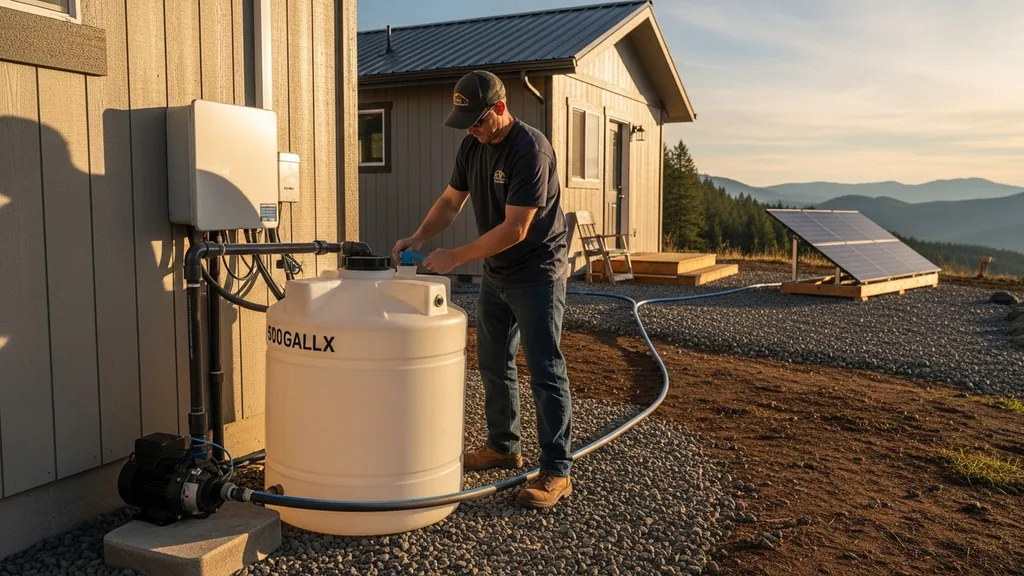
Practical, budget-friendly guide to designing and installing off-grid water systems for cabins — sources, storage, treatment, pumps, and sanitation.
Cabin Plumbing: Off-Grid Water Systems
Off-grid cabin plumbing requires simple, reliable systems that supply safe water, maintain pressure for fixtures, and handle sanitation without municipal hookups. This guide explains how off-grid water systems work for cabins and tiny homes, how to choose a source (well, spring, rainwater catchment, hauling), how to size tanks and pumps, which filtration and disinfection strategies work best, and practical steps for winter protection and budgeting. Readers will get concrete calculations (gallons per day, tank sizing), equipment options, maintenance schedules, and links to codes and deeper how-to checklists.
TL;DR:
- Design for conservation first: plan 10–50 gpd per person; size tanks for 3–7 days autonomy (e.g., 3 people × 20 gpd × 5 days = 300 gallons).
- Pick a source that matches site reliability: wells and springs give continuous supply; rainwater catchment yields ~623 gallons per 1,000 ft² roof per inch of rain.
- Invest in a reliable pump and multi-stage treatment (sediment → carbon → UV/chlorine) and winterize pipes to prevent freeze damage.
Overview: How Off-grid Water Systems Work for Cabin Plumbing
Cabin plumbing systems typically move water through four functional zones: source → storage → treatment → distribution (and sanitation/disposal). For a remote weekend cabin, the system may be small: a rainwater cistern, a single DC pump, and a cartridge filter feeding a gravity or low-pressure tap. For a year-round tiny home, expect a larger well or spring connection, a pressure tank plus pump, full filtration and disinfection, and a permitted septic or composting toilet.
Basic System Flow: Source → Storage → Treatment → Distribution
- Source: well, spring, rain catchment, or hauled water.
- Storage: tanks sized for days of autonomy and seasonal gaps.
- Treatment: filtration and disinfection tailored to source quality.
- Distribution/Sanitation: pumps, pressure control, fixtures, and wastewater management.
Typical flows and pressures
- Gallons per person per day (gpd): 10–50 gpd depending on conservation and use patterns. Weekend cabins often average 10–25 gpd; full-time tiny homes commonly use 40–60 gpd per person without aggressive conservation.
- Fixture pressure: Most fixtures perform well at 30–60 psi. For pumps, 40 psi equals about 90 feet of head.
Off-grid systems trade continuous municipal supply for storage and redundancy. That means sizing storage and planning backups is central. For water-saving design fundamentals, review the water-efficiency guide before final sizing; conserving 30–50% of water demand can reduce tank size and pump energy needs dramatically.
For broader context about extremely basic cabins that use no plumbing, see reporting on community cabins and shared sanitation at the Center for Health Journalism: an example site using portable toilets and no plumbing.
Choosing a Water Source: Wells, Springs, Rainwater Catchment, and Hauling
Selecting a source hinges on site geology, rainfall patterns, access, and local permitting. Use the table below to compare common options at a glance.
| Source type | Typical upfront cost | Ongoing maintenance | Water quality risks | Seasonal reliability |
|---|---|---|---|---|
| Dug/shallow well | $1,000–$5,000 | Moderate (pump, chlorination) | Surface contamination, bacteria | Variable with seasons |
| Drilled well | $3,000–$15,000+ | Low–moderate | Generally good if >50 ft; possible nitrates | Often reliable year-round |
| Spring | $500–$3,000 (collection works) | Low | Surface influence if not sealed | Can be steady, may drop in drought |
| Rainwater catchment | $300–$5,000 (tank + filters) | Low–moderate | Roof contaminants, organics | Seasonal with precipitation |
| Hauled water | Low infrastructure cost | Labor or delivery | Dependent on source quality | Reliable if deliveries possible |
Pros and Cons by Site and Reliability
- Wells: Drilled wells offer steady year-round supply in suitable aquifers. Upfront cost varies by depth and geology. Yield tests and pump sizing matter — drillers usually provide estimated yield (gallons per minute). Follow local plumbing code requirements for well construction. The 2022 California Plumbing Code provides model code language and amendments that can inform installation standards in regulated jurisdictions: 2022 California Plumbing Code - IAPMO.
- Springs: Gravity-fed springs can run continuously with low energy if collected properly; require secure spring boxes and basic filtration.
- Rainwater catchment: Use the rule-of-thumb: 1 inch of rain on 1,000 ft² roof ≈ 623 gallons. For example, a 500 ft² roof in a region with 30" annual rain could theoretically collect ~9,345 gallons annually (500 ÷ 1,000 × 623 × 30). Legal restrictions vary by state and locality; consult local rules before relying solely on rainwater. For collection best practices and roof yield calculations, see the water collection guide and the rainwater filtration checklist.
- Hauling water: Cheapest to start, but ongoing cost and logistics add up. Good as interim supply or emergency backup.
Contamination Risks, Testing, and Permitting Basics
- Test non-treated sources at least annually for total coliforms and E. coli; test for nitrates if agricultural activity is nearby. Industry guidance recommends annual bacteriological testing and immediate testing after heavy rainfall, landslides, or animal activity near the source.
- Check local permitting for wells, septic, and rainwater capture; some jurisdictions limit rainwater harvesting or require backflow prevention.
- Consider a baseline lab test for heavy metals and volatile organics if site history suggests risk.
Storage and Pressure: Tanks, Pumps, and Distribution for Off-grid Cabins
Tanks and pumps are the backbone. Size tanks for days of autonomy, and choose pumps that match head and flow needs while fitting the available power source.
Sizing Tanks and Siting Considerations
- Rule: Required tank gallons = desired days autonomy × daily use. Example: single-person weekend cabin using 20 gpd with 7 days autonomy needs 140 gallons.
- For seasonal sites, plan for longer autonomy (7–14 days) or supplement with hauled water.
- Tank placement: close to the cabin reduces trenching and heat loss; gravity-fed systems benefit from elevated tanks. Anchor tanks on compacted, level pads and provide overflow routing to a safe dispersal area.
Tank types comparison
| Tank type | Typical sizes (gal) | Lifespan | Freeze vulnerability | Avg price |
|---|---|---|---|---|
| Polyethylene | 50–5,000 | 15–25 years | Low if insulated | $200–$1,500 |
| Steel (lined) | 200–5,000+ | 20+ years | High if exposed | $500–$2,500 |
| Fiberglass | 100–5,000 | 25+ years | Moderate | $800–$3,000 |
Pump Types and Control Strategies
- Submersible well pumps: Good for drilled wells; AC or DC options. Pair with a pressure tank.
- Surface/jet pumps: Useful for shallow sources or boosted cistern supply.
- 12/24/48 V DC pumps (Shurflo, Grundfos DC variants): Ideal for small cabins with solar/battery systems. Brands like Shurflo and Grundfos offer 12V pump models commonly used in RVs and small cabins.
- SQFlex (Grundfos) and similar AC/solar hybrid pumps: Can run directly off PV or AC generator; check pump curves.
Understand pump head and flow
- Convert desired pressure to head: 1 psi ≈ 2.31 ft of head. So 40 psi ≈ 92 ft head. Check pump curves to find flow at that head.
- Use a small pressure tank (2–5 gallon) to reduce pump cycling. A larger pressure tank reduces cycles further and extends pump life.
Power sources for pumps
- AC with generator: Reliable but requires fuel and maintenance.
- Solar with batteries: For intermittent duty pumps and filtration; consult the solar sizing guide for array and battery estimates.
- Direct PV submersible pumps or micro-hydro: For sites with stream flow, see micro-hydro basics for continuous-power options.
- Battery selection and maintenance affect pump uptime; see battery lifespan tips.
Piping Materials, Valves, and Frost-safe Routing
- PEX is common for cabin distribution: flexible, freeze-resistant, and easier to route than copper. HUD’s PEX design guide covers recommended practices: PEX design guide - HUDUser.
- Use isolating valves, air chambers or pressure tanks, and accessible frost-proof hose bibs for exterior water points.
- Where freezing is a risk, route pipes inside insulated envelopes or below frost line.
Treatment and Filtration Strategies for Cabin Water Safety
Treatment strategy depends on source quality. For nearly all off-grid supplies, a multi-stage approach provides reliability.
Multi-stage Filtration: Sediment, Carbon, and Specialty Media
- Typical sequence: pre-filter → sediment filter (5–50 micron) → activated carbon → specialty media (iron or manganese removal) → final polishing.
- Sediment filters protect downstream components and UV lamps; replace or backwash frequently depending on turbidity.
- Carbon filters remove chlorine, taste, and organics; replace every 6–12 months by use.
- For iron or heavy metals, use appropriate media (greensand, catalytic carbon). Lab tests guide media selection.
Disinfection Options: UV, Chlorination, and When to Use Them
- UV disinfection: Effective for bacteria and viruses when water is clear (low turbidity). UV requires power and annual lamp replacement. Use a pre-filter to keep turbidity low.
- Chlorination (sodium hypochlorite): Provides residual protection and is inexpensive. Requires careful dosing and contact time. Useful for stored tanks and variable water quality.
- Combined approach: Sediment + carbon + UV for clean, low-turbidity sources; sediment + chlorination for turbid or groundwater sources that need residual disinfectant.
Monitoring and Testing: Kits and Schedules
- Testing cadence: Annual bacteriological testing for wells/springs; test after major events (heavy rain, flooding, maintenance). Test nitrates annually for shallow wells and in agricultural areas.
- Field kits: Coliform/E. coli kits and portable photometers for free chlorine are practical. For comprehensive contaminant profiling, send samples to certified labs.
- Add simple sensors—tank level, pressure, and leak detection—for remote monitoring. See smart water hookups to add tank level and leak alerts.
For a professional primer on residential plumbing installation and standards, consult the study guide from InterNACHI: Residential plumbing overview inspectors course.
Sanitation and Wastewater: Composting, Septic, and Graywater Options for Off-grid Cabins
Wastewater strategy should match occupancy, site constraints, and permits. Options range from dry composting toilets for low-use sites to full septic systems for year-round homes.
Composting Toilets: How They Work and Site Tips
- Dry composting toilets separate solids and liquids or use a single-chamber aerobic process. They significantly reduce water use and eliminate a septic drainfield.
- Advantages: low infrastructure, small footprint, minimal water. Disadvantages: regular maintenance, space for composting chamber or external disposal, potential odor if mismanaged.
- For background on composting toilet selection and moisture-control integration, see the composting toilet overview.
Septic Systems and Alternative Treatment Units (atus)
- Conventional septic with a drainfield is the standard for year-round occupancy. Design depends on percolation test, soil type, and local code; permitting is almost always required.
- ATUs (package treatment systems) provide aerobic treatment and reduced drainfield area but cost more upfront and need regular service.
- The VA Plumbing Design Manual outlines pipe selection and treatment considerations relevant to on-site systems: Plumbing design manual - va.
Graywater Reuse Basics and Simple On-site Strategies
- Graywater includes shower and laundry water (not toilet waste). Reusing graywater for subsurface irrigation can reduce potable demand.
- Simple systems: laundry-to-landscape diverter and a shallow mulch basin. Avoid storing graywater long-term; use promptly and follow setbacks.
- Do not use graywater for edible crops without advanced treatment; check local regulations for allowable uses and setbacks.
Maintenance rhythms and odor/health considerations
- Composting toilet maintenance cycle varies with model—emptying frequency can range from months to years depending on design and occupancy.
- Septic systems require periodic pumping (typically every 3–5 years depending on tank size and use).
- Graywater systems need simple filtration and routine checks to prevent clogging and odors.
Cold-climate Concerns: Freeze Protection, Pipe Insulation, and Moisture Control
Cold climates demand careful routing, insulation, and winterization to avoid burst pipes and lost supply.
Routing and Insulation Strategies to Prevent Frozen Pipes
- Where possible, bury supply lines below local frost depth. Frost lines vary by region — check local building department or code. If burying isn't possible, route pipes inside conditioned space or insulated chases.
- Use PEX for exterior runs where intermittent freeze risk exists; PEX tolerates some freeze expansion.
- Insulate hot and cold lines with closed-cell foam (typical R-values: pipe wrap 1–2) and insulate tanks with jacketed blankets.
Electric Heat-tracing, Passive Methods, and Winterizing
- Heat tape/heat cable: Use self-regulating heat cable with a thermostat for exposed runs and tank outlets. Ensure GFCI protection for electrical lines.
- Passive methods: Wrap tanks and pipes with foam and add a small insulated cabinet. A buried pump and insulated wellhead reduce freeze risk.
- Winterizing: For seasonal cabins, drain systems and blow out lines with compressed air or add non-toxic propylene glycol for non-potable loops. For potable systems, draining and winterizing are safer than antifreeze unless marked non-potable.
Addressing Moisture and Crawl-space Risks
- Condensation and high humidity in crawl spaces can freeze pipes and create mold. Use vapor barriers, insulation, and passive ventilation or a small dehumidifier where power allows.
- For practical crawl-space repair tactics, see crawl space moisture fixes and compare moisture control strategies in moisture absorber options.
The HUD PEX design guide offers recommended practices for routing PEX in cold climates: PEX design guide - huduser.
Sizing, Budgeting, and Materials: Estimate Water Use, Component Costs, and Where to Invest
Work through simple calculations and realistic price ranges so you can budget sensibly.
Daily-use Estimates and Sample Calculations
- Examples:
- Weekend solo cabin: 10–20 gpd; 3-day autonomy → 30–60 gallons.
- One-person year-round tiny home: 40–60 gpd; 7-day autonomy → 280–420 gallons.
- Family of three full-time: 40 gpd/person × 3 × 7 days = 840 gallons.
- Tank sizing formula: Tank gallons = Daily use × Days autonomy. Add 20–30% for emergency reserve.
Budget Ranges: DIY Low-cost Builds vs Durable Systems
- Low-cost DIY weekend system: $500–$2,000 (small tank, basic 12V pump, simple cartridge filters, hauled or rainwater source).
- Durable year-round system: $5,000–$20,000+ (drilled well, submersible pump, 500–2,000 gallon tank, full filtration, disinfection, and septic).
- Typical component cost examples:
- Poly tank 500 gal: $400–$1,000
- Pressure pump (DC/AC basic): $200–$1,000
- Sediment + carbon filters: $100–$600 installed
- UV unit: $250–$800
- Composting toilet: $600–$4,000 depending on model
- Septic installation: $3,000–$15,000+ (site dependent)
Hidden costs to watch for
- Permits and inspections, trenching and site prep, water testing lab fees, hauling hookups, and generator or solar support for pumps. See the hidden build costs breakdown for planning.
- Decide which tasks to DIY and which need pros by reviewing the labor cost comparison.
Which Components to Prioritize for Reliability
- Spend more on a reliable pump and pressure control, proper filtration and disinfection, and robust tank siting/anchoring. Save on temporary hauling, used tanks if inspected, and simple fittings.
For refrigeration and other electrical loads that affect pump sizing and energy budgets, consult off-grid refrigeration options.
Installation Checklist, Automation, and Troubleshooting
Step-by-step Install Checklist for a Basic Cabin System
- Site assessment: Verify source, elevation, frost depth, and access.
- Source connection: Drill well or install spring box; set intake and pre-filter.
- Tank pad: Level and compact a gravel/sand pad; anchor tank.
- Pump and pressure tank: Mount pump, connect pressure tank, install check valve and pressure switch.
- Filtration and disinfection: Install pre-filter, carbon/iron media as needed, and UV or chlorination point.
- Distribution: Run PEX or approved pipe to fixtures with isolation valves and frost-proof exterior taps.
- Wastewater: Install composting toilet or septic per permit; connect graywater routing if used.
- Commissioning: Pressure test lines, flush and disinfect tanks, run water through filters, test for bacteria and pressure stability.
Automation Options: Controllers, Floats, and Smart Monitoring
- Use float switches and low-voltage relays to prevent pump dry-run. Pair pressure switches with a pressure tank to reduce cycling.
- Low-cost controllers can automate filling from a backup source or trigger generator/solar inverter startup.
- Add tank-level sensors and leak detectors and integrate with the automate water pumps guidance to set alerts.
Common Issues and Quick Fixes
| Symptom | Likely cause | Fix |
|---|---|---|
| No flow | Pump power or dry well | Check power, floats, and priming; verify well yield |
| Low pressure | Pump cycling or clogged filter | Inspect pressure tank precharge; replace filters |
| Taste/odor | Carbon exhausted or chlorination imbalance | Replace carbon; check residual chlorine levels |
| Frozen line | Exposed routing or insulation failure | Thaw safely, insulate, reroute below frost line |
Quick Key Points and One-page Checklist
- Site prep: Level pad, plan drainage outflow from overflows.
- Safety: Install GFCI on electrical circuits, use proper grounding for pumps.
- Accessibility: Make filters and pressure tanks accessible for service.
- Redundancy: Have a small backup power option or manual hand pump for wells.
For a visual demonstration, check out this video on installing plumbing in our off-grid cabin:
For step-by-step pump automation and inexpensive controls, see automate water pumps.
The Bottom Line
Plan off-grid cabin plumbing around conservation, a source that matches site reliability, and storage sized for autonomy. Invest in a dependable pump, layered filtration plus disinfection, and freeze protection for cold sites. Maintain annual testing and simple automation for reliability in remote locations.
Frequently Asked Questions
How much water does a small cabin need per day?
Expect wide variation: a weekend-only cabin with strict conservation can use as little as 10–20 gallons per person per day. A year-round tiny home commonly uses 40–60 gallons per person per day without aggressive conservation measures. Calculate daily use from likely activities (drinking, cooking, showering, laundry) and then size tanks for desired autonomy (Days autonomy × daily use = tank gallons).
Can rainwater be my only water source for a year-round cabin?
Possibly, but it depends on rainfall, roof catchment area, and storage. Use the rule-of-thumb: 1 inch rain on 1,000 ft² roof ≈ 623 gallons. Year-round supply requires enough tank capacity for dry spells and reliable filtration/disinfection. Check local laws because some jurisdictions restrict rainwater harvesting. For practical steps on collection and conditioning, see the water collection guide and the rainwater filtration checklist.
Do composting toilets require electricity?
Some models are fully passive and require no electricity, relying on ventilation and manual management; others use small fans or heaters that need power. Choose a non-electric model for very remote sites or a low-power unit if you have solar and batteries. Maintenance and ventilation strategy matter more than power in preventing odors and ensuring composting.
What's the cheapest reliable pump option for a remote cabin?
For small cabins with solar or battery power, a quality 12V DC pump (e.g., Shurflo-style or compact Grundfos DC options) is a cost-effective and reliable choice. Expect $200–$800 depending on flow and head. For wells, a basic 240V submersible pump matched to well depth may be cheaper over time but needs AC power or generator. Prioritize a pump with a suitable pump curve for your head and a pressure tank to reduce cycling and extend life.
How often should I test my off-grid water supply?
Industry practice is annual bacteriological testing (total coliform/E. coli) for non-treated sources and immediate testing after heavy rain, flooding, or suspected contamination. Test nitrates at least annually for shallow wells or near agricultural activity. If using UV, monitor turbidity continuously and replace lamps annually; for chlorinated systems, monitor residual chlorine regularly.