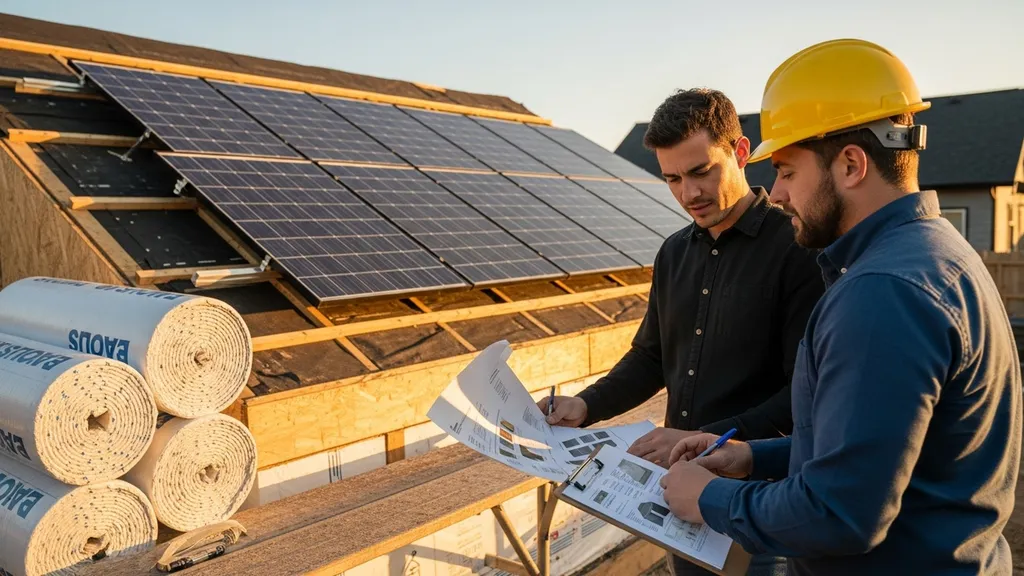
Current guide to green building tax credits, expired federal home energy credits, 45L timing, state rebates, utility incentives, and documentation for DIY eco-home projects.
Green Building Incentives and Tax Credits: 2026 Update
Green building tax credit options can reduce a DIY eco-home budget by thousands of dollars—but only if the homeowner documents purchases, chooses qualifying equipment, and times installation correctly. This guide explains which green building tax credit programs still matter for owner-builders and small contractors in 2026, how to handle expired federal home credits, how to find stackable state and utility incentives, and practical steps to calculate net project costs. Readers will learn the paperwork to collect, sample budget math for common retrofit and new-build scenarios, and where to confirm program rules (IRS, DSIRE, DOE/NREL).
TL;DR:
- Federal home energy credits changed after 2025: check current IRS rules before assuming solar, batteries, heat pumps, windows, or insulation still qualify; state and utility incentives may still cut net costs.
- Document purchases, manufacturer certification statements, and commissioning records; typical timeline is purchase → install/commission → claim on next tax return (months after completion).
- Start by checking federal rules (IRS guidance), search DSIRE for local programs, then run simple payback math before committing to higher-cost upgrades.
Overview: What "Green Building Incentives and Tax Credits" Means for DIY Builders in 2026
For 2026, the key point is that several major federal home energy credits have expired or are winding down, so homeowners should verify current IRS rules before budgeting around a credit. The phrase green building tax credit still covers federal credits, state incentives, and utility rebates that reduce net project cost for items like solar PV, battery storage, heat pumps, high-performance windows, and insulation. Research from energy agencies shows home energy upgrades commonly cut consumption by 20–40% when paired with efficient heating and envelope work, making incentives materially relevant to ROI and payback.
Who Qualifies (Homeowners, Owner-Builders, Small Contractors)
- Owner-occupied homeowners: Typically eligible for residential credits when they purchase and install qualifying equipment on their primary or secondary residences.
- Owner-builders: Can usually claim credits if they hold title and the dwelling is a qualifying residence; some builder credits (like 45L) apply to builders of new, energy-efficient homes subject to certification.
- Small contractors: May benefit indirectly (reduced client costs raise demand) and can claim business-related energy credits when equipment is for taxable rental or commercial properties—rules differ, so consult IRS guidance.
Types of Incentives: Tax Credits vs Rebates vs Performance-based Incentives
- Tax credit: Reduces federal tax liability directly. Example: the Residential Clean Energy Credit often covers a percentage of system cost.
- Rebate: Paid by a state or utility at point-of-sale or after inspection; reduces upfront expenditure.
- Performance-based incentive: Pays for measured energy production or demand reduction (payments per kWh or $/therm) and often requires metering or verification.
Key entities to consult: IRS, DSIRE (state and local program database), DOE and NREL for modeling and system costs. For green building certification approaches, see the Living Future Foundation’s green building frameworks for best-practice targets (Guide for Greener QAPs).
Major Federal Green Building Tax Credits Relevant to DIY Eco Homes
Federal programs used to provide the core tax incentives many DIY builders relied on. In 2026, treat federal home energy credits as a rules-check item first: the IRS says the Energy Efficient Home Improvement Credit and Residential Clean Energy Credit are not available after the 2025 cutoffs, while 45L has a separate mid-2026 acquisition deadline for eligible builder projects.
Residential Clean Energy Credit (solar, wind, geothermal, battery storage)
- What It Covers: Historically, a percentage of the cost for qualified residential solar electric equipment, small wind, geothermal heat pumps, and battery storage that serves the home.
- Rate and Timing: The Residential Clean Energy Credit was generally 30% for qualifying property placed in service through December 31, 2025. For 2026 projects, confirm IRS guidance before counting on a federal credit; carryforwards from prior-year credits may still matter.
- Documentation: Manufacturer certification, equipment invoices, and commissioning or interconnection records for grid-tied systems.
- Example: A prior-year $15,000 solar + battery install at 30% would have yielded a $4,500 federal credit; do not assume that applies to new 2026 work without checking IRS rules.
Home Energy Improvements and Efficiency Credits (Insulation, Windows, Heat Pumps)
- What It Covers: Specific items such as certain insulation materials, ENERGY STAR windows, air sealing, and high-efficiency heat pumps historically qualified under separate credits such as section 25C.
- Limits and Caps: These credits often had per-item or annual caps and required certified products or manufacturer statements; current-year eligibility should be verified before purchase.
- Example: Under prior rules, a qualifying heat pump could generate a credit, but 2026 projects should be budgeted around confirmed rebates or state programs unless IRS guidance says otherwise.
Builder Credits and New-Construction Incentives (When Applicable)
- 45L Credit: Provisions such as the 45L tax credit may apply to builders of new energy-efficient homes that meet testing or modeling thresholds for energy savings; current ENERGY STAR guidance says eligible dwelling units must be acquired before July 1, 2026.
- When Applicable: If an owner-builder constructs and follows applicable certification/inspection paths, they may claim certain builder credits; confirm IRS section references and state versions.
Compare tax credit vs tax deduction and rebates
- Tax credit: Reduces federal tax bill directly; more valuable than a deduction.
- Tax deduction: Lowers taxable income and depends on marginal tax rate.
- Rebate: Reduces the out-of-pocket cost immediately; some rebates require pre-approval and can affect the base used to calculate tax credits.
Official IRS guidance should be checked for code sections and up-to-date rules; see the IRS page on energy-efficiency deductions for commercial buildings for similar program structure (Energy efficient commercial buildings deduction - IRS).
State and Local Incentives: Finding Programs You Can Stack with Federal Credits
Most states, counties, and utilities run incentives that stack with federal credits—if you follow local rules. The Database of State Incentives for Renewables & Efficiency (DSIRE) is the primary search tool for current programs, and state energy office pages list program details.
How to Search DSIRE and State Energy Office Databases
- Search DSIRE by zip code or state and filter for residential incentives.
- Contact your state energy office for newer pilot programs or resilience grants not yet in DSIRE.
- Note: Many utility rebates require pre-approval, licensed installers, or follow-up inspection.
Common State-level Incentives: Tax Credits, Point-of-sale Rebates, Property Tax Exemptions
- State tax credits: Some states offer direct tax credits (percentage or fixed amount) for solar or efficiency upgrades.
- Point-of-sale rebates: Utilities may reduce the upfront price for heat pumps or EV chargers.
- Property tax exemptions: In some states, added home value from solar is exempt from property tax reassessment.
Local Utility Rebates and Performance Programs
- Utilities commonly offer rebates for heat pumps, smart thermostats, weatherization, and battery storage.
- Performance-based programs can pay for verified energy savings or demand response participation.
Examples of stacking across climates
- California: State incentives plus strong utility rebates for heat pumps and storage; local building codes often support higher efficiency.
- New York: Provider-based incentives and state-level tax credits can combine with federal credits for large savings.
- Texas: Fewer statewide incentives but some municipal/utility rebates and local property tax exemptions where available.
Also see Green Built Alliance’s overview of energy efficiency tax credits for program examples and state-level details (Energy Efficiency Tax Credits for Green Building | Green Built Alliance).
Which Upgrades Are Most Often Eligible (and Which Are Not): A Practical Inventory
This section lists common upgrade categories, typical eligibility, and what documentation or certifications are usually needed.
High-value eligible upgrades: solar PV, battery storage, heat pumps, high-efficiency HVAC
- Solar PV & batteries: Often qualify for the Residential Clean Energy Credit; battery storage may qualify if charged by on-site renewables or if used for home energy storage—check IRS definitions.
- Heat pumps: Usually qualify under efficiency credits if they meet seasonal energy efficiency ratio (SEER/HSPF/SCOP) thresholds or are on approved product lists.
- High-efficiency HVAC: Replacement of fossil-fuel equipment with qualifying heat pumps yields large credits and reduced operating cost.
Envelope Upgrades: Insulation, High-performance Windows, Air Sealing
- Insulation and windows: Often eligible for home energy improvement credits when products meet minimum R-value or U-factor thresholds; ENERGY STAR windows commonly qualify. Keep product datasheets and manufacturer certification.
- Air sealing and whole-house measures: May require blower-door tests or certified contractor reports for some performance-based programs.
Less-certain or Conditional Items: Green Roofs, Alternative Foundations, Unusual Materials
- Green roofs and alternative materials: Less consistently eligible; programs focus on energy performance or listed products. For alternative methods (hempcrete, ICF), incentives typically require measured performance or recognized product listings.
- Workmanship/labor: Many credits focus on equipment and materials; labor-only costs may be excluded for certain credits—read program rules.
Useful internal - Use the insulation comparison tool to pick insulation that meets qualifying R-values.
- See the sustainable materials guide when choosing certified products that often satisfy incentive criteria.
- For hybrid PV + battery systems, the hybrid energy systems guide explains when storage qualifies.
- For battery selection and warranty considerations, review battery lifespan tips.
- For R-value expectations and qualifying levels, see R-value basics.
Comparison/specs table (see next section) maps upgrades to typical credits and documentation.
Comparison Table: Credit Type, Typical Value, Qualification Requirements
| Incentive name (federal/state) | Eligible upgrade | Typical credit or rebate size | Certification required | Common documentation |
|---|---|---|---|---|
| Residential Clean Energy Credit (federal) | Solar PV, battery storage, small wind, geothermal | Prior rules were generally 30% through the 2025 cutoff; check IRS before assuming eligibility for 2026 work | Manufacturer spec sheet, inverter/battery datasheets | Invoice, manufacturer certification, interconnection/completion record |
| Home energy efficiency credit (federal, historically 25C) | Insulation, windows, heat pumps | Not available for property placed in service after Dec. 31, 2025 under current IRS guidance | ENERGY STAR, manufacturer efficiency ratings | Product datasheets, receipts, qualifying manufacturer statement |
| State solar rebate example (varies by state) | Solar PV | $0.10–$0.50/W or flat $1,000–$5,000 | State-listed contractors or product lists | Rebate application, inspection report |
| Utility battery rebate | Battery storage paired with PV | $500–$5,000 depending on size | Installer registration, UL listing | Application, commissioning report |
| Builder/new-home incentive (state/federal 45L) | New construction meeting energy modeling thresholds | Per-unit credit ($2,500–$5,000 historically) | Third-party verification (HERS, equivalent) | Certification reports, builder affidavit |
For context on green building costs and common energy savings, see the WBDG report on green building costs and benefits (Green building costs and financial benefits).
How to Calculate the Financial Impact on Your DIY Budget
A stepwise approach simplifies decision-making: estimate costs, identify incentives, apply credits, and compute payback.
Simple Calculation Steps
- Estimate upfront costs: Materials + equipment + permitted labor + inspection (include hidden costs like site access).
- Subtract point-of-sale rebates: Apply utility/state rebates that reduce the upfront price.
- Apply tax credits: Calculate federal credits (and any refundable status) and note caps; apply state tax credits after federal if rules allow.
- Adjust financing: Reduce loan amount by rebates; account for interest and loan term in annual cost calculations.
- Calculate operating savings: Estimate annual energy savings and change in maintenance costs.
- Compute payback and ROI: Net cost / annual savings = payback years. Compare to system lifetime.
Example Worksheets: Small Retrofit vs New Tiny-home Build
- Retrofit example (insulation + heat pump):
- Upfront: $8,000 insulation + $11,000 heat pump = $19,000
- Utility rebate for heat pump: $1,500 → net $17,500
- Confirmed utility/state heat-pump rebates reduce upfront cost; do not budget a new federal 25C credit for property placed in service after 2025
- Net after credit = $14,200 (but note credit reduces tax, not immediate cash)
- Annual energy savings ≈ $900–$1,200 → payback ~12–16 years (sensitive to electricity price).
- New tiny-home build (solar + battery + high-performance envelope):
- Upfront: $12,000 solar + $8,000 battery + $10,000 envelope upgrades = $30,000
- State rebate $2,000 + utility battery rebate $1,000 → net $27,000
- For projects already placed in service by the 2025 cutoff, a 30% federal credit may affect tax planning; new 2026 work should rely on confirmed state/utility programs
- Net cost after credit = $21,000; annual energy offset $1,200–$1,800 → payback 12–18 years.
How Credits Change ROI, Payback, and Financing Choices
- Credits can shift the break-even point materially when available. For 2026 planning, run the same math with confirmed utility/state rebates and any valid federal carryforward instead of assuming a new federal home credit.
- If credits are nonrefundable, ensure you have sufficient tax liability to use them; otherwise credits may carry forward depending on the program.
- Consider tax timing: the credit applies in the tax year the equipment is placed in service—plan installation date accordingly.
For help building realistic cost inputs, use the industry costing methodology from USGBC (A comprehensive cost database and budgeting methodology). Also check current material price trends in our materials cost trends and choose lower-upfront options using the budget-friendly materials guide. Don’t forget to include the hidden costs checklist.
Step-by-step: Documenting, Applying, and Claiming Green Building Tax Credits
Collecting the right documents and filing correctly avoids denied claims or delays. Start before you purchase.
Documentation Checklist
- Receipts and invoices: Itemized with product model numbers, costs, and seller contact.
- Manufacturer certification statement: Explicitly states product qualifies for the specific credit; keep PDFs or printed statements.
- Installation records: Signed contractor invoices showing installation date and scope; for owner-builders, maintain photos and dated logs.
- Commissioning and interconnection: For PV and batteries, include interconnection agreement and commissioning/inspection signoff.
- Energy performance tests: Blower-door or HERS reports for performance-based credits.
Filing the Claim: IRS Forms, State Forms, and When to Consult a Tax Professional
- Federal: Use the IRS form(s) specified in the current year instructions (Residential Clean Energy Credit guidance is on irs.gov). For commercial deductions see the IRS energy efficiency pages (Energy efficient commercial buildings deduction - IRS).
- State: File any state tax-credit forms with the state return; some states require pre-approval or system registration.
- Consult a CPA: Seek a tax professional for complex projects, builder credits, rental properties, or business-use apportionment.
Common Mistakes DIY Builders Make (and How to Avoid Them)
- Missing the manufacturer’s certification statement at claim time.
- Assuming labor is always eligible—labor may be excluded for certain credits.
- Installing before checking rebate pre-approval requirements—pre-approval is often required.
- Misclassifying a rental or business portion—credits often scale down for business use.
Watch this step-by-step guide on claiming residential energy credits on form 5695 (2026):
For PV technical recordkeeping and wiring details that support incentive claims, see solar-to-inverter wiring and our explanation of solar panel certifications.
Incentive Strategies for Off-grid, Passive House, and Alternative Construction Projects
Special-case builds need extra planning. Incentive rules often depend on interconnection, measured performance, or recognized product lists.
How Off-grid Setups Affect Eligibility (storage, Islanded Systems)
- Federal credits for storage: Battery systems can qualify even when installed off-grid if they meet the credit’s definition and are used to power the home; however, many utility rebates require grid interconnection.
- Interconnection caveat: Utility rebates and performance programs generally require grid-tied systems and proof of interconnection.
- Documentation: For off-grid projects, detailed commissioning records and energy-use logs help substantiate claims.
Passive House Upgrades and Certifications—what Incentives Apply
- Envelope-focused credits: Insulation, windows, and air sealing that meet qualifying product lists usually qualify for credits even if the project pursues Passive House certification.
- Performance programs: Some incentive programs pay for measured results; achieving Passive House performance can unlock higher-tier programs if documentation is accepted.
- Recommendation: Keep blower-door and PHI/PHPP outputs; some state programs accept modeled or measured verification.
Alternative Materials and New Techniques: Which Programs Recognize Them?
- Materials like hempcrete or ICF: Programs focus on performance; if an alternative material has test data showing required R-values or U-factors, it may be accepted.
- Hurdles: Manufacturer or third-party certification is often missing for new materials; plan to supply test reports and engineering statements.
- Resource: Compare options in our hempcrete vs ICF article to understand documentation differences.
For grid vs off-grid eligibility details, read the grid vs off-grid differences guide. For passive solar considerations that interact with incentive priorities, see passive solar shading tips.
Case Studies: Real DIY Projects and the Incentive Math
These anonymized examples show how incentives change decisions.
Tiny House Retrofit: Insulation + Mini-split + PV
- Scope: Add attic and wall insulation ($4,000), install a 9k BTU mini-split ($4,500 installed), and a 2 kW PV with battery-ready inverter ($6,000).
- Incentives: Utility rebate $500 for heat pump, state solar rebate $800, and any federal credit only if the project qualifies under current IRS timing rules.
- Net: Gross $14,500 → rebates $1,300 → net before tax credit $13,200 → tax credit $1,800 → final net cash cost $11,400. Annual energy savings ≈ $600–$900 → payback 12–19 years.
Owner-builder New Construction: High-performance Envelope + Solar + Battery
- Scope: New 800 sq ft bungalow with upgraded envelope ($12,000), 6 kW solar ($12,000), 10 kWh battery ($7,000).
- Incentives: State/utility solar or battery rebates where available, plus possible builder/new-home credits if the project qualifies before the applicable deadline and has third-party verification.
- Net: Gross $31,000 → federal credit $5,700 → net $25,300. With lower operating bills (estimated $1,400/year) and low maintenance, the owner-builder reaches payback in ~18 years, shorter if state/utility rebates apply.
Mid-size Reno: Replacing Fossil HVAC with a Heat Pump System
- Scope: Replace gas furnace + AC with whole-house heat pump ($18,000), add duct sealing and insulation ($6,000).
- Incentives: State rebate for heat pump $2,000, federal efficiency credit covering a portion of heat pump equipment (check current caps), utility demand response enrollment for additional savings.
- Net: Gross $24,000 → rebates $2,000 → taxable credit (example $3,600) → effective net $18,400. Annual energy savings compared to gas: $800–$1,200; payback sensitive to gas prices.
These examples show how incentives can tilt the decision between investing more in envelope vs more PV capacity. For alternative wall systems, read the hempcrete vs ICF comparison to see likely documentation needs.
The Bottom Line
Green building tax credit and rebate opportunities can still cut net costs on solar, storage, heat pumps, and key envelope upgrades, but the 2026 federal picture is narrower than it was in 2024 and 2025. Start early: inventory possible upgrades, confirm federal and local rules (IRS, DSIRE, state energy office), collect manufacturer certifications, and do simple payback math before buying.
Frequently Asked Questions
What records do I need to keep to claim a green building tax credit?
Keep itemized invoices showing model numbers, purchase dates, and costs; manufacturer certification statements that explicitly say the product qualifies for the named credit; installation records signed by the installer (or dated photos and logs for owner-builders); and commissioning/interconnection agreements for PV and battery systems. Maintain these documents for at least three years after filing in case of an audit.
Also store any blower-door or energy performance reports if claiming performance-based incentives; these often serve as required proof for higher-tier credits or builder incentives.
Can I claim credits for work I do myself (owner-builder labor)?
It depends on the credit. Many federal credits focus on equipment and materials, not labor, while some allow installation costs. Owner-builders who perform their own labor may still claim credits on qualifying products they purchased, but must provide clear proof the equipment was installed and placed in service. For builder-specific credits (like 45L), owner-builders should verify whether the program treats the owner as the builder and whether third-party verification is required.
Do off-grid systems qualify for the same federal credits?
Some federal credits cover battery storage and renewable systems whether grid-tied or off-grid, as long as the equipment meets the credit’s definition and is used to power the qualifying residence. However, many state and utility rebates require interconnection, so off-grid projects may miss those rebates. Carefully review IRS rules and program-specific guidance for storage and off-grid eligibility.
When in doubt, gather detailed commissioning records and usage logs to substantiate that the equipment serves the residence.
How do state rebates interact with federal tax credits?
State rebates typically reduce the system’s upfront cost and may lower the basis used to calculate a federal tax credit if the rebate is applied directly to the purchase price. Some programs explicitly allow stacking; others prohibit double-dipping. Check the rebate terms and IRS guidance to determine whether to subtract the rebate from the eligible basis before calculating the federal credit.
Use DSIRE or your state energy office to confirm rules, and document the rebate application and payment in your records.
When should I consult a tax professional?
Consult a CPA or tax advisor when projects are large, involve rental or business-use apportionment, include builder credits for new construction, or when credits are nonrefundable and you need to verify your ability to use them. A tax professional can also advise on carryforwards, state-federal interactions, and properly documenting complex installs.
If you’re claiming multiple credits across years, or if the project includes alternative materials or performance-based certifications, a professional review is a prudent step to avoid denied claims.