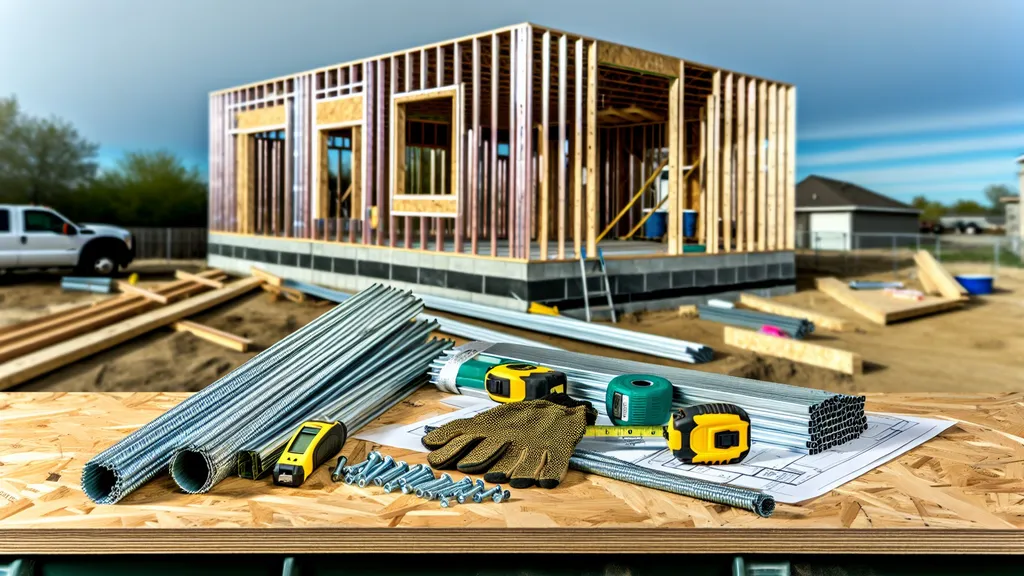
How recycled steel lowers embodied carbon, saves money, and performs in DIY construction—practical sourcing and installation guidance for eco self-builds.
Recycled Steel in Construction: Benefits and Uses
Recycled steel is a practical, low-embodied-carbon material option for DIY eco homes. Research shows global steel recycling rates exceed 80% and many construction-grade steels contain between 25% and 90% recycled content depending on the product and mill process. Using recycled steel can cut embodied carbon by roughly 30–70% compared with primary (virgin) steel in similar products, while also offering long life, fire and pest resistance—features that matter for off-grid, passive-house, and low-maintenance self-builds. This article explains where recycled steel fits on a small passive-ish shell, which products work for DIYers, sourcing and verification steps, mechanical specs to check, and hands-on installation tips.
TL;DR:
- Recycled steel cuts embodied carbon by ~30–70% and often contains 25–90% recycled content — check mill EPDs for exact numbers.
- Use recycled steel for roofing, cladding, cold‑formed framing, and rebar; verify mechanical specs (ASTM A36/A992, ASTM A615, AISI standards) and request mill certificates.
- Source from salvage yards, remelt mills, or reclaimed suppliers, inspect material condition, and plan for thermal-bridge details and corrosion protection before installation.
Why Recycled Steel Matters for DIY Eco Homes
Homebuilders working on tight budgets often look for materials that save money, reduce carbon, and simplify long-term maintenance. Recycled steel answers several of those needs: it resists rot and termites, tolerates outdoor exposure with appropriate coatings, and frequently costs less than specialty engineered timber when sourcing reclaimed batches. Industry groups such as worldsteel and the American Iron and Steel Institute report very high rates of steel recyclability and reuse; for a practical primer on steel recyclability see this guide to steel recycling from Service Steel Warehouse: https://www.servicesteel.org/resources/is-steel-recyclable.
For passive-house and off-grid projects, steel's durability and dimensional stability are attractive. Steel framing and metal roofing hold up under extreme weather, and metal roofs pair well with rooftop PV arrays described in resources for hybrid energy systems (see note on integration later). That said, steel is highly conductive, so thermal bridging and cold bridging must be addressed in the wall and roof assemblies by using continuous insulation, thermal break clips, or insulated sheathing (for air-barrier details see Zip sheathing as air barrier).
A quick, realistic scenario: swapping reclaimed corrugated roofing and cold-formed studs on a 40 m² outbuilding can save several hundred dollars in material and reduce embodied carbon by a few hundred kg CO2e compared with new, virgin-metal products. The trade-offs include cutting and fastening care, and checking that reclaimed elements meet code for structural loads.
Key Benefits of Recycled Steel at a Glance
- Lower embodied carbon: Typical reductions of about 30–70% versus virgin steel when recycled content is high (check EPDs for exact figures).
- Consistent structural performance: Properly remelted and certified recycled steel meets the same ASTM/EN specs as new steel.
- Stable value and salvage potential: Salvaged steel retains scrap/resale value and can lower upfront costs for DIYers.
- Durability and longevity: Resistant to rot, termites, and mildew; ideal for roofs, cladding, and exposed framing.
- Fire resistance: Non-combustible material suitable for fire-safe assemblies.
- End-of-life recyclability: Steel is effectively 100% recyclable and can re-enter the mill process without quality loss.
- DIY-friendly product availability: Common in corrugated roofing, cold-formed studs, rebar, mesh, and reclaimed beams.
- Lower price volatility for reclaimed stock: Reclaimed materials often avoid market swings tied to new steel mill pricing (inspect condition and straightness before buying).
For safety and handling guidance around metal scrap and processing, consult OSHA’s metal scrap recycling guidance: https://www.osha.gov/sites/default/files/publications/OSHA3348-METAL-SCRAP-RECYCLING.pdf.
Common Recycled Steel Products and Construction Uses
This section maps recycled steel to the real products DIY builders will encounter.
Structural Sections and Reclaimed Beams
- Typical recycled content: 40–90% depending on remelt source.
- Common sizes: W and I beams (hot-rolled), plates from 6 mm to 25 mm.
- Pros for DIY: Reclaimed beams can be cheap for garage frames or small-span lintels; good load capacity.
- Cons for DIY: May need NDT (non-destructive testing) or mill certificates for critical structural uses; welding or cutting requires experience.
- Practical example: Reclaim a short I‑beam from demolition stock for a 3–4 m garage lintel, confirm straightness and request a mill test certificate or have a structural engineer sign off.
Cold-formed Steel Studs and Framing
- Typical recycled content: 25–75% (cold-formed studs use substantial recycled scrap).
- Common sizes: 50 mm, 70 mm, 90 mm stud depths; gauges 18–25.
- Pros for DIY: Lightweight, easy to screw into, dimensionally consistent; pairs well with drywall alternatives and thin finishes.
- Cons for DIY: Thermal bridging; use continuous insulation or thermal break clips to meet passive-ish targets.
- Pair with: Drywall alternatives for interior finishes.
Rebar, Mesh, and Reinforced Concrete Uses
- Typical recycled content: 60–90% in remelted rebar.
- Common sizes: #3–#8 (10–25 mm); mesh panels standard 6×6/10×10 mm spacing.
- Pros for DIY: Recycled rebar in concrete performs the same when certified to ASTM A615; works well with recycled aggregate mixes.
- Cons for DIY: Corrosion risk in exposed conditions; ensure adequate concrete cover and corrosion protection.
- See how recycled steel pairs with recycled concrete in the recycled aggregate concrete guide.
Metal Roofing, Cladding, and Fasteners
- Typical recycled content: 25–80% depending on coil mill and coating.
- Common products: Corrugated sheets, standing seam panels, flashings, screws with washers.
- Pros for DIY: Quick to install, long life, excellent for rainwater harvesting and rooftop PV.
- Cons for DIY: Fastener and flashing details matter; pairing with gutter systems for rainwater capture affects material choices (see rainwater collection guide).
- For step-by-step roofing techniques see the recycled metal roofing guide.
For guidance on recovering and preparing steel for reuse in demolition projects, see the toolkit by the Alliance for Sustainable Building Products: https://asbp.org.uk/wp-content/uploads/2024/10/DISRUPT-2-Toolkit-full-BETA-1.pdf.
Note on fit-for-purpose: Use reclaimed or recycled steel freely for non-critical elements (roofing, cladding, outbuildings). For critical structural members—roof trusses spanning large distances, load-bearing beams—either require new mill-certified sections to specified ASTM/EN grades or have a structural engineer verify reclaimed stock and sign off.
Structural Performance, Specifications and a Comparison Table
DIY builders should know which mechanical properties and standards to check before using recycled steel in structural or semi-structural roles.
Key Mechanical Properties to Check (yield, Tensile, Ductility)
- Yield strength: Defines when permanent deformation starts (e.g., 250–355 MPa common for many construction steels).
- Tensile strength: Maximum stress before fracture.
- Ductility/elongation: Important for seismic or impact loads; expressed as % elongation in tensile tests.
Request mill test certificates showing the chemical and mechanical testing results (heat number traceability). Also look for Environmental Product Declarations (EPDs) when you want verified recycled-content and embodied-carbon data.
Standards and Testing to Verify (ASTM, EN, AISI)
- Rebar: ASTM A615 / A706 (U.S.) for deformed bars.
- Hot‑rolled structural shapes: ASTM A36, A992.
- Cold‑formed studs: AISI S100 / ASTM C955 (for steel studs).
- General mill certificates and EPDs: Ask for mill heat numbers, chemical composition, and relevant test reports.
The steel industry outlines recyclability and sustainability practice; see the Steel Manufacturers Association’s sustainability summary at https://www.steel.org/wp-content/uploads/2020/09/Steel-Sustains-in-Recyclability-Fact-Sheet.pdf.
Comparison Table: Recycled Steel vs Virgin Steel vs Alternative Materials
| Product | Typical recycled content | Yield strength (MPa) | Ductility | Embodied carbon (kg CO2e/kg) | Typical price |
|---|---|---|---|---|---|
| Rebar (A615) | 60–90% | 250–500 | High (10–20% elong.) | 0.6–1.2 (recycled), 1.8–2.7 (virgin) | $0.60–$1.00/kg |
| Hot-rolled I/W sections | 40–90% | 250–355 | Moderate | 0.7–1.3 (recycled), 1.8–3.0 (virgin) | $0.90–$1.50/kg |
| Cold-formed studs | 25–75% | 200–300 | Moderate | 0.5–1.0 (recycled) | $1.00–$1.80 per linear m |
| Corrugated roofing | 25–80% | N/A (panel) | N/A | 0.4–1.0 (recycled) | $8–$18 per m² installed |
Notes: Embodied carbon ranges are indicative and sourced from industry LCA summaries; actual EPDs provide exact kg CO2e/kg for a given mill and product. Prices vary regionally and over time; consult current local suppliers.
Properly remelted recycled steel that comes with mill documentation usually meets the same mechanical specifications as virgin steel. Exceptions occur when reclaimed or salvaged stock has surface defects, distortions, or unknown provenance; in those cases request secondary processing (straightening, shot-blasting) or new certified material.
For foundation and embedded steel behavior, pair rebar selection with slab design guidance in slab footing basics.
Sourcing, Certifications, and Verifying Recycled Content
Finding and verifying recycled steel is a process: inspect, document, and confirm.
Where to Buy: Scrap Yards, Remelt Mills, Reclaimed Suppliers
- Salvage yards and demolition suppliers sell reclaimed beams and decorative plates.
- Specialty remelt mills and rolling mills sell coil or section material with certified recycled content.
- Online marketplaces and local classifieds can yield one-off finds for small projects.
BuildSteel and industry data provide local recycling rates and supply context; read the construction recycling overview at https://buildsteel.org/why-steel/sustainability/recycles-steel-scrap/.
Questions to Ask Suppliers and Documentation to Request
- Ask for mill test certificates or heat numbers (traceability to a mill batch).
- Request an EPD or a written recycled-content percentage.
- Confirm compliance with relevant standards (e.g., ASTM A615 for rebar, ASTM A36/A992 for shapes).
- Inspect for warping, corrosion, pitting, and straightness in reclaimed pieces.
Use this practical checklist when evaluating deliveries: request the mill certificate, visually inspect, photograph non-conforming areas, and match alloys and grades to your design. For a broader procurement approach, consult the guide to recycled materials and the downloadable materials recycling checklist.
Cost Negotiation and Small-quantity Buying Tips
- Group-buy with neighbors or community builders to reach mill-minimum orders.
- Buy slightly oversized and cut down—remnant pieces often cost less by weight.
- Negotiate a cut-and-load service with salvage yards to avoid hidden labor costs.
- Confirm cutting/welding compatibility (e.g., avoid high-carbon steels if you plan simple on-site welding).
Chain-of-custody matters if claiming recycled content for certification or a green build label. Distinguish between "recycled content" (material processed into new products) and "reclaimed" (direct reuse of previously installed elements).
Cost, Embodied Carbon, and Lifecycle Benefits
DIYers need realistic cost and carbon figures to make material choices.
Typical Cost Comparisons for DIY Projects
- Recycled corrugated roofing (material only): $3–$8/m² vs new coated steel $6–$12/m²; installation parity depends on fasteners and flashing costs.
- Rebar (per tonne): recycled remelt rebar can be 5–20% cheaper than new mill-fresh rebar depending on local scrap markets.
- Cold-formed studs: reclaimed batches reduce cost but preparation and straightening add labor.
For broader market context, see green material price trends at materials cost trends.
Embodied Carbon and Lifecycle Analysis
Life-cycle studies summarized by industry groups indicate recycled-content steel has much lower embodied carbon than primary steel. A general rule: the higher the recycled content and the less energy-intensive the remelt/reforge process, the lower the kg CO2e/kg. For government guidance on secondary materials handling and life-cycle monitoring, consult the EPA’s HSM recycling checklist: https://www.epa.gov/system/files/documents/2024-07/hsm_checklist_july-2024_508.pdf.
Compare to alternatives:
- Timber has lower embodied carbon per kg but may require more maintenance and does not match steel for fire resistance or pest resistance.
- Aluminum has higher embodied carbon and cost than steel.
- Concrete with recycled aggregate reduces concrete carbon but still uses cement with significant emissions; pairing recycled rebar with recycled aggregate yields good circularity.
Long-term Value: Longevity, Maintenance, and Salvage Value
Steel's low maintenance (when properly coated or galvanized) and high salvage value mean lifecycle cost often favors steel for roofs and exposed elements. Expect decades-long service with periodic re-coating for some claddings. At end-of-life, steel typically returns to the recycling stream with high recovery rates.
Practical DIY Uses and Step-by-step Examples
These mini how-tos are for beginners to intermediate DIYers. For full roofing directions see the recycled metal roofing guide.
Small-span Framing with Cold-formed Recycled Steel Studs
Checklist:
- Select studs with mill certificates where possible.
- Use screws for connections (self-drilling Tek screws for metal-to-metal).
- Pre-drill fasteners where required and use sealing washers on exterior attachments.
Steps:
- Lay out plates and mark stud locations per design.
- Cut studs with an angle grinder and metal-cutting wheel; deburr cuts.
- Screw studs to tracks using self-tapping screws at recommended spacing (refer to AISI/ASTM spacing tables).
- Add continuous insulation (CI) outside studs to reduce thermal bridging and meet passive-ish targets.
Installing Recycled Metal Roofing (step Highlights)
- Check panels for straightness and corrosion; replace any with perforation.
- Install underlayment and flashing to manufacturer or local code standards.
- Use neoprene-washered fasteners in valleys and clips for standing seam.
- Seal all penetrations and ensure gutters are compatible if harvesting rainwater (see rainwater collection guide).
Using Recycled Rebar and Mesh in Concrete DIY Pours
- Verify rebar grade with mill certificate (ASTM A615 grade).
- Clean heavily rusted bars; light surface rust is acceptable.
- Use adequate concrete cover (usually 40–75 mm depending on exposure).
- Tie mesh and rebar per design, support with chairs, and avoid re-bending bars that show cracking.
For mixing recycled aggregate concrete with recycled rebar see the recycled aggregate DIY guide.
Permits and inspectors: structural and foundation work often requires engineering sign-off. If in doubt, hire a structural engineer to stamp drawings if reclaimed steel is used for load-bearing members.
Installation Best Practices, Corrosion Protection, Cutting and Maintenance
Good detailing prevents leaks, corrosion, and thermal losses.
Fastening, Thermal Bridging and Sealing Details
- Use neoprene or EPDM washered screws for metal roofs; stainless fasteners are best near coastal exposure.
- Break thermal bridges using insulated clip systems or continuous insulation outside the steel frame.
- Seal all laps and penetrations with compatible sealants (polyurethane or silicone rated for metal) and provide drip edges and kick-outs at eaves.
Surface Prep, Galvanizing, and Protective Coatings
- Hot-dip galvanizing or zinc‑aluminum coatings extend life; check coating mass (e.g., g/m²) when buying.
- For reclaimed steel, consider shot‑blasting and applying a high-quality primer before topcoat.
- Isolate dissimilar metals with neoprene washers or non-conductive tape to avoid galvanic corrosion.
Repair, Cutting, and Safe Disposal of Offcuts
- Cutting: angle grinder with metal-cutting wheel, portable bandsaw, or circular saw with a Ferrous Metal blade. Wear eye, ear, and respiratory protection.
- Welding: match filler to base metal and preheat when required. For novice welders, bolted connections are safer and easier.
- Dispose or recycle offcuts at local scrap yards—steel is widely accepted. Follow OSHA safety guidance for handling scrap and processing: https://www.osha.gov/sites/default/files/publications/OSHA3348-METAL-SCRAP-RECYCLING.pdf.
Here's a practical video showing on-site cutting, fastening, and corrosion-protection demos for recycled steel:
For air-barrier and sheathing details around steel penetrations see Zip sheathing as air barrier.
The Bottom Line
- Recycled steel reduces embodied carbon significantly and suits many DIY elements—roofing, studs, rebar, and cladding—when verified with mill certificates and EPDs.
- For budget-conscious self-builders, reclaimed steel often lowers upfront costs and raises lifecycle value, but plan for thermal-bridge mitigation and corrosion protection.
- Use the supplied sourcing checklist and request mill test certificates before installation; download the materials recycling checklist to get started.
Video: Steel Form Decking Guide: What is Form Decking? Form Deck
For a visual walkthrough of these concepts, check out this helpful video:
Frequently Asked Questions
Is recycled steel as strong as new steel?
Yes—when recycled steel is remelted and rolled to specification, its mechanical properties match new steel. Mill test certificates and standards such as ASTM A36/A992 (structural shapes) and ASTM A615 (rebar) verify yield strength, tensile strength, and chemical composition. For any critical load-bearing application, request the heat number and certificate and have a qualified engineer confirm fitness for purpose.
How do I verify the recycled content and embodied carbon of a steel product?
Ask suppliers for Environmental Product Declarations (EPDs) or a written recycled-content percentage tied to the mill heat number. Mill test certificates should include chemical analysis and batch traceability. EPDs provide verified kg CO2e/kg figures; if an EPD isn’t available, request the mill’s recycled-content statement and compare with published industry ranges.
Will recycled steel corrode faster than new steel?
Not necessarily. Corrosion depends on coating, exposure conditions, and maintenance. Proper galvanizing, zinc‑aluminum coatings, or painting deliver long service life for both recycled and new steel. For reclaimed pieces with surface rust, cleaning and recoating before installation is standard practice. Also isolate dissimilar metals to prevent galvanic corrosion.
How much can I expect to save by using recycled steel?
Savings vary by region and product. Reclaimed roofing material can be 10–50% cheaper than new coated panels. Rebar and studs may be 5–20% less expensive depending on scrap prices and processing costs. Factor in labor for cleaning, straightening, and certification when estimating total savings.
Are recycled steel products allowed by building codes?
Yes, provided the material meets the applicable code standards and documentation requirements. Building departments accept steel with mill test certificates and evidence of compliance with referenced ASTM or EN standards. For reclaimed structural members, an engineer’s assessment or a proof-of-performance may be required by inspectors.