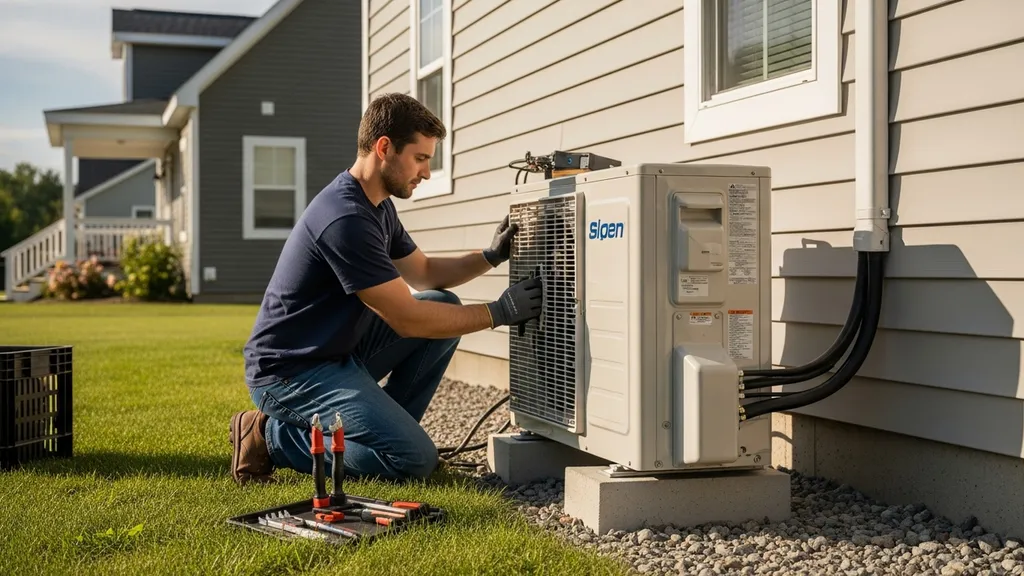
A practical, beginner-friendly guide to choosing, sizing, installing, and integrating air source heat pumps for eco DIY homebuilders.
Air Source Heat Pumps: Complete Buying Guide
Air source heat pump systems move heat from outdoor air into a home and can cut winter heating bills by 30–60% compared with resistive electric heat. This guide explains how an air source heat pump works, how to size one for a DIY eco home, cold‑climate performance limits, installation options and costs, model selection, and how to run a heat pump with solar and batteries. Readers will get practical examples, spec comparisons, a printable buying checklist, and a straightforward maintenance plan.
TL;DR:
- Choose a cold‑climate rated air source heat pump if winter temps regularly drop below -5°C; expect seasonal COPs from ~3.5 at mild temps to ~1.8 at very low temps for standard units.
- Size using a basic heat‑loss check or a Manual J; for a 1,200 sq ft moderately insulated home in a cold zone, plan ~6–8 kW (20,000–27,000 BTU/hr) of heat output, and avoid >20% oversizing to prevent short‑cycling.
- Budget $7,000–$15,000 installed for most detached homes; plan electrical upgrades, permits, and professional refrigerant work even if doing other tasks DIY.
Related guides: Ground source heat pumps geothermal explained, How to automate existing water pumps on a budget, Air sealing existing homes DIY guide, How to Automate Existing Water Pumps on a Budget (2026), How to source local materials for DIY homes, How to install airtight membrane walls roofs, and How to build a small cabin complete guide.
How air source heat pumps work: basic principles and key terms
An air source heat pump (ASHP) uses the refrigeration, or vapor‑compression, cycle to move heat rather than generate it. That cycle has four core components: compressor, condenser, expansion valve, and evaporator. Outdoors, the evaporator absorbs heat from ambient air; the compressor raises the refrigerant temperature and pressure; the condenser releases heat into the house; the expansion valve drops pressure and temperature so the cycle repeats.
The refrigeration cycle in plain English
- Evaporator: Low‑pressure refrigerant picks up heat from outdoor air and evaporates.
- Compressor: Vapor is compressed, raising temperature and pressure.
- Condenser: Hot refrigerant releases heat to the indoor side (air or water) and condenses.
- Expansion valve: Pressure drops, refrigerant cools, returns to evaporator.
Manufacturers such as Mitsubishi (Hyper‑Heat series), Daikin, NIBE, and Fujitsu produce both ducted and ductless systems that use inverter‑driven variable‑speed compressors for better part‑load efficiency. Inverter control reduces on/off cycling and improves heat pump efficiency across changing loads.
Air-to-air vs air-to-water vs hybrid systems
- Air‑to‑air: Delivers heated or cooled air directly through ductwork or indoor units (ductless mini‑split). Best for retrofit and zoned control.
- Air‑to‑water: Produces hot water for radiators, underfloor heating, or domestic hot water via a hydronic coil. Preferred for homes with existing hydronic distribution.
- Hybrid systems: Combine an ASHP with a gas boiler or electric resistance backup for very cold days or peak demand.
If pairing ventilation with an ASHP, consider whole‑house mechanical ventilation; see guidance on ventilation design to balance heat recovery and indoor air quality.
Key performance metrics: COP, HSPF, SCOP and capacity
- COP (Coefficient of Performance): Instantaneous ratio of heat output to electrical input. COP varies with outdoor temperature.
- HSPF (Heating Seasonal Performance Factor): Seasonal measure for heating efficiency in the U.S.
- SCOP (Seasonal Coefficient of Performance): European seasonal metric similar to HSPF.
- Capacity: Expressed in kW or BTU/hr; output falls as outdoor temperature drops.
Example COP change: a typical non‑cold‑climate ASHP might have COP ≈4.0 at +7°C, ≈2.8 at 0°C, and ≈1.8 at −10°C. Cold‑climate models with optimized compressors and refrigerants (e.g., Mitsubishi Hyper‑Heat) keep COPs higher at −10°C.
For practical installation pointers and best practices, see Slipstream’s Air‑Source heat pump best practices installation guide.
Sizing an air source heat pump: heat loss, capacity, and right‑sizing
Correct heat pump sizing keeps efficiency high and avoids short cycling. Industry pros use Manual J heat‑loss calculations; DIYers can use a room‑by‑room check and a worked example to estimate needs.
Manual J vs rules of thumb for DIYers
Manual J accounts for insulation, windows, orientation, infiltration, and internal gains. For a quick estimate, use square footage multipliers adjusted for climate and insulation:
- Well insulated: 30–40 W/m² (10–12 W/ft²)
- Moderate insulation: 50–70 W/m² (16–22 W/ft²)
- Poor envelope: 80–100 W/m² (25–30 W/ft²)
Worked example: a 1,200 sq ft (≈112 m²) moderately insulated home in a cold climate:
- At 60 W/m² → 112 m² × 60 W/m² = 6,720 W → ≈6.7 kW required.
- Add 10–15% for worst‑case rooms → choose ~7.5–8 kW nominal output.
Expressed in BTU/hr: 1 kW ≈ 3,412 BTU/hr → 7.5 kW ≈ 25,600 BTU/hr.
Factors that change required capacity (insulation, windows, airtightness)
- Insulation upgrades: Adding continuous insulation reduces required kW substantially; see practical choices in the insulation choices guide.
- Window area and orientation: South glazing can provide passive gains; large north glazing increases load.
- Airtightness: Reducing infiltration from 1.5 ACH50 to 0.6 ACH50 can cut design heat load by 15–30%.
When striving for Passive House levels, heat pump sizing often drops to small units (3–5 kW) because the envelope delivers most of the performance benefit. If unsure, hire a certified heat‑loss professional; a Manual J costs a few hundred dollars but avoids costly oversizing.
Matching the heat pump to your distribution system (radiators, underfloor)
- Underfloor heating: Works well with low‑temperature supply (35–45°C) — ideal for ASHPs.
- Radiators: Might need larger surface area or higher‑temperature models (air‑to‑water with boosted output) if existing radiators were sized for 70°C boiler water.
- Ducts and fans: Ducted air‑to‑air systems need good airflow; the Department of Energy recommends about 400 cfm per ton of AC capacity for cooling (adjust for heating loads) — see energy.gov for airflow guidance.
Avoid excessive oversizing: recommend staying within ±10–20% of calculated design load.
Performance in cold climates and low‑temperature operation
Cold weather affects both output and efficiency. Understanding manufacturer curves and defrost behavior helps determine whether a standard ASHP suffices or a cold‑climate heat pump is necessary.
How manufacturers rate cold‑climate performance
Manufacturers supply performance charts showing COP and capacity at specific outdoor temperatures (e.g., +7°C, 0°C, −7°C, −15°C). Cold‑climate models use enhanced compressors, optimized heat exchangers, and refrigerants to keep capacity and COP higher at subzero temperatures. Industry examples include Mitsubishi Hyper‑Heat and NIBE cold‑climate units.
Typical seasonal numbers:
- Mild temps (+7°C): COP ≈3.5–4.5
- Around 0°C: COP ≈2.8–3.5
- Very cold (−10°C and below): standard units COP ≈1.5–2.5; cold‑climate units may retain COP >2.0
Defrost cycles and efficiency losses
Outdoor coils accumulate frost; the unit runs defrost cycles that temporarily reverse the refrigerant flow to melt ice. Defrost consumes energy and can reduce instantaneous COP during cycles. Expect defrost energy penalties of a few percent to perhaps 10% of seasonal heating energy in snowy, subfreezing climates. Proper placement (above snow level) and coil design reduce frequency.
The Consortium for Energy Efficiency provides homeowner tips in their guide "YOU INSTALLED AN AIR SOURCE HEAT PUMP. NOW WHAT?" available at CEE's pdf.
Backup heat options and hybrid system scenarios
- Resistive backup: Simple, fast, and low capital, but expensive to run when electricity costs are high.
- Gas boiler backup: Effective when natural gas is available; hybrid controls switch to boiler at set temperatures.
- Secondary heat pump: A second heat pump sized for extreme cold offers redundancy and efficiency but increases cost.
For households in very cold zones, configure control logic so the heat pump runs as primary until a temperature or demand threshold triggers backup heat.
Installation options, DIY considerations, and realistic cost ranges
Installation covers siting, line‑set routing, electrical supply, and code compliance. Some tasks are DIY‑friendly, others legally require certified technicians.
Outdoor unit siting, line‑set routing, and noise considerations
- Clearance: Maintain manufacturer clearances for airflow and service access; keep the unit 0.5–1 m from walls and above typical snow depth.
- Mounting: Options include concrete pads, wall brackets, or elevated stands to avoid snow and debris.
- Line‑set routing: Minimize length and bends to reduce refrigerant charge and performance loss. Typical maximum run depends on model — check spec sheets.
- Noise: Outdoor units commonly rate 45–55 dB(A) at 1 m. Site the unit away from bedroom windows or use sound‑attenuating fencing or rubber mounts.
For practical installation practices, see NEEP's Guide to installing air‑source heat pumps in cold climates.
DIY‑friendly tasks vs work that needs a certified installer
- DIY tasks: site prep, pad or bracket mounting, routing low‑voltage control wiring, installing indoor non‑pressurized hydronic components, and basic electrical prep (panel space, conduit).
- Tasks for certified pros: brazing, refrigerant charging, high‑voltage wiring to the compressor, pressure testing, and system commissioning. In many jurisdictions, refrigerant handling requires EPA or local certification.
Electrical requirements: check breaker size and disconnects per manufacturer; some systems need 30–60 A breakers and a 240 V supply. For electrical parallels with PV work, review solar installation safety.
Typical installed cost ranges and how to budget
Installed cost varies with system size, climate rating, and complexity:
- Small homes / tiny houses: $4,000–$8,000
- Typical detached homes: $7,000–$15,000
- Cold‑climate or multi‑zone systems: $12,000–$25,000
Factors increasing cost: long refrigerant runs, multi‑zone indoor units, hydronic interface components, electrical panel upgrades, and structural work. Budget for permits and a commissioning visit.
Check rebates and financing from utilities, state programs, and national incentives to reduce upfront cost.
Choosing the right model: spec comparisons, warranties, and environmental impact
Pick a model that matches distribution type, climate, and budget. Compare capacity, COP at standard test points, cold‑temp ratings, warranties, and refrigerant type.
Comparison/specs table: capacity, COP/HSPF, low‑temp rating, price range
| Example model type | Nominal heating kW | COP @ +7°C | COP @ −7°C | HSPF/SCOP | Warranty (compressor/parts) | Price band |
|---|---|---|---|---|---|---|
| Small ductless split (6 kW) | 6 | 4.0 | 2.2 | SCOP 3.6 | 5 years / 5 years | $2k–$4k |
| Multi‑zone split (8–12 kW) | 10 | 3.8 | 2.0 | SCOP 3.4 | 5–7 years / 5 years | $4k–$8k |
| Air‑to‑water unit (8–16 kW) | 12 | 3.6 | 2.1 | HSPF 3.0 | 5–10 years / 5 years | $6k–$12k |
These bands are examples. Actual product curves differ; consult manufacturer data sheets.
Warranty types, expected lifespan, and maintenance intervals
- Warranty: Compressors often have 5–10 year warranties; parts typically 2–5 years. Extended warranties may be available.
- Lifespan: With maintenance, expect 15–20 years for the outdoor unit; indoor components can last longer.
- Maintenance: Monthly filter checks for ductless units; annual professional inspection for refrigerant checks, electrical connections, and defrost control.
The U.S. Department of Energy provides sizing and airflow guidance that helps match system capacity to distribution components — see the Department of Energy's air‑source heat pump page.
Refrigerant types and global warming potential (GWP) implications
- R‑410A: Widely used but higher GWP; being phased from new systems in some regions.
- R‑32: Lower GWP and higher efficiency; used increasingly in residential units.
- Low‑GWP alternatives: New refrigerants (e.g., R‑454B) appear in some models.
Refrigerant choice affects environmental impact and future servicing availability; consider models using lower‑GWP refrigerants if local regulations restrict high‑GWP gases.
Integrating air source heat pumps with solar, batteries, and off‑grid systems
ASHPs pair well with PV and storage because heat pumps convert electricity into heat at high efficiency. Integration requires planning for inverter sizing, control strategies, and storage.
Sizing PV and battery to match heat pump loads
A 1 kW ASHP running a few hours per day might consume 2–5 kWh/day depending on climate and COP. Rough sizing example:
- If an ASHP uses 8 kWh/day (seasonal average), a 3 kW PV array producing ~9–12 kWh/day could offset daily energy use in sunniest months.
- For 100% solar heating in winter, arrays and battery banks must be larger—often impractical without thermal storage.
For off‑grid planning and calculations, reference the site's off‑grid sizer.
Control strategies: timers, smart relays, and demand management
- Load shifting: Run heating when PV output is high; use pre‑heating or thermal stores to shift demand to midday.
- Smart relays and tariff awareness: Integrate with time‑of‑use tariffs to reduce operating cost.
- Thermal storage: A well‑insulated hot water tank allows storing heat when PV excesses are available.
For coupling strategies and inverter choices, see the detailed AC/DC coupling guide. For battery best practices when running high loads like heat pumps, consult how to monitor solar battery health.
AC vs DC coupling and hybrid system considerations
- AC coupling: Common with grid‑tied inverters; easier retrofit and flexible.
- DC coupling: More efficient when charging batteries from PV and then inverting for heat pump use; requires compatible inverter/charger.
Off‑grid systems need inverters that can sustain continuous power for the compressor starting current and must allow for load shedding. Consult the off‑grid sizing tool and inverter spec sheets before purchase.
Key points: quick buying checklist for DIY eco homebuilders
A printable checklist for shopping and project planning:
- Assess heat loss: Perform a room‑by‑room check or Manual J to determine kW needs.
- Choose distribution type: Decide between air‑to‑air (ductless/ducted) and an air‑to‑water heat pump for hydronic systems.
- Select cold‑climate rating if needed: Pick a model rated for low temperatures if winters dip below −5°C.
- Plan electrical work: Confirm breaker, disconnect, and potential panel upgrade requirements.
- Check permits and rebates: Research local incentives and building permits before ordering equipment.
- Plan renewables: If pairing with PV/battery, size arrays and storage to match expected heat pump loads.
This checklist matches the main decisions readers face when comparing models, installers, and financing.
Maintenance, troubleshooting, and a short how‑to video
Regular maintenance keeps efficiency high and reduces breakdown risk. Simple DIY checks prevent many common problems; refrigerant and mains electrical work should remain with certified technicians.
Routine maintenance checklist (filters, coils, condensate)
- Monthly: Inspect and clean indoor filters (vacuum or rinse for ductless units).
- Quarterly: Clear debris around the outdoor unit and check condensate drains.
- Annually: Schedule professional inspection for refrigerant pressures, electrical connections, defrost control, and coil cleaning.
NY‑SERDA’s maintenance tips explain basic filter care and inspection steps in their ASHP maintenance factsheet.
Common faults, simple diagnostics and fixes
- No heat / low heat: Check thermostat settings, breaker, and outdoor unit for ice. If ice persists beyond normal defrost cycles, call a pro.
- Frequent short‑cycling: Often a sign of oversizing or airflow restriction—clean filters and check setpoints.
- Strange noises: Loose panels, fan issues, or failing bearings require shutdown and professional diagnosis.
Minor repairs (fans, controls) often run $150–$500; major repairs (compressor replacement) can be several thousand dollars.
When to call a pro and expected repair costs
Avoid opening refrigerant lines or handling high‑voltage wiring. Call a certified HVAC technician for pressure testing, brazing, refrigerant top‑ups, or compressor faults. Expect service calls of $100–$200 plus parts; compressor replacements often exceed $2,000.
Watch this step-by-step guide on replace filter media to your ducted air conditioned or gas heater panel filter:
The bottom line: is an air source heat pump right for your DIY eco home?
Air source heat pumps offer large operating savings where electricity is reasonably priced or paired with PV; they suit well‑insulated homes and those willing to plan for electrical and refrigerant work. For very cold climates or poorly insulated envelopes, consider a hybrid approach with boiler backup. Next steps: calculate heat loss, get 2–3 quotes, and check available rebates.
Frequently Asked Questions
How long do air source heat pumps last?
With routine maintenance, outdoor units typically last 15–20 years. Indoor components and controls may last longer. Lifespan depends on operating hours, maintenance frequency, local climate, and build quality. Warranty periods often cover compressors for 5–10 years; extended warranties are available for added protection.
Can I install an air source heat pump myself?
Some installation tasks are DIY‑friendly—mounting the outdoor pad, running low‑voltage controls, and preparing the interior hydronic or ductwork. However, brazing, charging refrigerant, and final electrical connections typically require certified professionals due to safety and legal requirements. Many jurisdictions require licensed installers for commissioning and warranty validation.
Will an air source heat pump work in very cold climates?
Yes, cold‑climate heat pump models maintain better capacity and efficiency at low temperatures than standard units. Expect seasonal COP drops in very cold weather; cold‑climate models and proper sizing reduce the need for backup heat. Consider hybrid systems if temperatures frequently remain well below −10°C.
How noisy are outdoor units and how can I reduce noise?
Typical outdoor unit sound levels are about 45–55 dB(A) at 1 meter. Noise can be reduced by placing the unit away from bedrooms, using anti‑vibration mounts, installing a perforated fence or screen to block direct line‑of‑sight, and choosing low‑noise models from manufacturers like Daikin or Mitsubishi. Check manufacturer dB(A) ratings before purchase.
What rebates or incentives can lower the cost?
Rebates vary by country, state, and utility. Incentive sources commonly include federal tax credits, state rebate programs, and utility efficiency programs. Check local government sites and utility offerings for current programs. Also, many jurisdictions link incentives to installer certification and equipment performance ratings, so confirm eligibility before purchase.