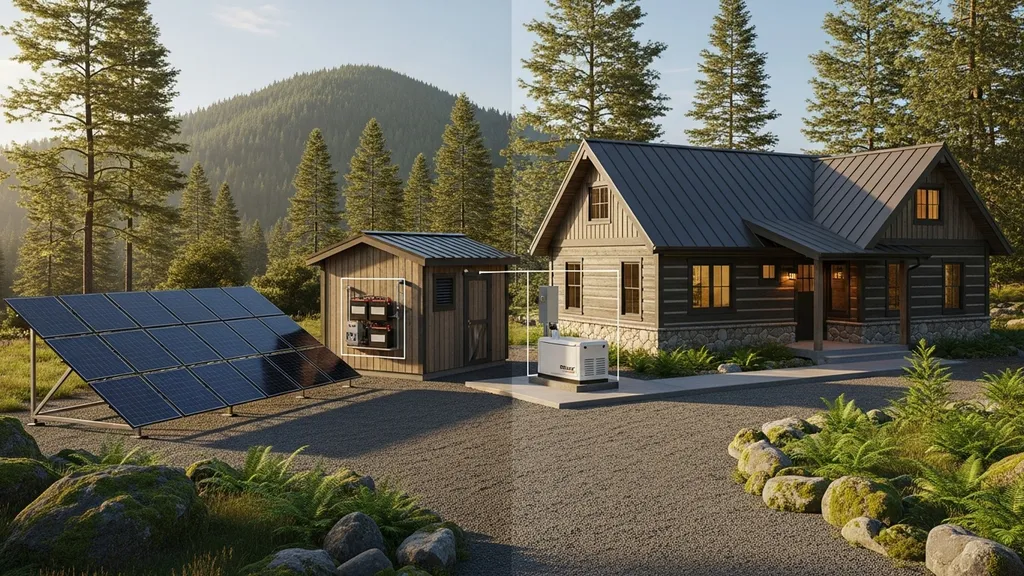
Compare off-grid and grid-tied cabin electrical systems — costs, reliability, sizing, and which setup fits your cabin lifestyle.
Cabin Electrical Setup: Off-Grid vs Grid-Tied
A clear decision between an off-grid or a grid-tied cabin electrical system shapes cost, comfort, and maintenance for any self-build. This guide explains cabin electrical options, compares upfront and lifecycle costs, walks through typical components and sizing, and gives scenario-based recommendations so budget-conscious DIY builders can pick the right path. The term cabin electrical covers the wiring, generation, storage, and controls that deliver power to a small dwelling — whether a remote weekend retreat or a year-round tiny home.
TL;DR:
- Off-grid: Expect $5,000–$25,000 upfront for a small cabin solar+battery system, plus ongoing battery and generator fuel costs; best when grid access is expensive or unavailable.
- Grid-tied: Expect $1,000–$50,000 to connect to the utility (highly distance-dependent); rooftop solar without batteries often costs $5,000–$15,000 and won’t run during outages.
- Hybrid: A grid-tied system with battery backup (hybrid inverter) costs more upfront but offers outage resilience and staged upgrades; good for near-grid cabins with occasional outages.
Related guides: DIY ventilation for off grid cabins, Ultimate guide to emergency off grid cooking, and How to build a small cabin complete guide.
Quick Overview: Cabin Electrical Setup — What We're Comparing And Why It Matters
This guide compares three core architectures: an off-grid cabin system that produces and stores all power on-site; a grid-tied solar system that exports and imports power from the utility; and hybrid systems that combine local storage with a grid connection. The comparison covers upfront cost, lifecycle cost, reliability during weather or outages, permitting complexity, and maintenance needs.
Research shows a small energy-efficient cabin often uses 3–10 kWh per day depending on heating and occupancy. For context, a modest off-grid build often pairs a 1–5 kW PV array with 3–20 kWh of usable battery capacity. For basic wiring and safety practices see the residential wiring standards and best practices, which outlines common wire sizes, grounding requirements, and installer responsibilities.
Who This Guide Is for:
- First-time self-builders deciding whether to extend utility service or invest in batteries.
- Tiny-house and cabin planners balancing budget, resilience, and environmental goals.
- DIYers who want clear sizing examples and permit steps.
Comparison table: Off-Grid vs Grid-Tied cabin electrical setups (at-a-glance)
| Category | Off-Grid | Grid-Tied | Hybrid |
|---|---|---|---|
| Typical upfront cost | $5k–$25k (small cabin PV+batt) | $1k–$50k (utility hookup varies widely), PV $5k–$15k | $8k–$35k (PV + battery + hybrid inverter) |
| Typical ongoing cost | Moderate: battery replacement, generator fuel | Low: utility bills, minimal battery costs if none | Moderate: some battery replacement, possible grid fees |
| Reliability (weather/outage) | Independent if sized correctly; needs generator in long low-sun periods | Dependent on grid; rooftop PV shuts off in outage without backup | Best compromise: islanding capability during outages |
| Typical components | PV, MPPT, battery bank (lead or LiFePO4), pure-sine inverter, backup generator | PV, grid-tie inverter, meter, safety disconnect | Hybrid inverter (AC/DC), battery, transfer switch or automatic transfer |
| Maintenance needs | Higher: battery care, generator service | Lower: inverter checks, minimal battery work | Moderate: battery and inverter maintenance |
| Permitting complexity | Requires battery and generator permits; off-grid rules vary | Interconnection agreement, net-metering paperwork | Interconnect + battery/backup permits |
| Environmental impact | Low operational emissions if renewable; fuel for generator may be needed | Lower lifecycle impact with grid + high-renewable grid mix; exports reduce grid load | Lower emissions if batteries used to optimize renewable use |
| Best use case | Remote cabin with no grid access or very costly line extension | Cabin near grid with reliable utility service | Cabin near grid with outages or owner who wants staged upgrades |
For electrical safety best practices and inspection guidance used by installers and verifiers, see the Electrical Safety First best practice guide.
Cabin Electrical Setup: Off-Grid Systems — overview, strengths, weaknesses, best for
Overview: core components and how it works
An off-grid system generates and stores all power locally. Core components are:
- Solar PV array (1–5 kW common for small cabins)
- MPPT charge controller
- Battery bank (lead-acid or LiFePO4)
- Pure sine inverter sized for peak loads
- Backup generator (propane, diesel, or gasoline)
- Distribution panel and safety devices
A typical small off-grid cabin might pair 2 kW of panels with 6–12 kWh of battery usable capacity to support lighting, a mini-fridge, water pump, and occasional heating loads (electric heating requires much more capacity). Batteries are sized for days of autonomy and worst-case low-sun stretches.
Strengths
- Independence from utility outages and political/regulatory changes.
- Feasible at sites where utility line extension costs exceed system cost.
- Scalable: solar can be added incrementally with modular batteries.
Weaknesses
- Higher upfront and lifecycle cost driven by battery replacement cycles and generator fuel for extended cloudy periods.
- Sizing risk: undersizing leads to repeated blackouts; oversizing wastes capital.
- Maintenance: battery bank ventilation, regular equalization for flooded lead-acid, and monitoring needed.
Batteries matter most. Lead-acid banks are cheaper per kWh but cycle-limited; LiFePO4 costs more but lasts 4–10× longer and tolerates deeper discharge. For tiny cabins, see the tiny-house solar sizing guide for a detailed 1 kW example. For battery lifecycle monitoring and strategies to extend life, consult battery health monitoring.
Best for
- Remote weekend cabins where grid extension is impractical.
- Owners who accept maintenance and occasional generator runs.
- Sites with good sun (or micro-hydro/wind potential) and low continuous heating loads.
Safety and code: off-grid installs still must meet National Electrical Code (NEC) provisions for grounding, inverter disconnects, and battery installations. Industry studies on small dwelling HVAC and energy use can help estimate winter loads; see KU ScholarWorks on tiny-house HVAC considerations for context: https://kuscholarworks.ku.edu/bitstreams/5111c475-ab7c-4e60-a02a-acb3d9bd4b2f/download.
Cabin Electrical Setup: Grid-Tied Systems — overview, strengths, weaknesses, best for
Overview: utility connection and grid-interactive solar
A grid-tied cabin relies on the utility for energy when solar doesn't meet demand. Typical simple setup: rooftop PV array, grid-tie inverter, meter and interconnection hardware. Batteries are optional for backup. A grid-tied inverter will automatically shut off during a grid outage unless paired with battery-based backup that isolates (islands) the cabin.
Strengths
- Lower upfront cost if the cabin is already near a utility pole.
- Net-metering or time-of-use billing can significantly reduce bills where available.
- Minimal battery maintenance if batteries are not used.
Weaknesses
- No power during utility outages unless a battery backup or generator and transfer equipment are added.
- Utility interconnection agreements and net-metering rules vary by provider and can change.
- Cost to extend service can be very high: a short run may be $1k–$5k, but long extensions into remote sites can reach tens of thousands — obtain quotes from utilities and contractors early.
For analysis of electric versus gas heating in small dwellings and how that affects grid demand, see the comparative study at Humboldt’s digital commons: https://digitalcommons.humboldt.edu/etd/711/. That study illustrates how heating choice alters yearly kWh needs, which drives solar sizing decisions.
Best for:
- Cabins close to existing service with reliable utility supply.
- Builders who want the lowest maintenance option and the ability to incrementally add PV.
- Owners who prefer not to manage battery banks.
Permitting and interconnection: most utilities require an application, safety inspections, and an inverter with UL/IEC certifications. A local electrician usually files interconnect paperwork.
Cabin Electrical Setup: Hybrid & Microgrid Options — combining off-grid and grid-tied approaches
What hybrid means: AC vs DC coupling, hybrid inverters
A hybrid system couples generation, storage, and the grid. Two common architectures:
- DC-coupled: PV charges batteries via the charge controller; an inverter draws from batteries to feed AC loads and the grid.
- AC-coupled: Grid-tied inverter produces AC for loads and the grid; a separate battery inverter/charger handles batteries. Hybrid inverters combine functions into one unit.
Hybrid inverters from brands like Victron Energy, Schneider, and SMA allow seamless charging, discharging, and automatic transfer during outages. For a technical walkthrough, see the guide on connecting solar panels. For a deeper cost breakdown of these setups, consult the hybrid cost analysis at hybrid system costs.
Strengths and trade-offs
- Strengths: Provides outage resilience, allows time-of-use optimization, and supports staged upgrades (start grid-tied, add batteries later).
- Trade-offs: Higher complexity and upfront cost than simple grid-tied; some hybrid systems require more sophisticated controls and commissioning.
When a hybrid setup pays off
- Seasonal cabins with long winter nights where occasional outages occur.
- Properties near grid with unreliable service.
- Owners who want quick ROI from exported solar but desire backup for critical loads.
State and local homeowner installation guidance can be useful; Montana’s building codes pamphlet covers common DIY homeowner considerations: https://bsd.dli.mt.gov/building-codes-permits/permit-applications/electrical-permits/ele-pamphlet.pdf.
Cabin Electrical Setup: Sizing and cost comparison for typical cabin setups
How to estimate your cabin electrical load (simple worksheet)
Step 1: List appliances, wattage, and daily hours.
- LED light: 10 W × 5 lights × 4 hours = 0.2 kWh/day
- Mini-fridge: 120 W average × 24 hours (duty cycle) ≈ 1.5 kWh/day
- Water pump: 500 W × 0.5 hour = 0.25 kWh/day
- Laptop/chargers: 60 W × 4 hours = 0.24 kWh/day
- Electric space heater (if used): 1,500 W × 2 hours = 3.0 kWh/day
Step 2: Sum daily kWh, add 20–30% for inefficiencies and inverter losses. That gives usable kWh/day.
Step 3: Decide days of autonomy (for off-grid). Two to three cloudy days is common for small cabin setups.
Step 4: Size PV and battery:
- PV (kW) = (daily kWh × safety factor) / average sun hours per day
- Battery (usable kWh) = daily kWh × days of autonomy / depth of discharge (DoD)
Sample system builds with ballpark costs
Minimal (weekend cabin)
- Load: ~3 kWh/day
- PV: 1 kW
- Battery: 3 kWh usable (LiFePO4 recommended)
- Upfront cost: $5k–$8k
- Best for: Occasional use, small loads
Modest (comfortable off-grid or hybrid backup)
- Load: ~6 kWh/day
- PV: 3 kW
- Battery: 10 kWh usable
- Upfront cost: $12k–$20k
- Best for: Regular occupancy, some electric appliances
Resilient off-grid (year-round with electric heating minimized)
- Load: ~12 kWh/day (passive-house measures)
- PV: 5 kW
- Battery: 20 kWh usable + generator
- Upfront cost: $20k–$35k
- Best for: Year-round occupancy with backup
Battery replacement intervals:
- Flooded/AGM lead-acid: 3–7 years depending on cycles.
- LiFePO4: 8–15 years typical, depending on cycles and depth of discharge.
Simple payback logic:
- For grid-tied solar, calculate annual kWh produced × local utility buyback rate = annual savings. Compare to system cost for payback years.
- For remote cabins, compare utility line-extension quotes (get multiple quotes; costs vary widely) to off-grid system cost. Often a line extension over a few hundred feet is expensive.
For panel siting and shading assessment see the solar site checklist.
Cabin Electrical Setup: DIY installation, safety, and permits
Permits, inspections, and utility interconnection steps
- Obtain an electrical permit from the local authority before work begins. Utilities often require an interconnection application for PV.
- For grid-tied systems, secure the interconnection agreement and follow the utility’s inverter and metering requirements.
- For battery installations, submit battery specs and ventilation plans; some jurisdictions require separate battery permits.
Common inspection items include proper grounding, labeled disconnects, conduit and cable sizing, and correct inverter model listings.
Basic wiring and safety rules for DIYers
- Do not work on service conductors; hire a licensed electrician for service panel changes.
- Use correct wire gauge for continuous loads and inverter output; undersized conductors create fire risk.
- Install overcurrent protection (fuses or breakers) at appropriate locations.
- Provide a reverse-feed/utility-disconnect per local code.
- For battery rooms: ventilate flooded batteries, secure batteries against tipping, and use insulated tools.
For an accessible primer on residential wiring standards, see the residential wiring standards and best practices.
Commissioning, monitoring, and routine maintenance checklist
- Verify proper inverter grounding and anti-islanding settings.
- Test automatic transfer switches and backup start sequences.
- Configure remote monitoring and alarms for battery state-of-charge and inverter faults.
- Schedule periodic checks: inverter fans, panel cleaning, battery terminal torque, and generator oil/filter changes.
Refer to the inverter maintenance steps for a simple 7-step checklist. Also review common zoning issues that can affect system installation and line runs in rural builds: zoning pitfalls.
For a visual demonstration, check out this video on how many solar panels do you need to:
Cabin Electrical Setup: Which should you choose? Scenario-based recommendations
Remote weekend cabin with minimal appliances
Recommendation: Off-grid minimal system. A 1–2 kW PV array, 3–6 kWh usable battery, and a small inverter will support lights, fridge, and pump. Expect $5k–$10k. Add a small generator only if extended cloudy periods occur.
Year-round off-grid homestead
Recommendation: Full off-grid with redundancy. Prioritize passive design (insulation, airtightness) to reduce heating loads. A 3–5 kW PV array, 10–20 kWh usable battery, and a reliable backup generator are typical. Budget $20k+.
Cabin near grid with occasional outages
Recommendation: Hybrid system. Install grid-tied PV with a hybrid inverter and a 5–10 kWh battery bank to power critical loads during outages. Staged approach: start with PV, add battery later to spread cost.
Tight budget but eco-focused: incremental approach
Recommendation: Start with efficient appliances, LED lighting, and a small rooftop PV grid-tied system. Monitor usage for a year, then add a hybrid inverter and batteries when savings justify it. This reduces risk and spreads cost.
Decision checklist (quick):
- Distance to utility: If extension > several hundred feet, get quotes; off-grid may be cheaper.
- Annual kWh needs: under 5 kWh/day favors small off-grid; over 10 kWh/day pushes toward grid or large battery budgets.
- Outage tolerance: If outages are unacceptable, plan hybrid backup.
- Willingness to maintain: Batteries and generators require regular work.
The Bottom Line
For most budget-conscious DIY cabin builders, a grid-tied system with the option to add battery backup later strikes the best balance between cost and resilience. For truly remote sites or owners who value total independence, a properly sized off-grid system with LiFePO4 batteries and a generator is appropriate.
Frequently Asked Questions
Can I start grid-tied and go off-grid later?
Yes. Many owners begin with a grid-tied PV system and add batteries and a hybrid inverter later. Choose an inverter and electrical layout that anticipates future battery integration to avoid expensive rewiring. A hybrid inverter or separate battery inverter with an automatic transfer switch simplifies the transition.
How big of a battery do I need for winter?
Estimate winter daily kWh (higher if electric heating is used), then multiply by the number of backup days you want. Example: 10 kWh/day × 3 days autonomy = 30 kWh usable. Adjust for depth of discharge (LiFePO4 80–90% usable, lead-acid 30–50% usable). Plan extra capacity for low-sun months and reserve some generator backup if needed.
Do I need a permit to run power to my cabin?
Almost always. Electrical permits, inspections, and utility interconnection paperwork are typically required. Local rules vary; check your building department early. For homeowner-performed work, some jurisdictions allow owner-applicant permits but still require inspections. Refer to local electrical permit guidance such as Montana’s homeowner pamphlet for examples: https://bsd.dli.mt.gov/building-codes-permits/permit-applications/electrical-permits/ele-pamphlet.pdf.
What's the lifespan of a cabin solar battery bank?
Battery life varies by chemistry and use. Flooded lead-acid may last 3–7 years with regular maintenance. AGM can last similar or slightly longer under good care. Lithium iron phosphate (LiFePO4) typically lasts 8–15 years with less maintenance. Depth of discharge, temperature, and charge control have large impacts on lifespan.
How can I reduce my cabin's electrical needs before sizing?
Prioritize insulation, airtightness, and low-power appliances. Switch to LED lighting, choose Energy Star refrigerators, and use propane or wood for primary heating where feasible to reduce electric loads. A well-sealed, insulated cabin can reduce heating loads dramatically and shrink PV and battery requirements.