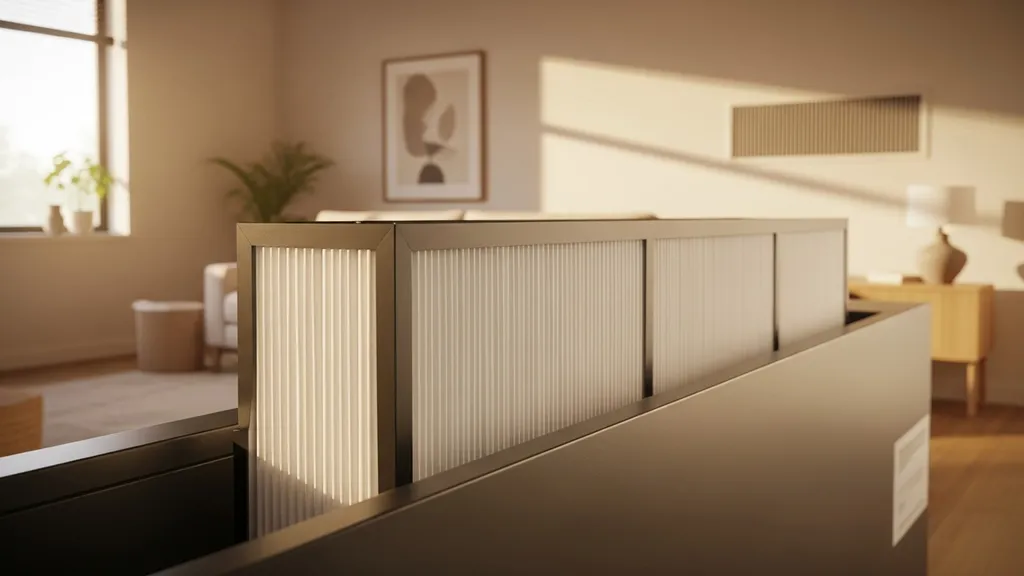
How to choose, size, install and maintain HEPA filter ventilation for healthier, energy-smart DIY and passive-house homes.
HEPA Filtration in Ventilation Systems
Indoor air quality changes fast when you add high-efficiency filtration. This article explains practical, step-by-step guidance for integrating HEPA filter ventilation into DIY and passive-house projects: what HEPA removes (and doesn't), how to size filters and fans, retrofit options, energy and noise trade-offs, and routine maintenance. Readers will learn how to choose between whole-house, inline, and portable HEPA approaches and how to estimate fan upgrades and replacement costs before committing to a project.
TL;DR:
- Use HEPA filter ventilation when you need particle removal at 0.3 µm and smaller: True HEPA removes 99.97% of 0.3 µm particles; add activated carbon for gas-phase contaminants.
- For whole-house filtration: size to achieve target ACH (convert ACH to CFM), expect higher fan power for HEPA pressure drop, and consider an inline fan or booster; for 1,200 sq ft at 8 ft and 3 ACH you need ~480 CFM.
- For retrofits or tight budgets: deploy CADR-rated portable HEPA units per room or build a sealed inline HEPA box; prefilters (MERV 8–13) extend HEPA life and reduce operating cost.
Related guides: Ultimate guide to ventilation for small eco homes, Erv vs hrv ventilation system better home, DIY ventilation for off grid cabins, How to connect smart water systems to hubs, and Ultimate guide to ac and dc coupling in hybrid systems.
Why HEPA Filtration Matters in Ventilation Systems
Particulate pollution is a serious indoor health issue: long-term exposure to PM2.5 is linked to increased respiratory and cardiovascular risk, and short-term spikes (wildfire smoke, indoor cooking) can double symptom rates for asthma sufferers. The CDC recommends upgrading ventilation and filtration where possible to reduce airborne pathogens and fine particles; see the CDC's guidance on improving air cleanliness for practical steps and HEPA use here.
HEPA filter ventilation captures airborne particulates—dust, pollen, mold spores, smoke, and many aerosolized pathogens—with high efficiency. A True HEPA rating means at least 99.97% efficiency at 0.3 µm. That makes HEPA valuable for homes with vulnerable occupants (children, elderly, allergy sufferers) and for tight passive-house envelopes where fresh-air dilution is intentionally low.
What HEPA does not remove well are gases and most VOCs. For odors, formaldehyde, and some combustion gases, pair HEPA with activated carbon or other sorbents. When planning a retrofit, also audit building airtightness and occupant activities. Small fixes—like the window sealing steps explained in our window sealing tips—reduce infiltration of outdoor smoke and thus the load on HEPA filters.
Industry guidance from ASHRAE advises that filters must be sealed correctly and matched to system capacity to perform as expected; mismatches in fan power or bypass gaps defeat the rating. For passive-house projects, higher filtration quality often makes sense, but design must account for increased pressure drop and energy. The CDC guidance and ASHRAE resources together show the trade-offs: better air cleanliness vs higher fan energy and possible noise.
How HEPA Filters Work and How They Compare to MERV and Activated Carbon
HEPA efficiency, particle capture mechanisms, and ratings
A HEPA filter uses a dense mat of fibers to trap particles via three principal mechanisms:
- Impaction: Larger particles collide with fibers due to inertia.
- Interception: Particles follow airflow streamlines and contact fibers.
- Diffusion: Very small particles (below ~0.1 µm) move erratically (Brownian motion) and hit fibers.
True HEPA means 99.97% capture at 0.3 µm; higher classes like H13 and H14 (EN standard) reach higher efficiencies. Note that some consumer products use terms like "HEPA-type" or "HEPA-style"—these are not the same as True HEPA.
MERV vs HEPA: practical differences for homeowners
Use this table for quick comparison of typical filter categories:
| Filter type | Efficiency at relevant sizes | Typical initial pressure drop | Typical residential use |
|---|---|---|---|
| MERV 8 | Good for >3.0 µm (30–70% at 1.0–3.0 µm) | 0.1–0.25 inches w.g. | Standard prefilters, HVAC protection |
| MERV 13 | Effective across 0.3–1.0 µm (50–75%) | 0.2–0.5 inches w.g. | Allergy control, many retrofits |
| True HEPA (H10–H14) | ≥99.97% at 0.3 µm (H13/H14 higher) | 0.5–1.5+ inches w.g. | Dedicated units, medical, labs |
| ULPA | ≥99.999% at 0.12 µm | 1.5+ inches w.g. | Cleanrooms, specialized labs |
Practical takeaway: put a MERV 8–13 prefilter upstream of a HEPA element to trap large dust and hair. That reduces HEPA replacement frequency and lowers the overall pressure drop problem.
When to pair HEPA with activated carbon or prefilters
- Use activated carbon cartridges when odors, VOCs, or wildfire smoke gases are a concern. Carbon doesn't remove particles—combine it with HEPA for comprehensive treatment.
- Use prefilters (MERV 8–13) to protect HEPA elements. A washable polyester prefilter or a cheap pleated MERV 8 filter catches large particles and can be replaced frequently at low cost.
- Consider GUV (germicidal UV) only as a supplement for pathogen inactivation; it does not capture particles.
For design standards and deeper filtration guidance, see ASHRAE's filtration/disinfection resources here.
Ventilation System Types Compatible with HEPA Filters
Central HVAC systems and inline HEPA options
Central forced-air systems can accept HEPA filter housings on the return side or be fitted with a dedicated inline HEPA box downstream of the air handler. In many homes, the stock filter slot is too small for True HEPA; solutions include:
- Installing a larger gasketed filter plenum at the return grille.
- Adding an inline filter housing with a matched fan (booster) sized to overcome HEPA pressure drop.
- Using a high-efficiency MERV prefilter in the existing slot and routing a bypass inline HEPA for critical rooms.
Typical residential return fans operate from 400–2,000 CFM. If a HEPA element causes extra 0.5 inch w.g. pressure drop at design CFM, the existing fan may struggle—measure static pressure or consult a contractor.
HRV/ERV: compatibility and constraints
Heat recovery ventilators (HRVs) and energy recovery ventilators (ERVs) are designed for controlled fresh-air exchange in tight homes. Most stock HRV/ERV modules accept MERV 8–13 filters but not True HEPA cartridges because of:
- High pressure drop that reduces balanced airflow and heat recovery performance.
- Size and sealing limitations in factory housings.
Some strategies:
- Use high-quality prefilters in the HRV/ERV and place a separate HEPA-treated supply to living spaces.
- If retrofitting a True HEPA, upgrade the HRV fan or add a parallel HEPA-treated supply duct; consult manufacturer guidance to avoid warranty or performance issues.
ASHRAE suggests filters must be sealed and matched to equipment to meet expectations; avoid forcing HEPA into an HRV without engineering verification.
Portable HEPA units and DIY filter boxes
Portable HEPA units are a fast retrofit option. Their effectiveness is measured by CADR (Clean Air Delivery Rate). For a single room:
- Choose units with CADR rated roughly equal to room volume × desired ACH.
- Common portable units provide 100–400+ CADR and 100–500 CFM at various fan speeds.
DIY box fans with MERV 13 filters or cartridge HEPA boxes can be an affordable alternative; however, research shows portable purifiers alone may not always reduce transmission in mixed-use settings—air mixing and positioning matter. See Mass General Brigham's study on HEPA purifiers in schools for context: https://www.massgeneralbrigham.org/en/about/newsroom/press-releases/hepa-purifiers-alone-may-not-be-enough-in-schools.
Portable HEPA units are ideal for room zoning, isolation rooms, or where whole-house retrofit isn't feasible.
Sizing, Airflow, and Pressure Drop: Planning HEPA Filter Integration
Key metrics: CADR, ACH, CFM and how they relate
Definitions:
- ACH (Air changes per hour): How many times the total air volume of a space is replaced per hour.
- CFM (Cubic feet per minute): Airflow rate; convert ACH to CFM: CFM = (Volume in ft³ × ACH) / 60.
- CADR: Effective clean-air output of a purifier for a particle size; CADR is roughly equal to the CFM of particle-free air.
Worked example for a 1,200 sq ft house with 8 ft ceilings:
- Volume = 1,200 × 8 = 9,600 ft³.
- For 3 ACH: CFM required = (9,600 × 3) / 60 = 480 CFM.
So to achieve 3 ACH with HEPA filter ventilation, plan for 480 CFM of HEPA-treated airflow. If using multiple portable units, sum their CADR to match or exceed that CFM target.
ASHRAE 62.2 provides baseline ventilation rates for residential ventilation; use it as a starting point and increase filtration for high-risk events (smoke, wildfire).
Pressure drop from HEPA and fan upgrade considerations
HEPA elements commonly add 0.5–1.5 inches w.g. of static pressure at rated flow. Typical residential furnace blowers are designed for low pressure drop; adding HEPA can reduce delivered CFM or stress the motor.
Options:
- Install a dedicated inline fan/booster rated for the required CFM at the expected static pressure.
- Use larger face area filters to reduce face velocity and thus lower pressure drop.
- Use variable-speed ECM fans to maintain target airflow while limiting energy use.
Include a differential static pressure gauge or manometer for commissioning. The NAFA guidelines offer advice on achieving clean air within HVAC limits; see their filtration guidance here: https://www.nafahq.org/assets/pdf/2023+Commercial+Office+Spaces+Secured/.
Example calculation and a quick specs table
Example: If a chosen HEPA cartridge has an initial pressure drop of 0.8 inches w.g. at 500 CFM, an inline booster fan should be sized to deliver 500 CFM against 0.8 inches w.g. plus duct losses (estimate another 0.1–0.3 inches). Allow margin—spec a fan with peak capability 10–20% above required CFM.
Common HEPA cartridge specs (illustrative):
| HEPA class | Typical initial pressure drop | Recommended prefilter | Typical CADR/CFM range |
|---|---|---|---|
| H10–H11 | 0.4–0.8 inches w.g. | MERV 8 | 250–500 CFM (large cartridges) |
| H12–H13 | 0.6–1.0 inches w.g. | MERV 11–13 | 200–400 CFM (common cartridges) |
| H14 | 0.8–1.5 inches w.g. | MERV 13 | 100–300 CFM (high-efficiency modules) |
When calculating energy use, account for fan power: a fan delivering 500 CFM against 1.0 inch w.g. often consumes 100–300 W depending on efficiency. For off-grid projects, see our off-grid solar sizing guide to estimate battery and inverter impacts.
Installation Options for DIY and Self-Builders
This section includes a short video to visualize retrofit steps and sealing methods. Viewers will see filter-box assembly, sealing techniques, and fan selection tips.
Watch this step-by-step guide on replacing install air filter home HVAC easy simple:
Retrofit methods for existing ducted HVAC systems
Common retrofit approaches:
- Return plenum upgrade: Remove the standard small filter slot and install a gasketed plenum that accepts a larger HEPA cartridge. Use metal framing, high-temperature gasket tape, and mechanical fasteners to prevent bypass.
- Inline HEPA module: Install a dedicated inline filter housing with a matched booster fan in the return or supply run. Isolate the housing with duct collars and seal joints with mastic.
- Split-path approach: Keep the central system for heating/cooling and branch a separate HEPA-treated supply to critical rooms with its own fan.
Materials list example:
- HEPA cartridge (size to fit housing), MERV 11 prefilter pads, metal plenum box or galvanized inline housing, silicone or butyl gasket tape, sheet metal screws, mastic sealant, inline booster fan with rated CFM and static pressure.
Safety and performance notes:
- Prevent bypass—seal every joint. Even a small gap can reduce effective efficiency by letting untreated air pass.
- Maintain system balance—if you add a high-resistance HEPA on return, ensure supply isn't starved causing negative pressure or backdrafting of combustion appliances.
For retrofit and airtightness tips, pair this work with passive-house retrofit strategies like those in our passive house retrofit tips.
Building a sealed inline HEPA filter box
For DIYers comfortable with basic sheet-metal work or buying an off-the-shelf housing:
- Measure the duct diameter and pick a housing with a flange that matches.
- Select a HEPA cartridge sized for the flow target (see sizing section).
- Install a MERV 11–13 prefilter upstream and make it accessible for frequent change.
- Mount an inline centrifugal fan rated for required CFM at the expected static pressure. Include a speed controller.
- Seal all flange joints with butyl tape and apply mechanical fasteners; insulate the box if noise is a concern.
Common pitfalls: undersized fan, flexible duct sagging, and neglecting an accessible access panel for filter changes.
For step-by-step retrofit examples and air-sealing techniques, watching the recommended video and following manufacturer instructions is advised; research shows that correct sealing and placement dramatically affect outcome compared with ad hoc installations (see Mass General Brigham study).
Portable units and room zoning strategies
Portable HEPA units simplify deployment:
- Place units to promote cross-room circulation: near pollutant sources or in central circulation paths.
- For whole-house coverage, deploy multiple units staged by CADR to meet the total CFM target from the sizing example.
- Use quieter units at night or lower fan speeds with longer runtimes; note that CADR drops at lower speeds.
Portable HEPA units are effective for seasonal events (wildfire smoke) or where central retrofits would be expensive. For budget builds, DIY box-fan + MERV 13 combos are common—just ensure the fan is rated for continuous operation and the filter is securely sealed to the fan face.
Maintenance, Filter Lifespan, Cost Estimates and Sustainable Disposal
Expected filter life and indicators to replace
Typical lifespans:
- Prefilters (MERV 8–11): 3–6 months depending on dust load.
- HEPA cartridges: 6–24 months depending on pollutant load (smoke, pet dander, cooking).
- Activated carbon modules: 3–12 months, often shorter for high VOCs.
Signs to replace:
- Noticeable increase in fan noise or fan motor current (indicates higher static).
- Drop in measured airflow (CFM) or room feels less ventilated.
- Visible loading or discoloration on the filter media.
Routine maintenance steps and DIY checks
- Replace or wash prefilters monthly or as needed.
- Record baseline static pressure across the filter and recheck monthly. A change of 0.3–0.5 inches w.g. suggests replacement.
- Inspect seals and gaskets yearly and reseal if gaps appear.
- For portable units, vacuum external grille and wipe down housing monthly; replace cartridges per manufacturer schedule.
A low-cost manometer or a $20 differential gauge gives useful data for DIYers. Studies including AAQR ventilation testing show that regular maintenance preserves performance in mixed HVAC environments; see the AAQR study here: https://aaqr.org/articles/aaqr-22-02-covid2-0054.
Cost breakdown and environmentally responsible disposal
Typical cost ranges (US retail estimates):
- MERV 8 prefilter: $5–$20 each.
- MERV 11–13 pleated filters: $15–$60.
- True HEPA cartridge (residential sizes): $80–$400 depending on size and efficiency.
- Inline booster fan: $150–$600.
- Portable HEPA unit: $100–$900.
Annual budgeting example for the 1,200 sq ft case using a central HEPA cartridge:
- Prefilter replacements: $60/year
- HEPA cartridge replacement (every 12 months): $200/year
- Electricity: if fans add 150 W continuous at $0.15/kWh, annual cost ≈ $200.
Total ≈ $460/year.
Disposal and sustainability:
- HEPA filters generally cannot be recycled through normal curbside programs due to mixed materials and contamination. Check local hazardous waste or municipal guidance for disposal rules; many areas allow HEPA in regular trash if double-bagged but check local regulations.
- Consider reusable/washable prefilters to reduce waste.
- When filters are contaminated with biological agents (suspected infectious aerosols), follow health authority guidance for safe handling and disposal.
For deeper reading on ventilation performance and filter interventions, consult the AAQR and Mass General Brigham research links provided earlier.
Energy, Noise, and Passive House Considerations for HEPA Integration
Minimizing energy penalties from higher pressure drop
Higher-grade filters increase fan energy. Strategies to minimize energy penalties:
- Use larger filter face area to reduce face velocity and pressure drop.
- Choose high-efficiency ECM fans; they are more efficient and maintain flow better under load.
- Schedule high-flow periods (e.g., run HEPA at high speed for 30 minutes each hour) rather than continuous high-power operation when full-time filtration is unnecessary.
- Use heat recovery where compatible—keep in mind most HRVs/ERVs can't accept True HEPA without modification.
For off-grid or low-power homes, refer to the off-grid solar sizing guide to model additional fan energy and battery capacity requirements.
Noise impacts and mitigation strategies
Noise sources include fan broadband noise and turbulence at filter faces. Mitigations:
- Use larger diameter ducts and reduce face velocity to lower turbulence noise.
- Install sound attenuators or lined duct sections where space permits.
- Choose quieter centrifugal inline fans and mount with vibration isolators.
- For portable units, locate them away from sleeping areas or use lower fan speeds overnight.
Balancing airtightness, ventilation rates and filtration in passive homes
Tight envelopes mean lower uncontrolled infiltration but also concentrate indoor pollutants if ventilation or filtration is insufficient. Passive-house projects gain the most from high-quality filtration because mechanical ventilation handles a large share of air exchange. However, design must maintain pressure balance and heat-recovery performance.
For design guidance that ties ventilation, airtightness, and filtration together, see our detailed how-to on design ventilation for passive houses. Also consider envelope upgrades like continuous exterior insulation—see the exterior foam insulation guide and use our insulation comparison tool to evaluate trade-offs that affect HVAC loads and filtration energy.
Account for the Passive House Institute or PHIUS guidance when integrating filtration into balanced ventilation systems. In many cases, the best path is to retain HRV/ERV for heat recovery and add targeted HEPA-treated zones or in-duct modules with dedicated fans sized to maintain balance.
The Bottom Line
HEPA filter ventilation delivers measurable particle removal—True HEPA is 99.97% efficient at 0.3 µm—but it rarely handles gases alone. For most DIY homebuilders, the practical approach is: assess current ACH, choose a combination of prefilter + HEPA (or portable CADR units) sized to achieve target CFM, and plan for the added pressure drop and maintenance. Start with a small test: measure room volume, pick a CADR-rated portable unit or build an inline box, and monitor performance before scaling to whole-house.
Frequently Asked Questions
Will HEPA remove VOCs and gases?
No. HEPA filters remove particles, not gases or most VOCs. Pair HEPA with activated carbon or specific chemisorption media to reduce odors, ozone, and VOCs; check manufacturer data for capacity and replacement intervals.
Can I put HEPA in my HRV or ERV?
Usually not without modifying the unit. Most HRV/ERV housings accept up to MERV 13 filters but not True HEPA due to high pressure drop and seal requirements. Options include using high-quality prefilters in the HRV and adding a separate HEPA-treated supply or inline module with its own fan.
How often should HEPA filters be replaced?
Replacement frequency varies: prefilters 3–6 months, HEPA cartridges typically 6–24 months depending on load (smoke, pets, dust). Use differential pressure readings and visible loading as replacement indicators.
How do I size HEPA for whole-house ventilation?
Convert desired ACH to CFM: CFM = (house volume × ACH) / 60. For example, a 1,200 sq ft × 8 ft ceiling house (9,600 ft³) at 3 ACH needs ~480 CFM of HEPA-treated airflow. Match filter and fan to this CFM at expected static pressure.
Are DIY HEPA box filters safe and effective?
Yes, when built correctly: use a rated HEPA cartridge, add a prefilter, seal around the fan-to-filter interface, and ensure the fan can handle the static pressure. Portable DIY solutions can provide good local air cleaning but may not equal professionally engineered inline systems for whole-house performance.