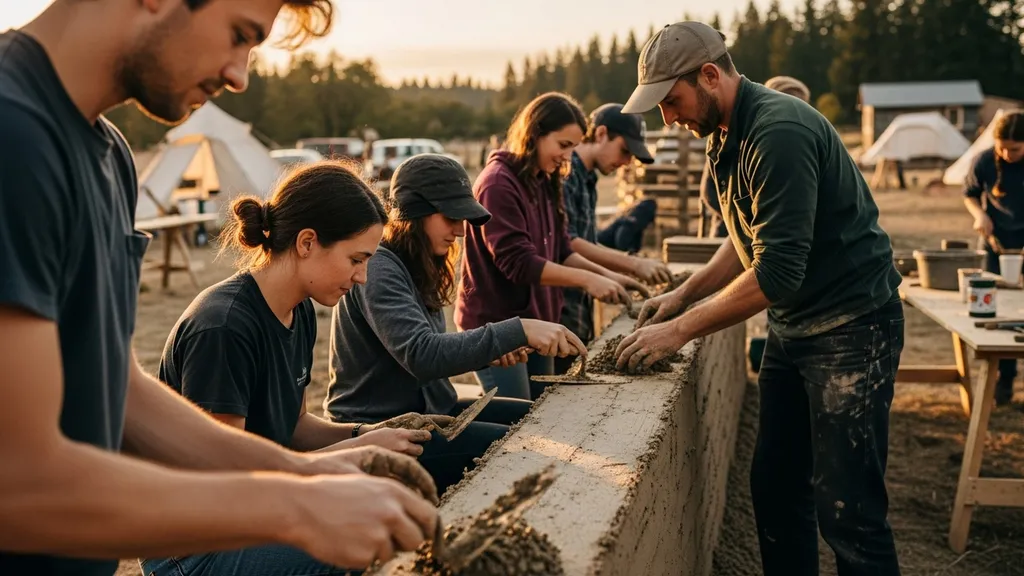
Find hands-on, online, and low-cost natural building workshops — where to learn cob, strawbale, hempcrete and earthbag for DIY eco homes.
Natural Building Workshops: Where to Learn
Natural building workshops teach hands-on methods for making walls, floors, and finishes from earth, straw, hemp, and recycled materials. A natural building workshop is the fastest way to go from curiosity to confident hands-on skills: attendees usually leave with mixing techniques, tooling know-how, and realistic estimates for labor and materials. This guide shows where to find in-person, hybrid, and online natural building courses, how much different formats cost, what a typical schedule looks like, and how to choose the right training for a tiny house, homestead, or full self-build.
TL;DR:
- Choose a short hands-on workshop (3–7 days) first: expect $150–$600 for weekend intensives and a 1:8–1:12 instructor-to-student ratio.
- Combine one in-person workshop with an online course for design, materials lists, and Q&A; use work-trade or volunteering to get multi-week experience at low or no cash cost.
- Pick your method by climate and code: cob and rammed earth for thermal mass; strawbale and hempcrete for higher insulation; consult a structural engineer or local building department for larger projects.
Why Attend Natural Building Workshops: Where to Learn Practical Skills
Natural building workshops are practical training sessions focused on materials like cob, strawbale, hempcrete, earthbag, and rammed earth. They deliver tactile skills—mix ratios, lift-and-pack techniques, plastering—that reading alone does not provide. For budget-conscious DIY homebuilders and first-time self-builders, a workshop reduces mistakes that cost time and money.
Who Benefits From Workshops
- Tiny-house builders: Learn low-cost wall systems and finish techniques that work with small footprints.
- Homesteaders and landowners: Gain skills for outbuildings, sheds, and tiny cabins.
- First-time self-builders: Get a realistic sense of labor intensity before committing to a full wall system.
- Small contractors and tradespeople: Add natural-material competencies to service offerings.
Typical Learning Outcomes
- Mixing and consistency targets for different mixes (e.g., cob: sand:clay ratios; hempcrete: binder-to-aggregate by volume).
- Wall-building rhythms: lifts, tamping/packing, and curing windows.
- Finish skills: base coat, scratch coat, lime or clay plaster techniques.
- Site and safety basics: tool use, PPE, basic scaffolding and ergonomic techniques.
- Networking: access to material suppliers, local builders, and potential collaborators.
Workshops commonly range from weekend demo days to multi-week apprenticeships. Weekend intensives run 1–3 days; focused immersions often last 3–7 days; season-long apprenticeships can cover an entire build season and sometimes exchange instruction for labor. For structured introductory content, see the School of Integrated Living’s introduction to natural building, which outlines slide lectures, Q&A, and hands-on segments for beginners.
Natural Building Workshops: Types and Formats (in-person, Hybrid, Online)
Different formats suit different goals. Choose based on whether the priority is tactile practice, design knowledge, or regulatory compliance.
Short Hands-on Intensives
- Duration: 1–3 days (weekend demos) or 3–7 days (intensive).
- Best for: sampling several methods quickly, learning mixing and plastering basics, or preparing for a specific part of a project.
- Typical cost: $150–$600 for weekend intensives; $800–$3,500 for week-long courses depending on meals and lodging.
- Tradeoff: High-intensity learning but limited repetition; plan a follow-up apprenticeship or volunteer build for deeper practice.
Multi-day Immersion and Apprenticeships
- Duration: Several weeks up to a full season.
- Best for: taking on a wall system from foundation to finish, developing muscle memory, and learning project sequencing.
- Typical cost: Apprenticeships are often work-trade or stipend-based; formal multi-week programs can range higher but sometimes include housing and certification.
- Tradeoff: Greater time commitment but stronger competency and portfolio-ready projects.
Online and Hybrid Courses
- Duration: Self-paced videos to scheduled cohorts with live Q&A.
- Best for: theory, design, materials lists, and planning before hands-on sessions; useful for remote learners.
- Typical content: Video demos, downloadable plans, tool lists, and forum support. Hybrid models pair online modules with an in-person practical day.
- Tradeoff: Online-only lacks tactile feedback; hybrid formats reduce travel and still deliver hands-on practice.
For an overview of materials you’ll encounter in courses, review the sustainable materials primer. The choice of format should align with your goals: sample a method first, then invest in apprenticeship-style hours if you plan to self-build a primary residence.
External coverage of community-led natural building (e.g., Dancing Rabbit’s materials and techniques overview) provides context for what to expect at many in-person programs: https://www.dancingrabbit.org/building/natural-building/.
Where to Find In-person Natural Building Workshops: Schools, Eco-centers, and Farms
In-person instruction is offered by several kinds of hosts: specialized schools, permaculture/ecology centers, community builds, and private homesteads.
Specialized Natural Building Schools
- Offer structured curricula, sometimes with certificates or a clear progression from introductory to advanced topics.
- Pros: Planned sequence, experienced instructors, on-site materials and tools.
- Cons: Often pricier than community events.
- Example resource: Network Earth’s overview of techniques lists types of schools and course structures—https://www.networkearth.org/naturalbuilding/overview.html.
Eco-centers, Permaculture Sites, and Community Builds
- These venues run seasonal builds where attendees help construct functional structures for education and community use.
- Pros: Real projects with client-style constraints and diverse tasks.
- Cons: Less formal curriculum; learning depends on the projects scheduled.
Volunteer and Work-trade Opportunities
- Many centers offer reduced-cost or free spots in exchange for labor; this is ideal for gaining many hours of hands-on experience.
- Pros: Low cash outlay, immersive practice.
- Cons: May focus more on labor than instruction; vet the host for mentorship quality.
When scouting in-person workshops, check local permaculture networks, meetup groups, and university extension calendars. For material comparisons and to evaluate school offerings, consult the ultimate materials guide. Sites like Network Earth compile community build listings and can point to regional opportunities.
A useful cross-application example: many eco-centers integrate natural building with off-grid systems like rainwater collection—see this practical guide on building a rainwater collection system: https://www.diyecohomes.com/blog/how-to-build-a-rainwater-collection-system-step-by-step-guide
Natural Building Workshops: Online and Hybrid Options for Diyers
Online and hybrid courses have matured. They are now a credible complement to in-person learning.
Best Use Cases for Online Learning
- Theory and planning: mix ratios, structural basics, and material sourcing.
- Prepping for a hands-on day: study methods before paying for an in-person intensive.
- Supplemental reference: revisiting techniques during a build.
- Online courses range from short video series to multi-module programs with assignments and tutor feedback. The Last Straw highlights the cultural and knowledge aspects of online resources for natural building: https://www.thelaststraw.org/mainstreaming-the-values-of-the-natural-building-movement/.
What to Expect From Hybrid Formats
- Online modules for foundations, moisture strategies, and finishes; one or more practical days for mixing and wall-building.
- Practical items to verify before signing up: does the course include downloadable material and tool lists, is there a community forum or Slack channel, and are live Q&A sessions scheduled?
- Hybrid can bridge the gap between book learning and muscle memory—look for programs that specifically include checklists and site prep guides.
Online formats are especially useful when paired with local code research. For retrofit-focused learners, combine course material with the using cork for insulation guide to understand how natural insulation choices integrate into existing shells.
Natural Building Workshops: What to Expect — Curriculum, Schedule, and Tools
Workshops typically balance theory with hands-on practice. Below is a realistic sample schedule for a 5-day immersion and the typical toolkit attendees should bring.
Sample Daily Schedule and Learning Milestones
- Day 1: Orientation, safety, basic theory (soil composition, structural principles), and material demos.
- Day 2: Foundations, plinths, and base detail work (drainage, moisture considerations).
- Day 3: Mixing practice and first wall lifts—students take turns mixing and applying materials.
- Day 4: Continue wall work, begin first coat plasters or external finishes.
- Day 5: Final plastering, detailing, maintenance tips, and troubleshooting common issues.
Typical Toolkit and PPE List
- Shovels, wheelbarrows, and hoes for mixing and earthwork.
- Trowels, hawks, and plastering floats for finish work.
- Mechanical mixer or rotating cement mixer for larger hempcrete or lime mixes.
- PPE: N95 respirators (for dusty tasks), gloves, steel-toe boots, eye protection, and ear protection when using mechanical tools.
- Recommended instructor-to-student ratios: 1:8 to 1:12 for safe, effective hands-on coaching.
Safety, Permits, and Site Prep
- Site prep: level pad, good drainage, covered mixing area, on-site water supply, and secure storage for tools and materials.
- Permits: Natural materials can meet code, but structural and fire-resistance requirements vary by jurisdiction. Check local building codes (e.g., IECC sections on wall assemblies) and consult a structural engineer for load-bearing decisions.
- For airtightness integration and small-home energy targets, pair workshop skills with guidance from our passive-house airtightness guide and the practical how to install airtight membranes walkthrough.
Before the YouTube placeholder, note: the following short video gives a real sense of daily rhythms, tool use, and the physical demands of a cob build—use it to set expectations for stamina, team coordination, and technique.
For a visual demonstration, check out this video on fall 2023 cob workshops - learn how to:
For finishing techniques often covered at workshops, see the step-by-step natural oil finishes tutorial.
Natural Building Workshops: Skills and Materials Comparison (table)
Below is a compact comparison to help choose which material to focus on in a course. For deeper technical reading about earthbag methods, see the earthbag building method. For hempcrete compared to insulated concrete, consult our hempcrete vs ICF guide. Use the wall assembly builder for R-value planning.
| Material | Typical workshop length to learn | Primary tools | Thermal performance notes | Moisture / durability | Typical cost per m² (range) | Best use cases |
|---|---|---|---|---|---|---|
| Cob | 3–7 days to gain basic plaster/mixing skills; longer for structural builds | Shovels, wheelbarrows, trowels, mixers (optional) | Good thermal mass; low R-value, benefits thermal lag | Requires good roof overhangs and breathable finishes | $30–$200 | Interior/exterior walls where mass is desired |
| Strawbale | 3–7 days for stacking and plastering basics | Bale hook, twine, baling needle, plaster tools | High insulation (R≈30–40 for 45cm bale) | Vulnerable to moisture if not detailed; needs raised plinths | $80–$250 | Cold climates, high-insulation walls |
| Hempcrete | Week-long intensives for mixing and formwork | Mixer, forms, tampers, respirator | Moderate insulation (R≈2–3 per 10cm depending on density) + breathable mass | Breathable, fungus-resistant when detailed correctly | $100–$300 | Infill and non-loadbearing walls, retrofit insulation |
| Earthbag | Multi-week to become proficient | Bags, tampers, barbed wire, mechanical equipment for lifts | Mass wall; low R-value unless insulated externally | Highly durable, good for seismic regions with proper reinforcement | $40–$150 | Low-cost domes, retaining walls, high-durability structures |
Notes on tradeoffs:
- Cob and rammed earth provide thermal mass, which helps in climates with large diurnal swings but does not replace insulation in cold climates.
- Strawbale and insulated hempcrete perform better for high-R envelopes; both require careful moisture detailing to pass inspections.
- Earthbag offers a low-cost structural option but often needs additional insulation strategies for cold climates.
For more on insulation choices and comparisons, use the insulation comparison tool and the university coverage of natural materials research: https://magazine.columbia.edu/article/why-natural-building-materials-are-making-comeback-columbia-architecture
Natural Building Workshops: Costs, Scholarships, and Low-cost Ways to Learn
Understanding cost structure helps plan learning without overspending.
Typical price ranges and what they include
- Weekend demo or intro day: $50–$200, often materials demo only (may exclude meals).
- 3–7 day intensives: $150–$3,500 depending on whether meals and lodging are included. Fees commonly cover instruction, basic materials, and on-site supervision.
- Apprenticeships: Often exchange-based (work for tuition) or paid stipends; formal apprenticeships may include housing.
Work-trade, Volunteer, and Scholarship Options
- Work-trade: Many eco-centers and community builds offer free tuition in exchange for labor; expect full days and mixed instruction-to-labor ratios.
- Scholarships and grants: Community education funds, local craft councils, and permaculture networks sometimes fund placements—check regional organizations.
- Volunteer platforms: Use local permaculture groups and networks like Network Earth to find builds that accept volunteers.
Budgeting for Tools and Materials
- Starter toolkit: Set aside $200–$700 for basic tools and PPE if you plan to continue DIY builds after a workshop.
- Tool-sharing: Coordinate with instructors or local maker spaces to borrow mixers and scaffolding.
- Low-cost material sourcing: Salvaged lumber, reclaimed windows, and community-sourced aggregates can lower build costs; use the recycling materials checklist for sourcing tips.
For off-grid sanitation or homestead builds, check local rules and inspection requirements: see the state-by-state composting toilet rules.
Natural Building Workshops: How to Choose the Right Course for Your DIY Eco Home
Choosing a workshop needs a short decision process to avoid wasted time and money.
Decision Checklist: Goals, Method, and Schedule
- Define the project: tiny house, accessory dwelling unit, full self-build, or retrofit.
- Identify priority outcomes: high insulation vs thermal mass, loadbearing vs infill, or finish skills only.
- Match course length to goals: short sample for method selection; longer immersion for build competence.
Questions to Ask Instructors Before You Sign Up
- What is your instructor-to-student ratio?
- Can you show a project portfolio and references from past students?
- Do you cover local code, permits, or structural design concerns?
- Is follow-up support available after the course (forums, video Q&A)?
How to Verify Instructor Experience and Accreditation
- Look for course affiliations with recognized organizations, published projects, or references from local building departments.
- Check student reviews and ask for contactable alumni.
- Verify if the instructor works with structural engineers on larger projects and whether the course includes site-specific details.
For builders targeting energy goals such as Passive House or net-zero, ask whether the course addresses airtightness details and mechanical ventilation. The passive-house airtightness guide helps align workshops with high-performance goals and can be a precondition for choosing a course. Consider the implications of your long-term energy target—see the primer on what is net zero to match building methods to performance objectives.
Natural Building Workshops: Key Takeaways — Where to Learn and Next Steps
- Best formats for beginners: Start with a 3–7 day hands-on building workshop to learn mix ratios, basic wall techniques, and plastering.
- How to evaluate workshops: Confirm instructor-to-student ratio (aim for 1:8–1:12), review portfolios, and ensure practical hours are included.
- Low-cost entry paths: Use work-trade, volunteer on community builds, or attend demo days for free or reduced-cost exposure.
- Top materials to start with: Cob for sculptural mass walls; strawbale for insulation-focused walls; hempcrete for breathable infill; earthbag for low-cost structural shells.
Practical next steps
- Choose a method: cob, strawbale, hempcrete, or earthbag based on climate and project size.
- Audit local options: search regional permaculture and natural building networks for upcoming builds.
- Book an intro weekend: sample a method before a larger time commitment.
- Prepare a materials and tool list from course syllabi.
- Arrange follow-up: find a mentor or online community for troubleshooting.
- Plan permits early: contact local building officials and consult a structural engineer for loadbearing walls.
- Budget for PPE and one essential tool (e.g., a mixer) to practice at home.
- Join a community forum or group to coordinate carpooling and tool-sharing for practical days.
The Bottom Line
Start with a short hands-on natural building workshop to learn mix ratios, plastering, and wall techniques; then use targeted online courses and work-trade opportunities to gain depth without breaking the bank. Prioritize methods that match your climate and code constraints, and verify instructor experience and post-course support before you commit.
Frequently Asked Questions
Do I need prior construction experience to attend a natural building workshop?
No, many workshops are designed for beginners and teach basic safety, tool use, and material handling. Short intensives assume little prior experience, while apprenticeships expect a baseline of physical fitness and tool competency. Always check the course prerequisites and ask the organizer about the expected skill level.
How long until I can build a small structure by myself?
It depends on the method and the hours invested. A 3–7 day intensive will teach fundamentals, but most DIYers need several multi-day builds or an apprenticeship (50–200+ hours) to build confidently alone. For structural elements or code-compliant projects, plan on additional study with engineers and permit approvals.
Can natural building meet local building codes?
Yes, natural materials can meet code when details meet structural and fire-resistance standards. Codes vary widely, so consult your local building department early. Courses that include code discussions or engineering partners are especially helpful for projects intended as primary residences.
What tools and personal protective equipment do I need to start?
Bring sturdy work boots (steel-toe if available), gloves, N95 masks for dusty tasks, eye protection, and clothing you can wash. Essential tools include shovels, wheelbarrows, basic trowels, and a mixing trough; a mechanical mixer is useful for larger hempcrete and lime mixes. The course syllabus should provide a recommended tool list in advance.
Are online natural building courses enough to learn how to build?
Online courses are valuable for theory, design, and planning, but they cannot replace tactile experience. Hybrid models that include at least one practical day or a follow-up apprenticeship provide the best balance: online study for knowledge and on-site practice for skills. Consider online learning a complement rather than a substitute for hands-on work.