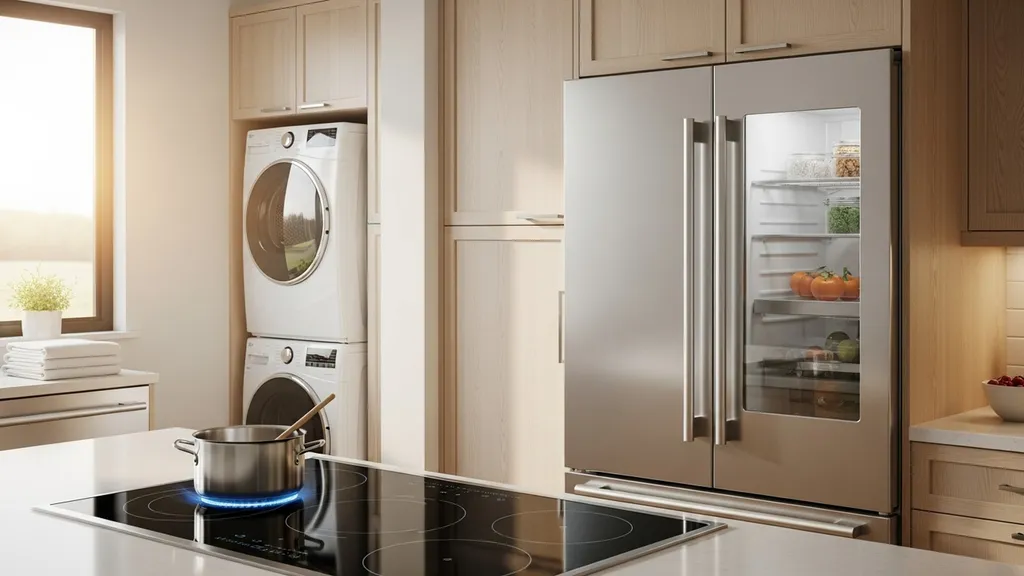
Practical guide to choosing energy-efficient appliances for net-zero homes: heat-pump tech, sizing, controls, costs, and quick buyer checklist.
Net Zero Home Appliances: Energy Efficient Choices
Choosing the right net zero appliances is one of the fastest ways for a DIY self-builder to cut bills and make a home work with solar and batteries. This guide explains which household devices count toward a net-zero target, the typical electricity they use, practical efficiency metrics (kWh/year, COP/EF), and clear steps for sizing, controls, and incentives so you can pick appliances that actually reduce both operational cost and carbon.
TL;DR:
- Prioritize reducing loads first (tight envelope, good windows): cutting 20–40% of heating/cooling need lowers appliance/HVAC size and PV cost.
- Favor heat-pump appliances: heat-pump water heaters and space heaters typically deliver COP 2.5–4.0, saving 40–70% of energy vs resistive or direct electric.
- Size and control to match PV/battery: estimate annual appliance kWh, size PV by local yield (1,200–1,500 kWh/kW-year), and time-shift major loads with timers or smart controls for cheaper batteries.
What "net Zero Appliances" Mean for a Net-zero Home
"Net zero appliances" refers to household devices selected and operated so the home's net energy use over a year can reach zero when combined with on-site generation (solar) and storage. That includes major appliances, HVAC, water heating, fans and ventilation, pumps, lighting, and EV charging. Small plug loads count, too; when you add them up they matter.
Two accounting layers matter:
- Operational energy: electricity used during normal operation (kWh/year). This is what solar and batteries offset.
- Upstream embodied carbon: emissions from manufacture, transport, and disposal. Appliance choice affects both; a long-lived, repairable heat pump with lower operational use can win on lifecycle carbon despite a higher upfront footprint.
Labels and standards help compare models. Use the ENERGY STAR rating where available, check EU Ecodesign and national MEPS (minimum energy performance standards) for baseline compliance, and look at IECC or local code for HVAC sizing rules. For broader planning, pair appliance choices with whole-house measures in the site's net-zero home guide and confirm terms with the net-zero definition.
Research shows maintenance and correct installation also determine real-world performance. A heat pump poorly sized or installed will underperform. For maintenance tips and practical care, see resources like BillionBricks' homeowner guide on keeping net-zero systems working over time: a newbie's guide to maintaining a net-zero home.
Appliance Categories and Typical Home Energy Loads
Major Appliance Categories to Plan For:
- Refrigeration
- Cooking
- Laundry (washer and dryer)
- Water heating
- Space heating and cooling (HVAC)
- Ventilation and fans
- Lighting and small plug loads
- EV charger and pumps
Typical shares (rough, depends on climate and whether heating is electric):
- HVAC (heating + cooling): 30–50% of electricity in electric-heated homes
- Water heating: 20–30% if electric
- Refrigeration: 5–15%
- Laundry and dishwashing: 5–12%
- Cooking: 5–12%
- Lighting and plug loads: 10–20%
These ranges follow patterns in residential studies from DOE and NREL; percentages vary by region and occupancy. The Department of Energy provides guidance on technologies and expected savings for high-efficiency appliances in housing stock: net-zero buildings overview and efficiency guidance.
Key points to remember:
- Improving the building envelope directly reduces HVAC share and can shrink required appliance capacity.
- Windows, airtightness, and insulation change heating/cooling loads and therefore HVAC sizing; compare options like energy-efficient windows, triple-pane windows, and sealing common air leakage points.
Comparison/specs table: common appliances with typical wattage, annual kWh ranges, and efficient technology examples.
| Appliance | Typical wattage/size | Typical annual kWh (low/med/high) | Efficient technology examples |
|---|---|---|---|
| Refrigerator (50–22 cu ft) | 100–800 W compressor cycles | 200 / 400 / 700 kWh | ENERGY STAR variable-speed fridge |
| Induction cooktop | 1.5–3.5 kW per burner | 150 / 450 / 900 kWh | Induction range with boost and pan detection |
| Dishwasher | 1.2–1.8 kW | 120 / 250 / 450 kWh | Low-water cycle, heat-pump-assisted models |
| Heat-pump water heater (50–80 gal) | 700–3,000 W (compressor + resistive backup) | 900 / 1,800 / 3,000 kWh | Air-source HPWH, COP 2.5–4.0 |
| Heat-pump dryer | 700–1,500 W | 400 / 800 / 1,200 kWh | Condensing HP dryer with inverter |
| Air-source heat pump (space) | 1–6 kW nominal | 2,000 / 6,000 / 12,000 kWh (heating/cooling) | Variable-speed inverter-driven heat pump |
Use these specs for preliminary sizing; confirm with product kWh/year labels and an energy model or load calculator.
How to Choose Energy-efficient Appliances: Labels, Features, and Sizing
Reading labels and metrics
- Look at kWh/year for direct comparison when available.
- For water heaters and heat pumps, check COP (coefficient of performance) or EF (energy factor). Higher is better; a COP of 3 means 1 kWh input produces 3 kWh thermal output.
- For clothes dryers, look for Combined Energy Factor or manufacturer test energy per cycle.
- Confirm ENERGY STAR certification where offered and compare to MEPS minimums for baseline compliance.
Features to prefer
- Inverter compressors and variable-speed motors reduce on/off cycling and improve part-load efficiency for refrigerators, heat pumps, and HVAC.
- Heat-pump technology for water heating and clothes drying cuts energy use substantially vs resistive electric.
- Induction cooktops convert more electrical energy to useful heat at the pan and have faster response than electric resistance.
- Smart controls and Wi‑Fi allow scheduling, demand shifting, and firmware updates; prefer models with open APIs if you plan system integrations.
Sizing and avoiding oversizing
- Oversized HVAC or water heaters spend more time cycling, lowering seasonal efficiency. Right-size based on heat load calculations (Manual J for HVAC), household hot-water draw profiles, and local climate.
- For water heaters: match tank volume and recovery to peak draw. For point-of-use or small systems, consider tankless heat-pump hybrids when justified.
- Before choosing appliance sizes, lower loads first with insulation and airtightness. See how insulation choices change needs in the site's spray foam vs cellulose discussion.
Examples:
- A 50-gallon electric resistance water heater using ~4,500 kWh/yr can be replaced by an HPWH with COP ~3, reducing use to ~1,500 kWh/yr — roughly a 66% cut.
- A mid-size refrigerator with a variable-speed compressor might use 300–400 kWh/year versus a baseline model at 700+ kWh/year.
Authoritative design guides, like the SUCF energy-efficiency design guide, recommend running hygrothermal and heat-transfer analyses early to set insulation and appliance requirements: energy efficiency design guide PDF.
Electrification & Heat-pump-first Strategy for Net Zero Homes
Why prioritize heat pumps Heat-pump appliances deliver thermal energy more efficiently than direct-resistive or combustion in many climates. They align well with PV because electricity is the common fuel. Typical COP ranges:
- Heat-pump water heaters: COP 2.5–4.0 (season and use dependent)
- Air-source heat pumps: seasonal HSPF/SEER translate to effective COPs in the 2–4 range for heating
- Heat-pump dryers: often 2–3x more efficient than vented electric dryers
Practical appliance examples
- Heat-pump water heater (HPWH): tanked HPWHs from manufacturers such as Rheem and Stiebel Eltron show real-world annual kWh savings versus resistive heaters. Compare product labels for EF/COP and standby losses.
- Heat-pump dryer: condensing heat-pump dryers cut energy per load while avoiding external venting.
- Induction ranges: reduce waste heat in the kitchen and pair well with heat-pump ventilation systems.
Installation and Wiring Considerations
- Heat-pump equipment typically requires 240 V circuits and dedicated space for compressors (outdoor unit) or HPWHs (indoor units with airflow clearance).
- Cold-climate performance can require cold-climate-rated outdoor units or hybrid strategies (backup electric resistance or gas in rare cases).
- Coordinate electrification with PV and battery plans early; see the site's advice on adding solar so the electrical panel, conduit runs, and meter setups match future loads.
This video provides a helpful walkthrough of the key concepts:
For design-level envelope and load control guidance supporting a heat-pump-first strategy, consult NIST's work on net-zero energy homes: NIST strategies to achieve net-zero energy homes PDF.
Sizing, Load Management, Smart Controls, and Pv/battery Matching
Estimating loads
- Start with appliance kWh/year estimates (table earlier). Add lighting and small plug loads (often 1,500–3,500 kWh/yr for a small home).
- Estimate peak demand by summing largest simultaneous draws (e.g., oven 3 kW + dryer 1.5 kW + EV charger 3.6 kW). For PV/inverter planning, both continuous and surge ratings matter.
- Use an energy monitor to verify actual use patterns. The site's DIY energy monitor calibration guide helps validate estimates.
Demand-shift strategies
- Schedule water heater charging during midday solar production using timers or smart relays.
- Set dishwashers and EV charging to run overnight or mid-day, depending on tariffs and PV output.
- Use smart thermostats and variable-speed HVAC settings to shave peaks and extend battery life.
Matching PV and battery capacity
- Rule of thumb: PV kW needed = annual appliance kWh / expected annual kWh per kW of installed PV. Use 1,200 kWh/kW-year for cooler northern sites and 1,400–1,600 kWh/kW-year for sunnier regions as a starting point.
- Example: If appliance load is 6,000 kWh/yr, PV needed ≈ 6,000 / 1,300 ≈ 4.6 kW.
- Battery sizing depends on how many hours of autonomy you want. For a 5 kWh evening appliance demand, a 7–10 kWh usable battery provides a buffer (account for inverter and depth-of-discharge).
- Consider inverter continuous and peak capabilities when integrating ovens and dryers — some inverters handle 5–7 kW continuous, others less.
For wiring and integration specifics for high-demand appliances with hybrid energy systems, consult the site's step-by-step hybrid energy system wiring guide. For monitoring best practice and calibrating your household model, follow the energy monitor tips.
Water-efficient Appliances and Plumbing Interactions
High-efficiency washers and dishwashers
- Front-load washers and high-efficiency dishwashers reduce water use and the amount of hot water needed per cycle. Look at gallons-per-cycle and energy per wash metrics.
- Cold-water detergent options and low-temperature cycles further reduce hot-water energy use.
Hot water strategies: tanked HPWHs vs on-demand vs tankless
- Tanked HPWH: best for households with sustained daily draw and where ambient air can supply heat; typical annual kWh 900–2,500 depending on size and COP.
- Point-of-use mini HPWH or small tankless electric: reduces distribution losses but may be less efficient per unit of heat delivered in high-demand scenarios.
- Electric tankless (resistive) has high instantaneous power (12–27 kW), which is hard to support off-grid unless oversized inverter/arrays exist.
Plumbing interactions and system-level design
- Insulate hot-water piping and minimize runs to reduce standby and distribution losses.
- Hot-water recirculation systems can increase convenience but may raise standby losses; prefer demand-controlled recirculation pumps.
- Greywater reuse and efficient fixtures reduce freshwater heating demand and can cut annual energy use. For guidance on system-level water-efficiency and off-grid approaches see the site's how to design a water-efficient plumbing system and the expanded water-efficient guide plus an integration primer on graywater integration.
The WBDG resource on Net Zero Energy Buildings provides useful framing for integrated water and energy strategies at building scale: Net zero energy buildings | wbdg.
Cost, Incentives, and Lifecycle Carbon Considerations
Upfront Cost vs Operational Savings
- Heat-pump appliances often carry a premium: expect HPWHs and heat-pump dryers to cost 25–100% more upfront than basic electric models depending on brand and capacity.
- Compute simple payback: annual kWh savings × local electricity price = annual $ savings. Divide appliance premium by annual savings to estimate years to payback.
- Example: HPWH saves 2,000 kWh/yr at $0.15/kWh → $300/yr savings. If premium is $900, simple payback ≈ 3 years.
Available rebates and tax credits
- Incentives vary by country, state/province, and utility. Common types include point-of-sale rebates, mail-in rebates, and tax credits for electrification, heat pumps, and efficient appliances.
- Always check local utility and government programs before purchase; incentives can change timelines and make higher-efficiency units cost-competitive.
Lifecycle Carbon: Embodied vs Operational
- An appliance's embodied carbon can be amortized by years of low operational emissions. For example, a durable HPWH with a 15–20 year lifespan may offset its extra embodied carbon within a few years due to reduced electricity use.
- Choose durable, serviceable models with replaceable components; this reduces waste and lifecycle impact.
- For macro trends in materials and price pressure that affect appliance choices, consult the site's analysis of materials cost trends.
The Bottom Line
Pick appliances after you reduce loads with good windows and airtightness, then prioritize electrification with heat-pump appliances and induction cooking. Right-size equipment, use smart controls to shift demand to daytime solar, and check available incentives to cut payback times. In short: reduce, electrify, and coordinate appliances to match PV and batteries for practical net-zero results.
Frequently Asked Questions
Are heat-pump water heaters worth it for a small self-build?
Yes, in most cases a heat-pump water heater (HPWH) pays off. HPWHs commonly deliver COPs of 2.5–4.0, cutting hot-water electricity by 40–75% compared with resistive electric tanks. For a small self-build using 1,800 kWh/year for hot water, an HPWH that reduces that to ~600–900 kWh/year can save several hundred dollars per year depending on local rates. Consider space needs (HPWHs need airflow) and check whether point-of-use units or small tanks better match your hot-water profile.
Tip: confirm available rebates first — incentives can reduce the upfront premium significantly.
Can induction cooktops run on a typical off-grid solar system?
They can, but plan carefully. Induction burners draw high power for short periods (1.5–3.5 kW per active burner). Off-grid systems must meet peak inverter capacity for simultaneous burners and include sufficient PV or battery to supply repeated heavy use. For most off-grid homes, staggering cooking times, using a single high-power burner, and pairing induction with a battery sized for short peaks keeps system costs manageable.
How much will efficient appliances reduce my home's total energy use?
It depends on your starting point and climate, but switching to heat-pump appliances and efficient refrigerators/lighting commonly reduces household electricity by 20–50%. The largest gains come from electrifying space and water heating with heat pumps and replacing old refrigerators and inefficient dryers. Envelope improvements can further reduce HVAC share, magnifying appliance gains.
Do ENERGY STAR-rated appliances make sense for tiny homes?
Yes. ENERGY STAR-rated models usually consume less energy overall and are often sized appropriately for smaller spaces. For tiny homes, pay attention to form factor (compact refrigerators, combo washer-dryer units), standby losses, and water use; in many cases, a high-efficiency compact unit outperforms a full-size non-rated model on both energy and total cost of ownership.
What maintenance do heat-pump appliances need?
Heat-pump appliances require periodic filter cleaning, airflow checks, and occasional refrigerant leak inspection for outdoor units. For HPWHs, clean condensate drains and keep the area clear for airflow. Follow manufacturer service intervals; simple preventive maintenance keeps COP high and extends service life.