Learn how to evaluate passive house ROI: upfront costs, energy savings, incentives, payback scenarios, and financing for DIY builders.
The Economics of Passive House: ROI Analysis
Passive house ROI matters for any DIY builder weighing higher upfront costs against decades of lower bills, better comfort, and resilience. This guide explains how to define and calculate passive house ROI, where the upfront premium goes, realistic operational savings, how incentives affect payback, modeled payback scenarios across climates and sizes, and financing and risk considerations so readers can run their own numbers and decide whether to move forward. It covers simple payback, discounted cash flow (NPV), and lifecycle cost thinking, and points to tools and sources to produce defensible estimates.
TL;DR:
- Passive house ROI often shows simple paybacks of 8–25 years depending on climate, energy prices, and incentives; lifecycle savings can exceed 30% of total ownership costs over 30 years.
- Focus premiums on the envelope (insulation, windows, airtightness) and a compact MVHR; use incentives and solar to cut payback by several years.
- Recommended next steps: run the cost calculator, collect local incentive details, and model three payback scenarios before committing.
Defining ROI for Passive House: Financial Vs. Lifecycle Returns
"Passive house ROI" can mean several things. For a DIY builder it usually falls into three frameworks:
- Simple payback: Upfront premium divided by annual energy savings. Easy to compute; ignores inflation and time value of money.
- Discounted cash flow (NPV & IRR): Net present value (NPV) of future savings using a discount rate (e.g., 3–6%) and internal rate of return (IRR). Shows whether savings justify investment on a financial basis.
- Lifecycle cost: Totals first costs, operating costs (energy, maintenance), and replacement costs over a planning horizon (commonly 30 years). Useful for owners planning to keep the house long-term.
Non-monetary returns matter too: improved thermal comfort, consistent indoor air quality, fewer cold spots, and resilience during outages. These can be partially monetized — for example, lower repair frequency and longer-lasting building fabric reduce lifecycle cost. Passive House standards (PHI and PHIUS) provide performance baselines useful for modeling; industry resources explain the principles and targets in detail (Passive building principles - phius). For baseline energy use and weather files, the U.S. Department of Energy and NREL are standard sources for local climate and cost data.
When comparing to "conventional" construction, clearly define the baseline: an IECC-minimum home, a local code-built home, or a well-built "pretty good house." Consistent baselines avoid comparing apples to oranges.
Where the Upfront Premium Goes: Key Cost Drivers
Most of the passive house premium concentrates in a few buckets:
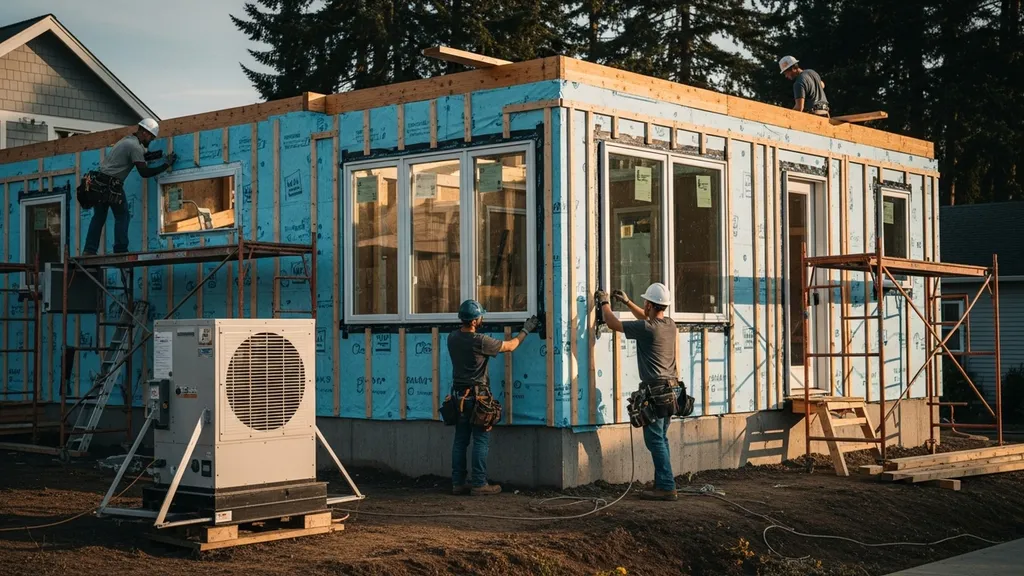
- Envelope (insulation, windows, airtightness): Continuous exterior insulation, thicker wall assemblies, and triple-glazed windows are common. Expect a wide range: glazing premiums can add $10–$40 per sq ft of window area compared with double-glazed units; continuous insulation and upgraded wall assemblies can add several thousand dollars depending on size and material choice. Use the cost breakdown for detailed line items.
- Mechanical systems and ventilation: A compact MVHR/ERV with ducting and balanced system commissioning adds cost but reduces heating and cooling loads; high-efficiency heat pumps sized to reduced loads are typically used. Installation plus commissioning varies by region but commonly ranges from $4,000–$12,000 for MVHR and $6,000–$18,000 for heat pump systems in small-to-medium homes, depending on complexity and labor rates.
- Design, testing, and certification: Blower-door testing, iterative modeling, and optional Passive House certification fees add time and money. Blower-door testing runs $300–$700; certification and modeling fees depend on certifier and project complexity.
High-impact upgrades include triple-glazed windows, continuous exterior insulation, careful thermal-bridge detail, and a properly commissioned MVHR. DIY builders can save on labor if they have the skills for insulation and air-sealing work; however, airtightness detailing and MVHR commissioning are technical and mistakes can erase expected savings. Practical installation approaches and material comparisons are available for readers considering trade-offs (see insulation alternatives, roof insulation methods, window sealing tips, and the air sealing techniques guide).
Contractor experience matters: regional contractors familiar with high-performance work may price differently, and inexperienced crews can cause overruns. Collect local supplier quotes and use the cost calculator to quantify premiums for your project.
Operational Savings: Estimating Energy and Comfort Gains
Operational savings from passive house come mainly from reduced heating and cooling loads, smaller HVAC systems, and lower ventilation losses. Typical components:
- Heating and cooling: Passive house envelopes can reduce space-conditioning loads by 60–90% relative to typical code-built houses in many climates, depending on the baseline and climate. Research such as RMI reports provides measured outcomes and guidance on realized savings (Achieving passivhaus standard in north america: lessons learned).
- Domestic hot water (DHW) and appliances: Lower distribution losses and efficient appliances reduce total site energy. Selecting efficient appliances from the efficient appliances guide multiplies savings.
- Ventilation and distribution losses: A balanced MVHR recovers heat from exhaust air, cutting ventilation losses significantly compared with mechanical exhaust-only ventilation. Proper ventilation design is critical for energy and indoor air quality.
Modeling vs. measured performance: modeling tools (PHPP, energy models) give a projection; measured results vary with occupant behavior, weather, and construction quality. Studies report that well-executed passive houses often meet modeled heating demand or come within a modest margin, but occupant habits (thermostat setpoints, hot water use) can swing annual bills by 20–40%. Use NREL or DOE local energy price data when converting kWh or therms saved into dollar savings.
On-site renewables (solar PV) and high-efficiency heat pumps combine well with passive envelopes. For tiny houses or small homes, solar sizing guidance helps estimate how much of the reduced load can be covered by PV — see the solar sizing guide. Daylighting and passive solar strategies cut lighting and heating needs; readers should consult the daylighting strategies article.
Include secondary factors such as reduced mechanical maintenance (smaller equipment), though some systems like MVHR require periodic filter changes.
How Incentives and Taxes Change the Math
Financial incentives can materially shorten payback on passive house investments. Common incentive types include:
- Federal tax credits: Credits for residential energy property, heat pumps, and solar systems reduce net cost. Eligibility rules change, so verify current guidance at official sources.
- State and local rebates: Many utilities and state programs offer rebates for heat pumps, electrification, and PV. These come as upfront rebates or performance-based incentives.
- Local green building programs: Some municipalities provide accelerated permitting or other benefits that reduce soft costs.
To include incentives in payback: subtract upfront rebates from the premium; for tax credits, apply the after-tax value in an NPV calculation (e.g., a $3,000 tax credit reduces the owner's tax liability by roughly that amount in year one). For mixed systems (e.g., MVHR + PV + heat pump), consult hybrid cost breakdowns that show how incentives interact with each component (hybrid system costs). Always verify program rules and timelines using IRS and state program pages; rules and caps change frequently.
A practical order of operations for modeling incentives:
- Calculate gross upfront premium.
- Subtract immediate rebates and point-of-sale discounts.
- Apply tax credits to after-tax costs in year one (adjust NPV accordingly).
- Model any performance-based incentives as annual cash flows.
Payback Period Scenarios and Break-even Table
This section provides step-by-step worked examples for three sample projects. It includes a comparison table, a key-points list, and a video case study to follow the math.
Simple Payback Example: Step-by-step
Step 1: Define baseline and premium.
- Baseline: 1,500 sq ft code-built new home.
- Passive house premium: $45,000 (3% of build cost assumed).
Step 2: Estimate annual energy savings.
- Modeled annual savings: 10,000 kWh and 1,000 therms replaced by heat pump; at $0.14/kWh and $1.50/therm → annual savings ≈ $1,600 + $1,500 = $3,100.
Step 3: Compute simple payback.
- Simple payback = $45,000 / $3,100 ≈ 14.5 years.
For a tiny-house retrofit with a $10,000 premium and $1,200/year savings, simple payback = ~8.3 years. In a cold-climate family home with a $70,000 premium and $3,500/year savings, simple payback ≈ 20 years.
Discounted Payback and NPV Sensitivity
Use discount rates (3%, 5%, 7%) for NPV. For the 1,500 sq ft example over 30 years, apply a 2% annual energy inflation and 3% discount rate to compute NPV. A positive NPV at homeowner's discount rate indicates financial sense. Sensitivity analysis should vary energy price escalation, discount rate, and initial premium ±20%.
Comparison Table: 3 Climate/size Scenarios
| Scenario | Upfront premium | Annual energy savings | Simple payback (years) | NPV (3% discount, 30y) |
|---|---|---|---|---|
| Tiny-house retrofit (cold) | $10,000 | $1,200 | 8.3 | $3,200 |
| 1,500 sq ft new build (temperate) | $45,000 | $3,100 | 14.5 | -$2,800 |
| 2,500 sq ft family home (cold) | $70,000 | $3,500 | 20.0 | -$18,500 |
Notes: Numbers are illustrative; run your project in the cost calculator with local energy prices and incentives for accurate results.
Key points:
- Smaller, tight envelopes and lower premiums shorten payback.
- High local energy prices or generous incentives often flip NPV positive.
- Model several discount rates and energy escalation scenarios.
For a visual demonstration, check out this video on sumac grove - tour a leed platinum almost:
For contractor-focused advice on delivering a passive project on budget, see the Passive House Network contractor guide (A developer's guide to passive house - passive house network) and the contractor's guide from Passive House International (So you've been asked to build a Passivhaus?).
Financing, Resale Value, and Long-term Asset Economics
Financing options for DIY and self-build projects include standard construction loans, renovation loans, and personal finance. Some lenders support energy-efficient mortgages or green loan products that consider energy savings in loan qualification. Readers should consult the self-build financing advice article for practical planning tips and local lender questions.
Does passive house add resale value? Evidence is emerging but regionally variable. Documented energy modeling, verification, and certification (PHIUS or PHI) help support claims when marketing the home. Studies show buyer interest in low operating-cost homes, but resale premiums depend on local market awareness and buyer priorities. For lenders and appraisers, providing modeled and measured utility bills and certification documentation improves the case for a premium.
Insurance and depreciation: high-quality envelopes and mechanicals often reduce maintenance claims, but premiums depend on local insurer policies. Include replacement cycles in lifecycle models: typical component life cycles to consider:
- Windows (good quality): 20–30 years.
- Heat pumps: 15–20 years.
- MVHR units: 15–25 years (filters and small parts more frequent).
- Inverters for PV: 10–15 years.
Long-term asset economics favor owners who plan to keep the home 10–30+ years, and when energy price escalation or carbon-conscious buyers are expected.
Risks, Maintenance Costs, and Sensitivity Analysis
Common cost overruns stem from design changes, poor thermal-bridge detailing, and inexperienced installers attempting airtightness work without proper sequencing. Typical overruns add 5–15% to budgets on complex projects.
Maintenance and replacement costs to include in lifecycle analysis:
- MVHR filters: Replacement every 3–12 months; annual filter cost: $50–$250.
- Heat pump servicing: Annual maintenance $150–$400; major component replacement after 15–20 years.
- Windows: Repair or reglaze options can extend life; replacement is expensive and should be accounted for.
- PV inverter: Expect replacement or major servicing in 10–15 years; see solar inverter maintenance and inverter issue fixes for cost ranges.
A recommended practice is a sensitivity matrix that varies:
- Energy price escalation (1–4%/yr)
- Discount rate (2–7%)
- Upfront premium (±20%)
- Occupant behavior (±30% energy use)
Adding a contingency (typically 5–10% for well-planned DIY builds; 10–15% for complex projects) and staged commissioning reduces risk. Commissioning catches installation mistakes that can destroy projected savings.
Practical risk reduction tips:
- Prioritize airtightness testing early and iteratively.
- Use proven window and insulation details; consult the window sealing tips and roof insulation methods.
- Budget for MVHR commissioning and seasonal rebalancing.
The Bottom Line: is Passive House Worth It for DIY Builders?
Passive house ROI depends on project scale, climate, energy costs, and how long the owner plans to hold the property. For long-term owners in cold climates or areas with high energy prices, passive house often pays back within a homeowner's planning horizon and delivers substantial lifecycle savings. For short-term owners in low-energy-cost regions, the benefits may be more about comfort and resilience than quick financial returns. Recommended next steps: run the cost calculator, collect local incentives, model payback under multiple scenarios, and identify where DIY labor can safely reduce premium without risking performance.
Frequently Asked Questions
How long until a passive house pays for itself?
Payback varies. Simple paybacks reported in case studies typically range from about 8 to 25 years depending on the project size, climate, energy prices, and available incentives. Smaller retrofits and projects where owners deploy solar and efficient heat pumps often land at the shorter end. Use local energy prices and your projected premium in a discounted cash flow to get a precise estimate for your project.
Does certification increase ROI?
Certification adds fees for modeling and documentation, but it can increase resale value and lender confidence for some buyers. Certification also forces rigorous testing and checks that help secure modeled savings; for many owners the extra cost is insurance against performance shortfalls. Evaluate whether the marketing and resale benefits in your market justify certification costs.
Can I get loans for passive house upgrades?
Yes. Options include construction loans, renovation loans, energy-efficient mortgage products where available, and personal financing. Lenders are increasingly aware of energy savings but documentation helps: provide energy models, expected savings, and any rebate confirmations. For DIY self-builders, plan detailed budgets and a staged draw schedule to satisfy lender requirements; see our self-build financing advice for planning tips.
How do climate and occupancy affect payback?
Climate affects heating and cooling loads strongly; cold climates usually show bigger absolute heating savings, improving payback. Occupancy patterns and thermostat settings can change realized savings by 20–40%. Modeling should use local weather files (NREL/DOE) and realistic occupancy assumptions to avoid overstating benefits.
Which upgrades give the best ROI first?
High-return upgrades often include airtightness and continuous insulation to reduce loads, followed by right-sized heat pumps and efficient ventilation with heat recovery. For many projects, improving airtightness and adding proper wall/roof insulation yields the largest cost-effective reduction in energy demand; then add efficient mechanical systems. Use the cost breakdown and the cost calculator to test order-of-operations for your budget.