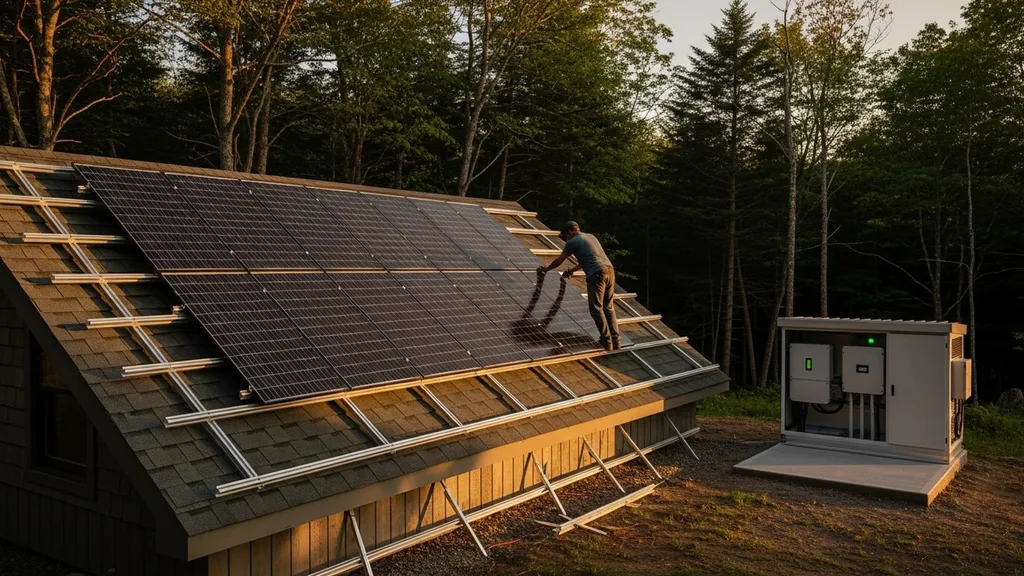
Practical guide to sizing a 5kW solar system for a cabin — panels, battery and inverter sizing, sample calculations, costs, and off-grid vs grid-tied choices.
5KW Solar System for Cabin: Complete Sizing Guide
A 5kW solar system for cabin owners often hits the sweet spot: enough PV to run lighting, fridge, pumps and basic hot water while keeping equipment and installation costs manageable. This guide shows how to audit your cabin loads, translate daily kWh needs into panel counts and battery size, pick the right inverter, and decide between off-grid, grid-tied, or hybrid topologies. Read on for worked calculations, two example builds, BOS details, and an actionable planning checklist.
TL;DR:
- A 5 kW solar array typically produces about 12–25 kWh/day depending on site sun-hours; expect 3.5–5.5 peak sun-hours in many regions.
- For a weekend cabin (minimal battery) a 5 kW grid-tied or hybrid with ~5–10 kWh usable battery is common; for full-time off-grid plan 15–25 kWh usable for multi-day autonomy.
- Start with a load audit, size inverter for continuous and surge loads, pick a 48 V battery bank for efficiency, and follow NEC/local code for wiring and grounding.
Why a 5kw Solar System is a Common Choice for Cabins
A 5 kW DC nameplate array (solar module total rated power) balances cost, roof space, and practical production for many small dwellings. In clear-sky conditions a 5 kW array will produce roughly 12–25 kWh per day depending on latitude, tilt, and season. That range uses a PVWatts-style framing: multiply array rating by peak sun-hours (e.g., 5 kW × 4.0 PSH = 20 kWh), then apply system derates for inverter and wiring (typical total system efficiency 75–85%).
Who benefits from a 5 kW system
- Weekend/seasonal cabins that need enough generation for fridge, lights, and occasional electric cooktop.
- Small full-time cabins and tiny homes where electric loads are modest but continuous.
- Off-grid homesteads that combine a 5 kW array with a battery bank and generator for reliability.
Typical Performance Expectations
- Low-sun site (3.0 PSH): ~11–13 kWh/day after losses.
- Moderate-sun site (4.0–4.5 PSH): ~15–20 kWh/day.
- High-sun site (5.0+ PSH): ~22–27 kWh/day.
Expect seasonal swing: winter output can be 40–70% of summer in high-latitude sites. For smaller or strictly weekend use, compare the tradeoffs with a smaller 3kW system comparison or the 1kW shed sizing notes.
External perspective: generationecoStore recommends 3–5 kW arrays paired with ~10 kWh+ storage for many cabin setups, which aligns with the numbers above (see their off-grid kit guidance)[Off grid solar kit guide].
How to Calculate Your Cabin’s Real Energy Needs (step-by-step)
A reliable system starts from an accurate load audit. The goal: translate every appliance and usage pattern into daily kWh, and identify peak and surge loads for inverter sizing.
Quick On-site Load Audit: What to Measure and Record
- List every appliance and device: fridge, lights, water pump, microwave, heater, AC, hot-water heater, chargers, router.
- Note rated wattage from nameplate. If unknown, use typical values (fridge 100–150 W running, well pump 400–1500 W, LED light 5–12 W).
- Log hours of use per day and duty cycles (e.g., fridge runs 30% of the time).
- Measure actual loads with a clamp meter or plug power meter when available. Record peak draws (for motors and inrush currents).
Useful internal references: planning and appliance choices in the building a small cabin guide and pump duty cycles from off-grid water system options or off-grid pumps options.
Creating a Simple Daily and Seasonal Load Profile
Convert watts and hours to kWh:
- Example formula: Appliance kWh/day = (Wattage × Hours per day) / 1,000.
Worked sample: weekend day-use cabin
- Refrigerator: 120 W nominal × 24 h × 30% duty = 0.120 kW × 7.2 h = 0.864 kWh/day.
- LED lighting: 6 fixtures × 8 W × 4 h = 48 W × 4 h = 0.192 kWh/day.
- Water pump (intermittent): 750 W × 0.5 h = 0.375 kWh/day.
- Microwave: 1,000 W × 0.25 h = 0.25 kWh/day.
Total ≈ 1.68 kWh/day — small. A 5 kW array is overkill for this use, so consider a smaller system or use a 5 kW array sized for future growth.
Worked sample: full-time tiny cabin
- Refrigerator: 120 W × 24 h × 40% duty = 1.15 kWh/day.
- LED lighting and outlets: 150 W × 4 h = 0.6 kWh/day.
- Well pump: 750 W × 1 h = 0.75 kWh/day.
- Electric cooking (moderate): 1,500 W × 1 h = 1.5 kWh/day.
- Space heating (electric baseboard) or heat pump will dominate — see insulation notes below.
Total baseline (without heating): ~4 kWh/day. Add heating hot water and heating loads to estimate total seasonal needs. To reduce heating energy, consult off-grid insulation advice in off-grid insulation tips.
Translate Daily Kwh Into Array Size
Use: Required array kW ≈ (Daily kWh needed) / (Peak sun-hours × system efficiency)
Example: Cabin needs 12 kWh/day, site average = 4 PSH, system efficiency = 0.80:
- Array size = 12 / (4 × 0.80) = 3.75 kW. A 5 kW system gives a comfortable buffer for cloudy days and battery charging losses.
For a visual demonstration, check out this video on step by step budget solar install with eco-worthy!:
Sizing the 5kw Solar Array: Panels, Roof Space, Orientation and Production Expectations
This section turns array size into panel count, area, and expected output by region and tilt.
How Many Panels? (comparison by Panel Wattage)
Panel wattage affects count and roof area. Typical choices:
| Panel wattage | Panels to reach ~5 kW |
|---|---|
| 300 W | 17 panels (5.1 kW) |
| 350 W | 15 panels (5.25 kW) |
| 400 W | 13 panels (5.2 kW) |
| 450 W | 12 panels (5.4 kW) |
Panel area rough estimate: many modern panels are ~1.6–2.0 m². Example: 13 × 1.7 m² ≈ 22 m² (≈ 236 ft²). Higher-efficiency modules (e.g., PERC or N-type) reduce area.
Refer to our panel efficiency primer when choosing modules: compare panel efficiency ratings.
Roof vs Ground-mount: Space and Tilt Trade-offs
- Roof mount: Saves ground space, integrates with structure, but watch shading from chimneys or trees and roof structural capacity. For aesthetics and shading management see matching panels to your roof.
- Ground mount: Easier access and optimal tilt; requires secure foundation and fencing for livestock. Tilt manufacturer recommendations usually follow latitude-based rules (latitude ± 10° as a simple starting point).
Expected Energy Output by Region and Tilt
Using 3.5–5.5 PSH:
- Low-sun region (3.5 PSH): 5 kW × 3.5 × 0.80 ≈ 14 kWh/day.
- Mid-sun region (4.5 PSH): ≈ 18 kWh/day.
- High-sun region (5.5 PSH): ≈ 22 kWh/day.
Seasonal and shading impacts can halve winter output in cold climates. For more conservative estimates, simulate with PVWatts or a local installer model.
External source: Jackery’s 2026 guide gives panel-count and roof area ranges for a 5 kW system that align with the table above (10–17 panels and 16–34 m² roof area)[5kw solar power system].
Choosing the Right Inverter and Battery for a 5kw Cabin Setup
Pick inverter and battery to match continuous loads, surge requirements, and charging strategy.
Inverter Sizing: Continuous vs Surge, Off-grid vs Hybrid
- Continuous rating should at least match your expected peak continuous AC load. For example, if max continuous loads sum to 4 kW, choose an inverter with ≥4 kW continuous rating. Many cabin installs choose a 5 kW inverter to match PV.
- Surge (inrush) matters for motors, refrigerators, and pumps. Look for an inverter with 2–3× surge capability for several seconds, or plan for soft-start motor controllers.
- Off-grid inverters are often all-in-one units (inverter, charger, transfer switch). Hybrid inverters support grid interaction and battery storage. Compare AC-coupled solutions vs DC-coupled ones in the AC and DC coupling overview. For troubleshooting, see common inverter faults.
Battery Capacity: Usable Kwh, Dod, and Days of Autonomy
Battery math:
- Usable battery (kWh) = Daily kWh demand × Days of autonomy / System round-trip efficiency.
- Example: 12 kWh/day × 2 days / 0.85 ≈ 28.2 kWh usable.
Battery chemistry examples:
- Lithium (LiFePO4, NMC): usable DoD 80–90%. Use 80% for conservative sizing.
- Flooded lead-acid: usable DoD ≈ 50% (choose larger nominal capacity).
- Ask: Do you want 1 day, 2 days, or 3+ days autonomy? Weekend cabins often use 0.5–1 day; full-time off-grid usually 2–5 days.
System voltage banks and matching:
- 48 V battery banks are common for >3 kW systems due to lower current and smaller wire sizes; 12/24 V banks are usually for very small setups. Match inverter input voltage to battery voltage.
External explanation: PiForz and other guides show typical battery sizing for off-grid 5 kW arrays and expected daily generation ranges, useful when checking assumptions[5kw off grid solar power system guide].
AC vs DC Coupling and Charging Strategies
- DC-coupled: PV charges battery directly through MPPT charge controller — efficient for some hybrid inverters.
- AC-coupled: PV inverter exports to AC bus; hybrid inverter/charger handles battery charging. This approach is easier to retrofit. See our detailed guide on AC and DC coupling overview for pros and cons.
External and brand mentions: brands like Jackery produce integrated portable systems useful for very small cabins, while full-install hybrid inverters from established inverter manufacturers suit permanent installs.
Balance of System (BOS): Charge Controllers, Wiring, Mounting and Safety
BOS components are often 10–20% of project cost but essential for safe, reliable operation.
Choosing MPPT Charge Controllers and Appropriate Ratings
- Use MPPT controllers for their higher efficiency and ability to accept higher voltage arrays. MPPT controllers are standard for cabin systems.
- Calculate controller rating: Controller current (A) ≥ Max array current (Isc) × safety margin (1.25). Confirm controller Voc and Isc limits versus panel string configuration.
Wire Sizing, Fusing, Grounding and Lightning Considerations
- Size DC wire to limit voltage drop to 1–3% depending on run length; use voltage-drop calculators and follow NEC/IEC guidelines. For a 48 V system, currents are lower so wire sizes are smaller than 12 V systems.
- Place DC fuses or breakers close to the battery and PV array as required by NEC. Use proper negative and positive disconnects.
- Ground all metal racking and equipment. Consider a whole-site lightning strategy if the cabin is in lightning-prone areas.
For safety checklists and PPE, consult the solar installation safety best practices and wiring tips in DC to AC wiring best practices. An example small power shed layout is available in the build update: power shed framing.
Mounting Hardware and Roof Attachment Best Practices
- Use manufacturer-specific racking and flashing kits for roof attachments to preserve weatherproofing.
- Check roof structural capacity; older cabins may need reinforcement. For ground mounts, anchor to concrete piers or driven posts per local code.
External source: SunGoldPower’s off-grid hardware guide contains practical mounting and BOS checklist items for small systems[Best off grid solar power systems complete guide].
Off-grid, Grid-tied, or Hybrid: Choosing the Right System Topology for a Cabin
Choosing topology depends on grid access, budget, occupancy patterns, and reliability needs.
When Full Off-grid Makes Sense
- No nearby utility connection or very high cost to connect.
- Owner prefers total independence and has budget for battery bank and generator backup.
- Remote sites with seasonal occupancy where the system can be winterized or secured.
Benefits of Hybrid or Grid-tied with Battery Backup
- Grid-tied without batteries is lowest installed cost and simple but offers no blackout protection.
- Hybrid systems give battery backup, smoothing generation and providing outage protection with lower battery capacity than full off-grid. Hybrid often gives the best balance for cabins on weak or expensive grid connections. See cost comparisons in our hybrid systems cost breakdown.
Permitting, Interconnection and Generator Backup Considerations
- Check local permitting and interconnection rules; net metering varies by utility and state.
- Install a generator for multi-day autonomy in off-grid or hybrid systems where extended cloudy periods are possible.
- Follow NEC and local electrical code for inverter transfer switches and anti-islanding protections on grid-tied systems. For broader context on expected array daily outputs and off-grid tradeoffs see Pretapower’s 5 kW off-grid guide[5kw off grid solar system 2026 guide daily kwh output battery size and real world use].
Typical Costs, Incentives, and a DIY vs Pro Install Decision Framework
Costs vary widely by region and choice of battery; provide ballpark ranges and decision criteria.
Equipment Cost Ranges for a 5kw System (panels, Inverter, Batteries)
- Panels (5 kW): $2,000–$5,000 depending on panel quality and efficiency.
- Inverter (5 kW hybrid): $1,500–$4,000.
- Battery bank: small lithium bank (5–10 kWh usable) $3,000–$8,000; larger 20–30 kWh usable $10,000–$25,000 depending on chemistry and brand.
- BOS, racking, wiring, charge controller, permits, and shipping: $1,500–$5,000.
- Installed total (equipment + labor): $10,000–$30,000 depending on batteries, labor rates, and permitting.
For broader per-kW context, see our solar power costs overview.
Incentives, Rebates and Tax Credits to Look For
- In the U.S., the federal Investment Tax Credit (ITC) can reduce project cost for systems meeting eligibility; states and utilities often add rebates or performance-based incentives.
- Many countries offer feed-in tariffs, grants, or low-interest loans for renewables. Check the Department of Energy's homeowner guide to solar for federal-level resources and links to state programs.
When to DIY and When to Hire a Pro
DIY makes sense for owners with electrical skills, proper tools, and willingness to manage permits and inspections—especially for ground mounts and small battery-free grid-tied systems. Hire a licensed electrician or certified installer when:
- Working with high-voltage battery banks or AC coupling to grid.
- Your local code requires licensed installers for interconnection.
- Roof work or structural upgrades are needed.
Consider warranties: many equipment warranties require professional installation to remain valid.
Planning Checklist and Two Example 5kw Cabin System Builds (quick Spec Comparison)
This section gives two ready-to-adapt example builds and a site planning checklist you can copy.
Example a — Weekend/seasonal Cabin (minimal Battery Backup)
- Panel array: 5 kW (13 × 400 W panels)
- Inverter: 5 kW grid-tied/hybrid inverter (no continuous battery charging needs)
- Battery: 6 kWh usable lithium for brief backup (optional)
- Estimated daily production: 12–18 kWh (site dependent)
- Roof area: ~22 m² (13 panels × 1.7 m²)
- Equipment cost (approx.): $8,000–$14,000 (installed)
Example B — Full-time Off-grid Tiny Cabin (multi-day Autonomy)
- Panel array: 5 kW (13 × 400 W panels) with ground-mount option for optimal tilt
- Inverter: 5 kW off-grid inverter/charger (48 V)
- Battery: 20–30 kWh usable lithium (48 V bank) for 2–3 days autonomy
- Estimated daily production: 15–22 kWh (site dependent)
- Roof area: ~22 m² (or larger ground array)
- Equipment cost (approx.): $20,000–$40,000 (installed)
Comparison table:
| Item | Example A — Weekend cabin | Example B — Full-time off-grid |
|---|---|---|
| Panel count (400 W) | 13 | 13 |
| Inverter | 5 kW hybrid | 5 kW off-grid/charger |
| Battery usable | 5–8 kWh | 20–30 kWh |
| Estimated daily kWh | 12–18 kWh | 15–22 kWh |
| Approx. roof/ground area | ~22 m² | ~22 m² (+ extra for expandability) |
| Equipment cost (installed) | $8k–$14k | $20k–$40k |
Key Points Checklist for Site Planning and Installation
- Site shading test: Conduct a full-day sun-path check or use an app to record shading.
- Roof structural check: Verify rafter spacing, roof age, and need for reinforcement.
- Permit list: Contact local AHJ for electrical and building permits and interconnection forms.
- Electrical panel & grounding: Confirm service panel capacity and plan for new breakers and grounding.
- Access for installers: Ensure clear access to roof and equipment location for deliveries.
- Battery enclosure: Choose a ventilated, secure location with correct fire separation and signage if required.
This checklist is a quick-start reference for planning. For permit and installation safety, consult the solar installation safety best practices.
The Bottom Line
A 5 kW solar system for cabin use maps well to many small full-time and larger weekend cabins — it commonly produces 12–25 kWh/day depending on sun-hours. The most important sizing steps are a careful load audit, choosing battery days of autonomy that match occupancy, and sizing the inverter for continuous and surge loads. Next steps: do a measured load audit, run a PVWatts or similar production estimate, and consult local code before ordering equipment.
Frequently Asked Questions
Can a 5kW system run HVAC or electric heating for a cabin?
Short answer: not reliably unless the HVAC system is a high-efficiency heat pump sized for the cabin and you have sufficient battery storage or grid support. Electric resistance heating draws large amounts of power (several kW continuously), so a 5 kW array will struggle to sustain heating during low-sun periods without large batteries or a backup generator. For cold climates, prioritize insulation and a heat-pump system to reduce energy demand.
How many batteries do I need for two days of autonomy?
Start by calculating your daily usable kWh. Multiply by two days and divide by system round-trip efficiency (≈0.85 for lithium). Example: 12 kWh/day × 2 / 0.85 ≈ 28 kWh usable. With LiFePO4 at 80% DoD, nominal battery capacity required ≈ 35 kWh. That might be a 48 V bank with several modules—check manufacturer specs and plan for inverter compatibility.
How much roof space does a 5kW system need?
Typical range: about 16–34 m² (170–370 ft²) depending on panel wattage and efficiency. For example, 13 × 400 W panels at ~1.7 m² each use ~22 m². Higher-efficiency panels reduce area but cost more. Always account for spacing, roof obstructions, and installation clearances.
Can I install a 5kW cabin system myself?
DIY is possible for experienced DIYers on ground-mounts or small grid-tied arrays, but many jurisdictions require licensed electricians for the final interconnection. Safety-critical tasks—battery wiring, high-voltage DC runs, and grid interconnection—are commonly done by pros to meet code and maintain warranties. If unsure, hire a licensed installer for the electrical work and do lighter tasks under supervision.
What are the main differences between off-grid, hybrid, and grid-tied systems for cabins?
Off-grid systems operate independently and need sufficient generation, battery storage, and generator backup for reliability. Hybrid systems tie to the grid but include batteries to handle outages and shift load; they balance cost and resilience. Grid-tied systems without batteries are cheapest and simplest but provide no backup during outages. Choose based on grid availability, budget, occupancy, and tolerance for outages.