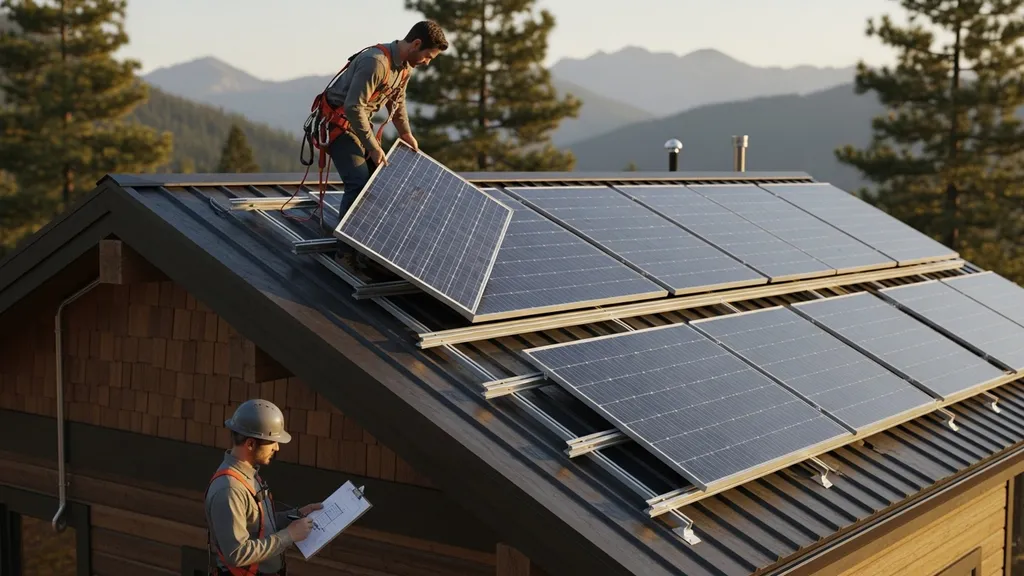
A practical, step-by-step guide to sizing a 10kW solar system for a cabin — panels, batteries, inverters, production estimates, and budgeting.
10KW Solar System for Cabin: Complete Sizing Guide
A 10kW solar system for cabin planning starts with one core question: how much usable electricity will you actually need? This guide shows how to estimate cabin energy use, convert that need into panel and inverter specs, size a battery bank, and budget for a DIY or contracted install. Readers will get concrete examples (daily kWh math), panel count tables, battery sizing formulas, site-production estimates, and a compact checklist to take to an electrician or installer.
TL;DR:
- A 10kW solar system typically produces roughly 30–60 kWh/day depending on location; plan for 20–60 kWh/day as a design range for cabins.
- For a 10kW array you’ll need ~25–32 mid-size panels (330–400 W) after derate; pair with a 20–60 kWh usable battery bank depending on days of autonomy.
- Run a PVWatts or local solar resource model, build an appliance load list, and get at least one electrician quote before ordering major equipment.
Why Choose a 10KW Solar System for a Cabin?
A 10kW array sits near the high end for small cabins but can make sense for full-time off-grid use or cabins that run electric heating, laundry, a freezer, and well pumps. Research from national energy resources and homeowner guidance shows output varies widely by location, so think in daily kWh rather than only system kW when matching loads (see the Department of Energy's homeowner guidance for solar sizing for more context).
Common Cabin Energy Profiles a 10kw System Supports
- Weekender with modest appliances: 10–25 kWh/day — a 10kW system will be oversized unless you add storage or electric heating.
- Full-time small cabin with heat pump, fridge, freezer, water pump: 25–45 kWh/day — a 10kW array is a common choice to meet peak months and recharge batteries.
- Electrified cabin with laundry and backup electric cooking: 40–60 kWh/day — 10kW can handle daytime loads and recharge batteries on sunny days but expect larger battery and generator backup in long cloudy stretches.
When 10kw is Overkill — Matching System Size to Use
- If your typical use is 5–15 kWh/day (lights, fridge, phone), a 2–3kW system often covers needs with much smaller battery requirements. For comparisons, see the 2kW cabin sizing guide and the 3kW tiny-house example.
- If space or roof load is tight, downsizing to 7kW may reduce cost and simplify installation — compare with the 7kW shed comparison.
Key points:
- Convert your expected daily kWh into array production targets.
- Match the system to heating type: heat pumps lower energy per degree vs resistive electric heat.
- Plan battery capacity for the number of days you want to run without sun.
Estimating Your Cabin's Energy Use for 10KW System Sizing
Start by building a simple appliance load list and convert watts × hours into daily kWh. Use conservative run-times for motors (pump, compressor) and realistic hours for HVAC.
How to Build a Simple Appliance Load List
- Make a table with Appliance | Rated Watts | Hours per Day.
- Multiply Watts × Hours, divide by 1,000 to get daily kWh.
- Sum all appliances to get daily kWh.
Example load list (typical full-time small cabin):
- LED lights: 10 fixtures × 10 W each × 4 hours = 0.4 kWh/day
- Refrigerator (efficient compressor): 150 W average × 24 hours × duty cycle 0.35 = 1.26 kWh/day
- Mini-split heat pump (heating season): 1,200 W average × 6 hours = 7.2 kWh/day
- Freezer: 120 W × 24 × 0.4 = 1.15 kWh/day
- Water pump (well): 500 W × 0.5 hours = 0.25 kWh/day
- Microwave/oven/laundry occasional use: estimate 4–8 kWh/day when used
Sum = ~14–20 kWh/day baseline; add heating and laundry spikes seasonally to reach 25–45 kWh/day in many full-time cabins.
Adjusting for Seasonal and Occupancy Variation
- Scale the daily kWh by occupancy: two occupants working remotely will use more than weekend guests.
- Factor heating: resistive heat multiplies winter kWh; a heat pump cuts that load by 2–4× in favourable conditions.
- Use a seasonal multiplier: multiply baseline by 1.2–2.5 depending on winter heating method.
For broader methods and examples, consult the cabin system sizing overview.
Translating Daily Kwh Into Panel Output Requirements
- Determine desired usable kWh/day (site loads + inverter losses).
- Divide by expected array production per kW for your location. Use tools like PVWatts for site-specific estimates, or use rough averages: 3–6 kWh/kW/day depending on latitude and climate.
- Example: If you need 30 kWh/day and site average is 4 kWh/kW/day, required array = 30 / 4 = 7.5 kW. A 10kW array provides headroom for losses and winter months.
Government guidance on sizing and solar resource estimation can help — see Australia's energy department guidance on system sizing for concepts and checklists.
Calculating Panels and Inverter Size for a 10KW Cabin System
This section shows panel-count math with typical panel wattages and discusses derate factors and inverter sizing considerations. Use the example numbers below for an initial BOM and then refine with an installer and site model.
Panel Wattage, Panel Count, and Realistic Output
- Target nominal DC: 10 kW (10,000 W) PV.
- Typical panels: 320 W, 350 W, 400 W. Panel counts vary:
| Panel wattage | Panels to reach ~10 kW (nominal) | Roof area estimate (sq ft) |
|---|---|---|
| 320 W | 32 panels (32 × 320 = 10,240 W) | ~480–640 sq ft |
| 350 W | 29 panels (29 × 350 = 10,150 W) | ~435–580 sq ft |
| 400 W | 25 panels (25 × 400 = 10,000 W) | ~375–500 sq ft |
Area depends on panel dimensions and spacing. High-efficiency modules reduce area but cost more per watt.
Include realistic system losses (shading, soiling, temperature) — apply a derate factor of 0.75–0.85 to nominal DC when estimating AC production. For example, a 10 kW nominal array at 0.8 derate produces like an 8 kW effective system for daily kWh calculations.
System Losses and Derate Factors to Include
- Soiling and dust: 2–5% annually
- Temperature loss (hot climates): 5–12%
- Shading: 0–30% depending on trees and roof obstructions
- Wiring and inverter losses: 3–5%
Use conservative derates for off-grid cabins in wooded sites. For final production numbers, run PVWatts or a shade-modeling tool.
Choosing a Central vs String Inverter for Cabins
- String inverter: Lower cost, works well if panels see similar sun. Good for simple roof arrays and grid-tied cabins.
- Microinverters or power optimizers: Improve performance if shading or varied orientations; costlier per watt.
- Central inverter (for larger arrays): Efficient and economical at scale; for cabins, string inverters with an inverter/charger function are common when batteries are present.
If using batteries and off-grid or hybrid setups, select an inverter-charger that can handle continuous AC loads and expected surge loads (motors). Size the inverter to handle peak motor starts — e.g., a 5 kW continuous inverter with 10 kW surge might be required for certain appliances. When pairing PV to batteries, also confirm MPPT charge controller current ratings and voltage compatibility; see the panel-to-battery matching guide for technical background.
For product examples and engineering guides to 10kW systems, see an industry overview of 10kW engineering and panel count options.
Sizing the Battery Bank for a 10KW Cabin Setup
Battery sizing starts with usable kWh needs, days of autonomy, and battery chemistry choices. Use the following formula and examples.
How Many Kwh of Battery Storage Do You Need?
- Choose daily usable load (kWh/day).
- Choose days of autonomy (1–3 days typical for cabins).
- Adjust for system losses: inverter efficiency (~90–95%), battery round-trip (~85–95% depending on chemistry).
- Calculate nominal battery capacity: Usable required / (DoD × battery efficiency × inverter efficiency).
Example: 30 kWh/day need, 2 days autonomy = 60 kWh usable. Using LiFePO4 with 90% usable DoD and 95% round-trip:
- Nominal battery = 60 / (0.90 × 0.95) ≈ 70 kWh nominal.
If using lead-acid with 50% DoD, nominal battery doubles to maintain usable kWh, increasing weight and cost.
Battery Chemistry and Depth-of-discharge Considerations
- Lead-acid (AGM, flooded): Lower upfront cost, recommended DoD ~40–50%, shorter cycle life, more maintenance.
- LiFePO4: Higher upfront cost, DoD 80–95% usable, longer cycle life, lighter, higher usable energy per nominal kWh.
- Other lithium chemistries: Check thermal and BMS characteristics.
Industry sources and product specifications show LiFePO4 often provides lower lifecycle cost for frequent cycling. Also check battery BMS features, recommended C-rate for charge/discharge, and warranty cycle ratings.
Practical Battery Bank Examples for Cabins
- Weekend cabin (10 kWh/day, 1 day autonomy): 12–15 kWh usable battery bank (e.g., 15 kWh LiFePO4 nominal).
- Full-time cabin (25 kWh/day, 1–2 days autonomy): 30–50 kWh usable (e.g., 40 kWh LiFePO4 nominal).
- Electrified cabin with laundry and backup (40 kWh/day, 2 days autonomy): 80 kWh usable (e.g., 90–100 kWh nominal LiFePO4).
For maintenance and troubleshooting guidance, consult the DIY solar battery troubleshooting page before committing to a chemistry.
Note: Avoid wiring or configuration details that could be hazardous. Consult a licensed electrician for final battery bank wiring and interconnection.
Installation Layout, Wiring, and Safety for a 10KW Cabin System
A clear high-level single-line makes communication with an electrician simple: panels → combiner → PV disconnect → MPPT/charge controller or inverter → battery bank (if off-grid) → AC distribution and loads → optional generator for backup.
Sample Single-line Layout: Panels → Combiner → Mppt/inverter → Battery → Loads
- PV strings wired to a combiner box with string fuses.
- From combiner to PV disconnect and PV input of inverter/charger.
- Battery bank connects to inverter/charger via DC disconnect and battery fuse.
- AC output of inverter feeds cabin subpanel and critical loads panel.
- Include generator auto-start and transfer switch if hybrid backup is used.
Common Safety Components: Fuses, Disconnects, Grounding, and PV Rapid Shutdown
- DC fuses or breakers on strings to protect against overcurrent.
- PV-rated DC disconnect at array and AC-rated disconnect at the inverter output for service isolation.
- System grounding and equipment bonding per NEC (or local code) and installer practice.
- Rapid shutdown compliant with local code for rooftop arrays where required.
- Arc-fault protection, surge protection devices (SPDs), and appropriate conduit/breaker ratings.
For wiring practices and grid interconnection differences, see the off-grid vs grid-tied electrical options article. For troubleshooting after install, reference the solar troubleshooting guide.
This DIY video shows you the hands-on process:
Permitting, inspections, and working with an electrician:
- Most jurisdictions require permits and final inspection for systems over small sizes. Electrical code (NEC in the U.S.) sets rules for disconnects, conductor sizing, and grounding.
- Hire a licensed electrician for AC interconnection or any work on the building electrical system. DIY installation is common for mounting and DC wiring on remote properties, but AC tie-in and municipal inspection usually require a professional.
Site Assessment and Expected Annual Production for a 10KW Cabin Array
Use a solar resource model and an on-site survey to convert nominal 10 kW into realistic annual and seasonal production.
Using Solar Resource Tools (pvwatts and Map Lookup)
- Run PVWatts (NREL) or similar regional tools to estimate annual kWh/kW. Input tilt, azimuth, shading, and system derate.
- PVWatts gives month-by-month estimates; use that to size battery and generator backup.
- A rough rule: southern latitudes may yield 4.5–6 kWh/kW/day; northern mountain locations may be 3–4.5 kWh/kW/day.
Tilt, Orientation, and Shading — How They Change Production
- Tilt close to latitude yields good year-round production; steeper tilt helps winter months.
- Azimuth: true south (Northern Hemisphere) optimizes total production. 20–30° west or east reduces some output but can be beneficial for afternoon or morning loads.
- Shading: even minor shade on one panel can reduce a string's output significantly. Use loss percentages: light shading 5–10%, moderate 10–20%, heavy >20%.
A focused site survey and shade analysis will show whether microinverters or optimizers are needed to mitigate partial shading.
Climate Examples: Coastal, Mountain, and Inland Expectations
- Coastal temperate: moderate year-round sun, 3.5–5 kWh/kW/day.
- Mountain clear-sky sites: high clear-sky output but snow cover and angle losses; 4–6 kWh/kW/day in summer, lower in deep winter.
- Inland arid: high sun, 5–6 kWh/kW/day with higher temperature losses in summer.
For practical site-prep items and to evaluate shade and roof suitability, see the site selection checklist.
Cost Breakdown and Budgeting for a 10KW Cabin Solar System
Estimate costs by component category and compare DIY vs contractor scenarios. Presenting ranges avoids promising specific prices.
Component Cost Categories: Panels, Inverter, Battery, Balance of System
- Panels: price per watt varies with efficiency and brand.
- Inverter/inverter-charger: grid-tied string inverters, hybrid inverter-chargers for batteries, or inverter + separate charger.
- Battery bank: major cost driver — LiFePO4 banks are higher upfront but have longer life.
- Balance of system (racking, wiring, combiner, disconnects, monitoring): typically 10–20% of parts cost.
- Labor, permitting, and inspection: can be 20–40% of total installed cost when hiring contractors.
See the broader context of system cost by size in the solar power costs by house size guide and consider hybrid setups with the hybrid system cost breakdown.
Sample Budget Scenarios: DIY vs Hiring a Contractor
- DIY (parts-only, owner installs panels and wiring under inspection): significant savings on labor but still expect to pay for professional electrician for AC tie-in. Batteries and inverters are high-cost line items.
- Contractor install (turnkey): higher labor cost, includes warranty, permit management, and interconnection handling.
Provide realistic ranges locally by requesting quotes — prices vary by region, incentives, and labor rates.
Incentives, Tax Credits, and Payback Considerations
- Federal tax credits (e.g., U.S. ITC) and local incentives reduce upfront cost where applicable; confirm current programs and eligibility.
- Payback depends on how much of the produced electricity offsets billed grid usage or fuel for generators, and on usage patterns (high daytime loads shorten payback).
- Include maintenance and battery replacement costs in lifecycle analysis.
10KW vs Smaller Cabin Systems — a Practical Comparison
A simple comparison helps decide whether 10kW fits a particular cabin type.
| System size | Approx. midday production range | Typical use cases | Typical battery implications | Approx. panel footprint |
|---|---|---|---|---|
| 2 kW | 6–12 kWh/day | Weekend cabin, minimal loads | 6–12 kWh usable battery | 10–16 panels (small area) |
| 3 kW | 9–18 kWh/day | Tiny house, light full-time use | 12–20 kWh usable battery | Moderate roof area |
| 7 kW | 21–35 kWh/day | Full-time small cabin with heat pump | 20–50 kWh usable battery | Large roof area |
| 10 kW | 30–60 kWh/day | Electrified full-time cabin, laundry, freezer | 30–100 kWh usable battery | Largest area, up to ~640 sq ft |
Compare individual cases in-depth with the 2kW cabin sizing guide, 3kW tiny-house example, and the 7kW shed comparison.
When to scale up or down:
- Scale up if you plan electric space heating, frequent high-draw appliances, or long off-sun autonomy.
- Scale down if you can shift heavy loads to daytime or use propane/generators for intermittent high draws.
Footprint and roof-loading tradeoffs are key: consult structural guidance like advanced wall framing if you anticipate mounting heavy racking or want to reinforce roof structure.
Quick Sizing Checklist for Installing a 10KW Solar System on a Cabin
- Confirm average daily kWh and seasonal peaks using an appliance load list.
- Choose panel wattage and rough panel count based on available roof area and tilt.
- Decide battery days of autonomy and select battery chemistry that meets DoD and cycle needs.
- Select inverter/inverter-charger capacity sized for continuous and surge loads.
- Run PVWatts or equivalent site model to estimate monthly production and winter shortfall.
- Plan permits, disconnects, grounding, and PV rapid shutdown per local code.
- Get at least one electrician quote for AC interconnection and a second for full turnkey pricing.
Also confirm roof structural capacity and mounting method; see the earlier link to framing guidance for reinforcement options.
The Bottom Line
A 10kW solar system for cabin use provides substantial daytime production and the capacity to support full-time living with electric appliances when paired with a properly sized battery bank. Start by building an accurate load list, run PVWatts for site production, then size panels, inverter, and battery to match your daily kWh and desired days of autonomy. Get professional quotes for permitting and AC interconnection before buying major components.
Frequently Asked Questions
How many solar panels do I need for a 10kW system?
Panel count depends on module wattage. For typical mid-size modules: about 25 panels at 400 W, about 29 panels at 350 W, or about 32 panels at 320 W to reach roughly 10 kW nominal. Allow extra panels or capacity margin if shading or temperature losses are expected; use the panel wattage table above for quick planning.
Can a 10kW system run electric heating in a cabin?
It can, but whether it’s practical depends on heating type. A 10kW array paired with a large battery bank and efficient heat pump can support most daily heating loads in milder climates. Resistive electric heating dramatically increases daily kWh and often requires far more array and storage capacity, plus backup generation for extended cloudy periods. Consider a heat pump to reduce overall energy needs.
How big of a battery do I need for a 10kW cabin system?
Battery size follows usable daily load and days of autonomy. For 25–30 kWh/day, a 1–2 day autonomy recommendation implies 30–60 kWh usable battery; LiFePO4 nominal capacity will be somewhat higher depending on DoD and efficiency. Use the battery sizing formula in the battery section to calculate nominal capacity based on DoD and inverter losses.
Is a 10kW system too big for a weekend cabin?
Often yes. Weekend cabins with low daily loads (under 15 kWh/day) usually do not need 10 kW and can save money with 2–3 kW or 5–7 kW systems plus a small battery. However, if the weekend cabin includes high-draw appliances or you want fast battery charging and generator replacement, a larger array may be justified. Compare to smaller examples in the linked guides to decide.
Do I need permits to install a 10kW array on my cabin?
Most jurisdictions require permits and inspections for systems of this size. Electrical code requirements (for example, NEC provisions in the U.S.) dictate disconnects, grounding, and interconnection standards. Hire a licensed electrician for AC interconnection and to navigate permitting. Local building departments or your utility can confirm specific permit requirements.