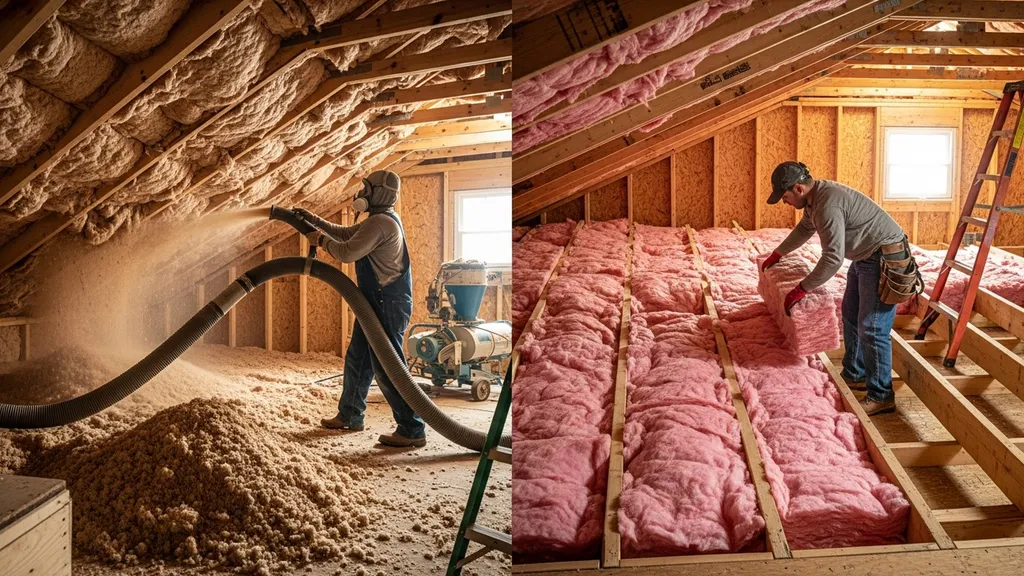
Practical, side-by-side comparison of cellulose and fiberglass insulation — performance, installation, durability, sustainability, and when to choose each.
Cellulose vs Fiberglass Insulation: Complete Comparison
Choosing between cellulose vs fiberglass insulation matters for every budget-conscious DIY builder. This article explains how the two materials differ in thermal performance (R-value), installation method (blown-in vs batts), air-sealing behavior, moisture response, fire and pest resistance, embodied carbon, and DIY difficulty—so you can pick the right product for an attic retrofit, wall cavities on a self-build, a tiny house, or an off-grid cabin.
For external source context, review Cellulose Vs Fiberglass Insulation: Complete 2025 Guide - SolarTech.
TL;DR:
- Cellulose typically delivers about 3.2–3.8 R/in and fills irregular cavities well; good for attic retrofits and dense-pack wall fills.
- Fiberglass batts are lower density (around 2.2–2.9 R/in) but stable and easy to buy; best for new stick-frame walls and DIY batt installs.
- For very cold climates or long-term performance, prioritize air sealing and continuous exterior insulation; consider hybrid assemblies (exterior CI + interior fill).
Cellulose vs Fiberglass Insulation: Complete Comparison — Quick Overview
Why This Comparison Matters for Budget DIY and Self-builds
Insulation choice affects comfort, heating bills, moisture risk, and embodied carbon. DIY and small-contractor projects often trade off upfront cost, labor time, and long-term performance. The decision between cellulose and fiberglass often comes down to cavity geometry (irregular vs standard stud bays), how much air-sealing you can do, and whether recycled-content or non-combustible materials matter more for your build.
Research from Oak Ridge National Laboratory shows real-world thermal performance depends on installation and air movement in the cavity, not just lab R-values (Thermal performance of fiberglass and cellulose attic insulations). Practical takeaway: both materials can perform well if installed correctly, but they behave differently when cavities have gaps or when moisture is present.
TL;DR paragraph recap: you'll get clear guidance on R-value ranges, settling risk and solutions, DIY vs pro installs, moisture behavior and drying potential, fire/pest treatments, and scenario-based recommendations for attics, walls, tiny houses, and cold-climate cabins.
At-a-glance Comparison Table — Cellulose vs Fiberglass
| Attribute | Cellulose | Fiberglass |
|---|---|---|
| Common forms | Loose-fill, dense-pack | Batts/rolls, loose-fill |
| Typical R-value per inch | 3.2–3.8 (varies by product) | 2.2–2.9 (varies by density) |
| Installation method | Blown-in; dense-pack for walls | Friction-fit batts in stud bays; blown loose-fill for attics |
| DIY difficulty | Moderate for attic blow; dense-pack usually pro | Easy for batt installs; take care cutting/fitting |
| Settling risk | Moderate for loose-fill; low if dense-packed | Minimal for batts; loose-fill may shift if not supported |
| Moisture behavior | Absorbs moisture but can dry if detailed | Does not absorb; wet fiberglass loses value and can hide mold |
| Fire/pest treatment | Borate-treated for fire and pests | Inorganic glass fibers, non-combustible |
| Recycled content | High (often >70% post-consumer paper) | Contains recycled glass; manufacturing energy varies |
| Typical use cases | Attic retrofits, irregular cavities, dense-pack walls | New construction stud bays, DIY batt installs, non-combustible needs |
Note: R-value ranges above are typical product ranges reported by industry and technical reviews; actual performance depends on density, installation quality, and convective air control. For attic R-targets and layering strategies, see our attic insulation guide. For a full product comparison that includes cost and claimed R-values, some industry guides summarize measured differences between these materials.
Cellulose Insulation — Overview, Strengths, Weaknesses, and Best Uses
What Cellulose is and How It's Made
Cellulose insulation is usually made from recycled newsprint and office paper, mechanically shredded and treated with borate or other salts for fire and pest resistance. Installed as loose-fill for attics or dense-pack for wall cavities, it's blown into spaces using a hopper and hose. Dense-pack installs compress the material to block airflow and reduce settling.
Strengths
- Fills irregular cavities and around obstructions better than standard batts, reducing voids and convective loops.
- High recycled content; often one of the lowest embodied-carbon insulation options by material weight.
- Good low-frequency sound absorption—useful in party walls or between living spaces.
- For attic retrofits, loose-fill cellulose can be added over existing insulation to increase R-value with minimal disturbance.
Weaknesses
- Loose-fill settling can reduce installed depth and effective R-value over many years unless installed at high density or topped up.
- Hygroscopic: cellulose can absorb moisture. It will often dry if assemblies are detailed for drying (air barrier, vapor control, capillary breaks), but wet cellulose can compact and reduce thermal performance.
- Dense-pack for walls typically requires a professional installer with the right equipment to avoid voids and bulging drywall.
Best-for: Practical Use Cases and Installation Types
- Attic retrofits where cavities are irregular and recycled content is a priority.
- Dense-pack wall fills in renovations where removing drywall isn’t practical (hire a pro).
- Projects seeking improved acoustics or where filling around plumbing, wiring, and odd framing is needed.
Fiberglass Insulation — Overview, Strengths, Weaknesses, and Best Uses
What Fiberglass is and Common Product Forms
Fiberglass insulation is made from spun glass fibers. It comes as batts and rolls sized to standard stud bays, and as blown loose-fill for attics. Manufacturers offer varying densities and facing (faced or unfaced vapor retarder options).
Strengths
- Widely available at retail and contractor supply stores; many DIYers can buy the correct batt sizes for 2x4 or 2x6 walls.
- Non-combustible glass fibers—useful where code or insurance favors inorganic materials.
- Stable over time: properly installed batts don’t settle the way loose-fill cellulose can.
- Lower inhalation irritation risk when wearing basic PPE vs older insulation fibers, though handling still requires care.
Weaknesses
- Performance drops sharply if compressed, bent, or cut poorly; tight fit and no gaps are required to approach rated R-value.
- Batts are less forgiving in irregular cavities and around obstructions; cutting and fitting increase labor.
- Handling can cause skin and respiratory irritation—use gloves, long sleeves, and a proper respirator.
Best-for: Practical Use Cases and Installation Types
- New stick-frame construction with consistent stud spacing and straight cavities.
- DIY enthusiasts installing batt insulation themselves in simple walls, floors, and attics.
- Projects that require non-combustible fill or where installers prefer a low-dust product.
See our comparison of mineral-wool alternatives in the rockwool vs fiberglass comparison if fire or moisture resistance is a priority.
Performance Head-to-head: Thermal, Moisture, Air-sealing, Fire, and Acoustics
Thermal Performance and Effective R-value Comparisons
Published lab values and product datasheets place cellulose in the ~3.2–3.8 R/in range and fiberglass in ~2.2–2.9 R/in, depending on density and product. Those numbers are useful for rough design, but effective R-value on a wall or attic also depends on cavity air movement, compression, and thermal bridging. For background on how to interpret rated R, see understanding R-value basics.
Cellulose's higher density and tendency to limit air movement in loose-fill form can reduce convective heat transfer, improving effective R in attic applications. Fiberglass batts rely on a tight fit and external air barriers to reach rated performance.
Air Infiltration and Integration with Air Barriers
Neither material stops air movement by itself. Air sealing must be done before installing insulation: seal penetrations, rim-joist gaps, and the attic plane. Cellulose can help plug small air channels because it nests around obstructions; dense-pack is effective at blocking airflow through cavities. Fiberglass batts require a separate air barrier (housewrap, taped sheathing, or interior membrane) to prevent convective losses.
For step-by-step air-seal techniques and required tools, consult our air-sealing tools and materials guide and the airtight membrane installation primer at airtight membrane installation.
Moisture Behavior, Drying Potential, and Mold Risk
Cellulose is hygroscopic and will absorb moisture; borate treatment resists mold and pests but does not stop water. If an assembly allows drying to a breathable side (vapor-open sheathing, capillary breaks, controlled interior humidity), cellulose can recover. In contrast, fiberglass does not absorb water, but wet fiberglass loses insulating effectiveness because water fills the air spaces; water trapped against organic materials or paper facings can support mold.
If your build has a history of dampness or high humidity (unvented crawlspaces, flood risk), consider moisture elimination first—see our fix damp crawl space guide.
Fire Behavior, Chemical Treatments, and Pest Resistance
Cellulose is treated with borate salts that provide flame retardancy and pest resistance. Fiberglass fibers are inorganic and non-combustible, though facings and installed details may introduce combustibles. For strict non-combustible requirements, fiberglass or mineral wool may be preferable.
Soundproofing and Durability Over Time
Cellulose usually outperforms fiberglass at low-frequency sound attenuation due to higher density. Over decades, dense-packed cellulose and properly installed fiberglass batts both retain performance if kept dry and undisturbed. Loose-fill cellulose should be monitored for settling; topping up or using dense-pack methods prevents long-term loss.
For climate-specific R-value decisions, check our "choose R-value for your build" article: choose R-value for your build.
Installation and Retrofit Considerations for DIY and Small Contractors
Tools, Materials, and Step-by-step Options for Attics and Walls
- Cellulose attic loose-fill: Rent a blower from a home center, load bags into the hopper, and work outward from the attic hatch. Wear a P100 respirator, goggles, and coveralls. For attics, maintain ventilation paths (baffles at eaves) and avoid covering recessed light housings unless rated for insulation contact.
- Dense-pack walls: Drill access holes in the top plate or exterior sheathing, use a specialized dense-pack nozzle and compressor; patch holes afterward. Often best handled by pros for uniform density.
- Fiberglass batts: Measure and cut batts to fit stud bays, avoid compression, and fill around wiring and boxes. Use unfaced batts with a separate interior vapor retarder where code requires.
For attic insulation quantities and layering strategies, review our attic insulation guide. For advice on sheathing and how insulation interacts with common boards, see OSB use cases.
DIY-friendly Installs vs Jobs That Need a Pro
- DIY-friendly: Installing fiberglass batts in simple stud bays, adding loose-fill cellulose to an accessible attic (with rental blower), and air-sealing accessible penetrations.
- Pro-recommended: Dense-pack wall fills, whole-house blowers for large jobs, attic encapsulation with complex ventilation changes, and any situation with suspected moisture pathology.
Health, Safety, and Cleanup Tips
- Wear a P100 respirator when installing cellulose and at least an N95 (P100 preferred) for fiberglass during dusty work. Use gloves and long sleeves for fiberglass to avoid skin irritation.
- Control dust at the source: lightly mist cellulose during blowing if recommended by product instructions, and seal off HVAC intakes.
- Remove old insulation with care—mask, bag, and dispose according to local rules. See "reduce construction waste" suggestions in our reduce construction waste article.
Air-sealing and Vapor-control Coordination
Always complete major air-sealing before insulating. Place continuous air barrier or taped sheathing on the exterior or install an interior airtight membrane per our airtight membrane installation guide. Coordinate vapor control with climate: in cold climates, prioritize interior vapor control; in mixed or warm climates, allow assemblies to dry outward.
Watch this step-by-step guide on installing blown-in or loose fill insulation:
Cost, Lifecycle Carbon, and Sustainability Trade-offs
Embodied Carbon and Recycled Content Considerations
Cellulose typically uses a high percentage of post-consumer paper, which can result in lower embodied carbon per unit of installed R compared with some mineral wool and foam products. Fiberglass often contains recycled glass cullet but requires high-temperature melting during manufacture, which influences its upstream energy use. Lifecycle assessment (LCA) studies vary by region and manufacturing process; for deeper comparisons between spray foam and cellulose, see our spray foam vs cellulose guide and the overview piece at spray foam vs cellulose overview.
Waste, Disposal, and End-of-life Notes
Cellulose is biodegradable and treated for durability; disposal options are similar to general construction waste, but local recycling or compost restrictions apply. Fiberglass is inert but not biodegradable; recycling infrastructure exists in limited locations. Plan to reduce waste: salvage usable batt offcuts, reuse packaging, and follow the tips in reduce construction waste.
Upfront Cost vs Long-term Performance and Maintenance
Upfront costs vary by region, product, and the need for professional installation. Cellulose often has competitive installed cost for attic projects when including blower rental or contractor labor. Fiberglass batts have low retail price and are labour-friendly for DIY installs. Long-term, energy savings depend more on airtightness, continuous insulation strategy, and correct thickness than on the fill material alone. For very cold or off-grid projects, investing in continuous exterior insulation (rigid foam or wood-fiber CI) plus an interior fill (cellulose or fiberglass) generally reduces heat loss through thermal bridging more than choosing one fill material over another. For alternatives with low embodied carbon, see how to use cork for insulation and the broader sustainable materials guide.
Which Should You Choose? Scenario-based Recommendations
Attic Retrofit on Older House
Likely best: Cellulose loose-fill or a dense top-up. Cellulose fills irregular joist bays and tight spots around wiring and vents; it reduces convective losses if installed at recommended density. Combine with attic air sealing from the attic side before adding insulation—see our attic insulation guide.
New Stick-frame Walls in a Budget Self-build
Likely best: Fiberglass batts for speed and DIY simplicity. Batts sized to stud bays are fast to install and cheap at retail. If higher performance is needed, consider exterior continuous insulation plus interior fiberglass or cellulose.
Very Cold Climates or Off-grid Cabins
Likely best: Prioritize air sealing and continuous insulation first. Either fill can work if assemblies dry properly; cellulose offers slightly higher R/in and better cavity fill, but dense-pack wall installs by pros are often recommended. See our off-grid cabin insulation tips for climate-specific strategies and recommended R-values.
Tiny Houses, Sheds, and Compact Builds
Likely best: Choose the system that fits your frame and skill level. Fiberglass batts are straightforward for simple stud bays; cellulose can be used for attics or irregular shapes. For mobile tiny houses, consider closed-cell spray foam alternatives for moisture and air-seal benefits (see the spray-foam comparisons).
Soundproofing or Party-wall Situations
Likely best: Cellulose or mineral wool (see our rockwool comparison). Cellulose’s density and ability to fill voids makes it effective at reducing low-frequency transmission.
Hybrid approach tip: Exterior continuous insulation plus interior fill (cellulose or fiberglass) often outperforms a deep cavity fill alone by reducing thermal bridging through studs and improving whole-wall effective R.
The Bottom Line
Cellulose and fiberglass both work when installed correctly; cellulose typically gives higher R/in and better cavity fill, while fiberglass batts are simple and non-combustible. For most DIY attic retrofits choose cellulose for irregular cavities and recycled content; for standard new-construction stud bays choose fiberglass for speed and ease. Prioritize air sealing and continuous insulation for the biggest performance gains.
Frequently Asked Questions
Will cellulose settle and reduce R-value?
Generally, loose-fill cellulose can settle over time if installed at low density, which reduces depth and effective R-value. Dense-pack methods or installing to manufacturer-specified installed density reduce settling. Periodic inspection of attic depth and topping up loose-fill cellulose can restore design R-values.
Is fiberglass safer or healthier than cellulose?
Both materials have handling considerations. Fiberglass can irritate skin and lungs during install; wear gloves, long sleeves, and a NIOSH-rated respirator. Cellulose is dusty during blowing and also needs respiratory protection (P100 recommended). Cellulose is treated with borate for pest and mold resistance; borates have a long safety record in building materials when used per instructions.
Can I mix cellulose and fiberglass in the same assembly?
Yes—hybrid assemblies are common. For example, exterior continuous insulation with an interior cavity filled with cellulose or fiberglass combines the benefits of both materials. Avoid layering different loose fills directly on top of one another in a way that could trap moisture; keep clear drying paths and coordinate vapor control.
Which one is better for soundproofing?
Cellulose generally outperforms fiberglass at reducing low-frequency sound because of its density and ability to fill voids. Mineral wool (rockwool) is another strong sound-control option; compare it to fiberglass in our rockwool vs fiberglass comparison if acoustic performance is a priority.
Do either of these prevent air leaks?
Neither cellulose nor fiberglass is an air barrier by itself. Air sealing—sealing gaps, rim joists, and penetrations—must be done before insulation is added. Cellulose and dense-pack installations reduce airflow through cavities better than loose fiberglass, but a continuous air barrier (taped sheathing or interior membrane) is still required for best airtightness. See our air-sealing tools and materials guide for practical steps.