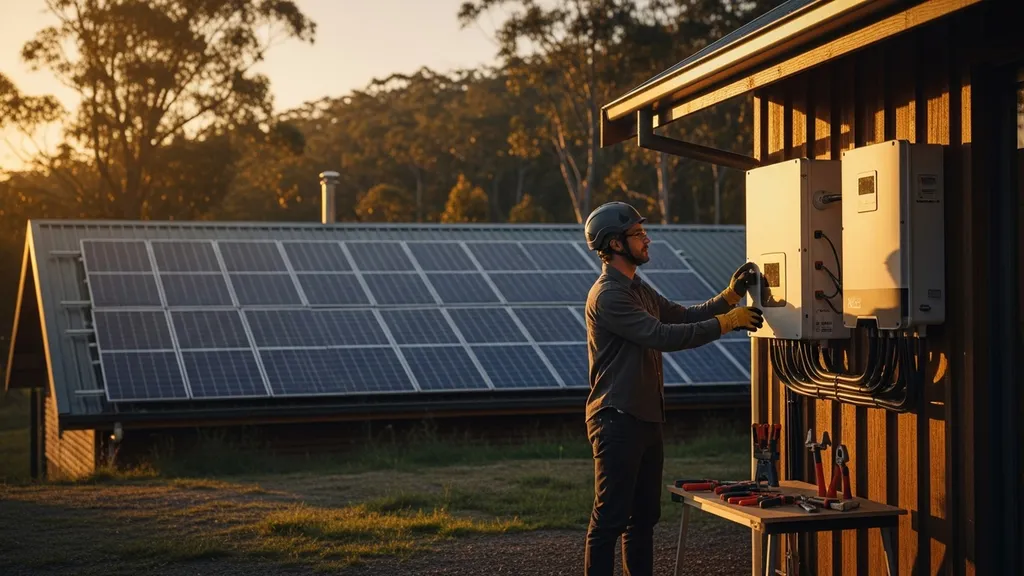
Step-by-step sizing guide for planning a 10kW off-grid solar system — calculate loads, battery size, inverter choice, wiring and costs.
10KW Solar System for Off Grid Home: Complete Sizing Guide
A 10kw solar system for off grid home is a practical choice for many rural self-builds: it typically delivers enough daytime generation to cover basic loads and charge a battery bank sized for 1–3 days of autonomy. This guide shows how to translate your appliance list into kWh, estimate 10kW solar production by location and tilt, pick batteries and inverters, size wiring and protection, and budget a full off-grid system so you can make an informed decision.
TL;DR:
- A 10kW array commonly produces about 30–50 kWh/day (varies with location); plan for 10–20% system losses.
- For 1–3 days autonomy expect a usable battery range of ~40–150 kWh; lithium batteries reduce required gross capacity due to higher DoD and efficiency.
- Pair a 10kW array with a 5–12 kW continuous inverter (1.5–2x surge) and MPPT charge controllers sized to the array current.
How a 10kw Solar System Performs for an Off-grid Home
A 10kW DC array is a mid-sized array for off-grid use. In strong sun regions it typically produces 40–50 kWh per day on average; in moderate sun regions expect 30–40 kWh/day. These numbers follow the same methodology used by NREL's PVWatts: array size × peak sun hours × system efficiency. Research on hybrid off-grid systems also shows wide variation depending on load profile and backup sources, so use these figures as planning averages rather than guarantees (Design and performance evaluation of an off-grid hybrid solar ...).
Account for losses: inverter inefficiency, battery round-trip loss, wiring, mismatch, and soiling typically reduce usable delivered AC energy by ~10–20%. So a 10 kW DC array that produces 45 kWh DC might yield 36–40 kWh AC to the home after losses.
Real-world Scenarios:
- Tiny home or well-insulated cabin: Daily load 8–15 kWh. A 10kW system is oversized but useful when combined with modest battery storage and heat pumped systems or EV charging on rare occasions.
- 2–3 person off-grid family home: Daily load 20–40 kWh. A 10kW array is a reasonable baseline paired with a 40–100 kWh usable battery.
- Small family (electrified cooking, electric heat, hot water, pump): Daily load 40–60+ kWh. A 10kW array is borderline; expect to supplement with fuel or a generator in winter or increase array/battery capacity.
Compare alternatives: a 5kW system is more suited to micro-homes and sheds; a 15kW system is recommended if your average daily kWh consistently exceeds 50. For a direct comparison see the 5kW sizing guide. For readers exploring a broader set of off-grid topics, visit the site’s solar off-grid hub.
Step 1 — Calculate Your Home's Daily Energy Needs for a 10kw System
Start with an itemized load sheet. Use wattage × hours = Wh, then convert to kWh/day. Categorize loads so you can prioritize critical loads for a critical-load subpanel.
Typical load categories:
- Basics: refrigerator, lighting, outlets, electronics
- Water and waste: well or booster pumps, pressure tanks
- HVAC: heat pumps, electric resistance heaters, fans
- Water heating and cooking: electric water heater, induction cooktop
- Specialty: EV charging, workshops, freezer, sump pumps
Peak demand vs average daily kWh: Average kWh sets battery and PV sizing; peak demand sets inverter and surge requirements. For instance, a fridge may use 1–2 kWh/day but have a 600–1000 W running load and a 1.5–2 kW startup surge. Pumps can draw 1–2 kW with 2–4× startup current.
Worked example — 2–3 person off-grid home (sample daily totals):
- Refrigerator: 1.8 kWh/day
- LED lighting and outlets: 3.0 kWh/day
- Well pump (30 minutes total): 3.0 kWh/day
- Hot water (heat pump or solar-preheated electric backup): 6.0 kWh/day
- Cooking (electric range occasional): 4.0 kWh/day
- Misc (washer, electronics, fans): 2.0 kWh/day
Total ≈ 19.8 kWh/day (~20 kWh/day). A 10kW array producing 35–45 kWh/day would cover this with room to charge batteries and handle cloudy days.
Tools and measurement:
- Build a simple spreadsheet or use apps to log device hours.
- Use clamp meters or smart plugs for measured wattage.
- Consult the Department of Energy's homeowner resources for estimating appliance energy use (Department of Energy's homeowner's guide to solar).
Design choices that reduce load: adopt a water-efficient plumbing strategy, low-flow fixtures and heat-pump water heaters. See the water-efficient plumbing guide and off-grid water systems for pump-sizing implications.
Step 2 — Estimate 10kw Solar Production: Site, Tilt, and Weather
A practical formula: estimated daily AC kWh ≈ array size (kW) × peak sun hours × system efficiency (≈0.8–0.9). For a 10 kW array:
- 3.5 sun-hours: 10 × 3.5 × 0.85 ≈ 30 kWh/day
- 4.5 sun-hours: 10 × 4.5 × 0.85 ≈ 38 kWh/day
- 5.5 sun-hours: 10 × 5.5 × 0.85 ≈ 47 kWh/day
Use tools: NREL PVWatts is the standard for US estimates and models tilt and orientation. The Australian government also provides guidance on sizing and expected yield (Size your solar system).
Factors that change production:
- Tilt and orientation: Aim for true south (northern hemisphere) tilt near your latitude for year-round performance, or optimize tilt for winter if heating loads peak then.
- Shading: Even partial shade on one string can reduce output significantly unless microinverters or optimizers are used.
- Temperature: High panel temperatures lower power; check panel temperature coefficient in spec sheets.
- Soiling and snow: Plan accessibility for cleaning and consider monocrystalline panels with higher performance in shaded or low-light conditions. For cost-performance tradeoffs, see our budget panel options.
Factor in seasonal swings: winter production may be 40–60% of summer in northern climates. Design for worst-case multi-day low-insolation stretches using battery autonomy or backup genset.
Key Sizing Numbers and Quick Reference for a 10kw Off-grid System
- Expected production: 30–50 kWh/day (site dependent).
- Typical system losses: 10–20% (inverter, wiring, battery round-trip).
- Battery usable kWh (1–3 days autonomy): roughly 40–150 kWh usable.
- Inverter continuous rating: 5–12 kW (size to peak continuous loads); surge rating: 1.5–2× continuous for motor starts.
- Charge controller: MPPT controllers sized to handle array current at your battery voltage.
- Example starting points: a 10kW array + 80 kWh usable battery + 8 kW inverter works for many 2–3 person homes.
Quick Checklist of Inputs to Finalize Design:
- Daily kWh and peak loads from your load sheet.
- Location peak sun hours and seasonal variations.
- Desired days of autonomy and backup strategy.
- Roof area or ground mount space and shading map.
- Budget for panels, batteries, inverter, racking, and BOS.
For detailed design steps pair this article with the designing an off-grid system.
Step 3 — Battery Storage: Sizing Batteries for a 10kw Off-grid System
Battery sizing formula:
- Required usable kWh = daily kWh × days of autonomy × safety factor (1.1–1.3).
- Nominal battery capacity = usable kWh ÷ allowable DoD.
Examples (for a 20 kWh/day home):
- 1 day autonomy: usable 20 × 1 × 1.15 = 23 kWh → Nominal at 80% DoD (Li-ion) ≈ 29 kWh.
- 2 days autonomy: usable 20 × 2 × 1.15 = 46 kWh → Nominal ≈ 58 kWh.
- 3 days autonomy: usable 20 × 3 × 1.15 = 69 kWh → Nominal ≈ 86 kWh.
Battery chemistry trade-offs:
- Lead-acid (flooded/AGM): lower capital cost, DoD 40–50%, cycle life lower, charging limited in cold, round-trip efficiency ~70–85%.
- Lithium iron phosphate (LiFePO4): higher upfront cost, usable DoD 80–95%, longer cycle life, better temperature performance, round-trip efficiency ~85–95%.
- Nickel-based and other chemistries are niche for off-grid.
Round-trip efficiency matters: if batteries are only 80% efficient, PV energy required increases by 25% to deliver the same usable kWh. That affects PV sizing. For broader context on combining energy sources and costs, see the hybrid systems cost guide.
Common battery bank sizes to pair with a 10kW array:
- Minimal: 40 kWh usable for energy-constrained homes.
- Typical: 60–100 kWh usable for full daily use plus 1–2 days autonomy.
- Larger: 100–150+ kWh usable for long-autonomy setups or high seasonal loads.
Bank voltage and modularity:
- Higher battery voltage (48V, 120V DC, etc.) reduces DC current and conductor sizes; 48V is common for residential off-grid systems.
- Design modularity: use identical, stackable battery modules to make expansion straightforward.
Temperature and enclosure: batteries need ventilated, protected locations with temperature control for long life—LiFePO4 performs better across temperatures than lead-acid.
Step 4 — Choosing Inverters and Charge Controllers for 10kw Systems
Inverter sizing strategy:
- Continuous rating should match sustained AC loads. For a home drawing 6 kW continuous, choose an inverter ≥6 kW.
- Surge capacity must cover motor starts: motors often require 2–4× running current. A fridge might need 1.5–2 kW surge; pumps can need 4×.
- Types: Off-grid (standalone) inverters, hybrid inverters (integrated battery inverter/charger), and inverter-chargers. Pure sine wave output is recommended for household electronics and motors.
Example inverter brands and types to consider: Victron Multiplus (hybrid inverter/charger), Schneider Conext, OutBack/Radian, SMA Sunny Island. Each has different parallel scaling and grid-interaction features—check vendor specs.
Charge controller sizing:
- MPPT controllers increase harvest under variable conditions and allow higher PV voltages.
- Calculate current: Array max power (W) ÷ battery voltage (V) ÷ controller efficiency ≈ required current. For a 10 kW array at 48 V, peak charge current ≈ 10,000 ÷ 48 ≈ 208 A, so multiple MPPT controllers in parallel or high-current models are typical.
- Pay attention to voltage limits: panel Voc vs controller max input.
AC vs DC Distribution and Critical-load Subpanels:
- Put essential circuits (fridge, well pump, communications) on a critical-load subpanel powered by battery-backed inverter output.
- Non-essential heavy loads can be isolated or managed by relay-based load shedding.
For common inverter faults and fixes, consult inverter troubleshooting tips.
System Layout, Wiring, and Safety for a 10kw Off-grid Install
A sound physical layout improves performance and serviceability. Key layout choices:
- Array layout and stringing: size strings to inverter/charge controller input limits. Avoid long series strings with shading. Use combiner boxes for multiple strings.
- Roof vs ground mounts: roof mounts use less land but may complicate wiring; ground mounts are easier to orient and clean.
- Combiner and disconnect placement: place combiner boxes near array or inverter to reduce long-run DC conductors where possible.
Protection and safety:
- Install DC disconnects, AC disconnects, fuses on each string per NEC requirements.
- Grounding: bond array frames to an equipment grounding conductor and ground electrode system.
- Lightning protection and surge arrestors are recommended in exposed sites.
Wiring guidance:
- Size conductors for ampacity and acceptable voltage drop; larger DC currents from battery systems favor 48V or higher nominal systems.
- Fuse each string at source and use appropriately rated combiners.
- Keep PV DC runs short where practical to minimize voltage drop and energy loss.
Comparison/specs table (example components):
| Component | Typical spec | Notes |
|---|---|---|
| Inverter (hybrid) | 5–12 kW continuous, 10–24 kW surge | Choose pure sine wave, parallelable if future expansion planned |
| MPPT charge controller | 60–200 A @ battery voltage | Use multiple controllers for >150 A |
| LiFePO4 battery module | 5–20 kWh, 48 V nominal, DoD 90% | Modular for scaling |
| Lead-acid battery bank | 10–20 kWh modules, 48 V, DoD 40–50% | Lower cost, more maintenance |
| Combiner box | 4–12 string inputs | Include fusing and surge protection |
Watch code: National Electrical Code (NEC) and NFPA standards govern PV installations in the U.S.; follow local interpretations and inspection requirements. If you need technical wiring guidance, see DC-to-AC wiring best practices.
For a visual demonstration, check out this video on complete hybrid solar inverter wiring installation:
Above video shows stringing, combiner placement, inverter and battery layout, and key disconnects—useful for visualizing the steps described here.
When to hire a professional: any work requiring grid tie or permitted electrical service should be done or at least inspected by a licensed electrician. Complex battery installations and PV systems with high DC voltages have significant shock and fire hazards.
Costs, Permits, and DIY vs Contractor Choices for a 10kw System
Rough parts-cost breakdown (ranges, subject to market change):
- Panels (16–20 × 400–600W): $4,000–$12,000 depending on panel price and efficiency.
- Racking and mounts: $500–$3,000.
- Inverter(s): $2,000–$8,000 depending on capacity and hybrid features.
- Battery bank: $5,000–$40,000 depending on chemistry and size (lead-acid cheaper, lithium pricier).
- Wiring, conduits, protection devices: $1,000–$4,000.
- Balance of system and misc: $500–$3,000.
Labor (if contracted): 10–30% of total equipment cost or more, depending on site complexity.
For sequencing and integration with foundation, water, and building systems see the start-to-finish build guide. Permit items commonly include electrical permits, roof penetrations, and structural mounting checks—see the permit checklist (California example) for typical inspection items.
DIY vs contractor:
- DIY strengths: save labor, learn system details, greater control over components.
- Contractor strengths: code compliance, warranty-backed installs, faster completion.
- Hybrid approach: hire an electrician for final connections and inspections; install mounting and panels yourself if comfortable.
Budget tips: buy panels in a single lot for volume discounts, plan cabling runs to minimize conductor lengths, and size batteries for modular expandability to spread capital costs over time.
Installation Checklist, Maintenance, and Scaling a 10kw Off-grid System
Pre-install Checklist:
- Site survey with sunpath and shading analysis.
- Finalized load sheet and required inverter surge/continuous sizing.
- Equipment list and compatibility check for battery voltage/inverter/MPPT.
- Permits pulled and inspection schedule arranged.
- Conduit and combiner box routing planned; reserve conduit capacity for future expansion.
Installation steps (high-level):
- Mount racking and secure roof penetrations or install ground mounts.
- Install panels and wire strings to combiner boxes.
- Run DC conduits to battery/inverter location; install batteries per manufacturer specs.
- Connect inverter, MPPT controllers, and AC distribution; label circuits and create a critical-load subpanel.
- Test system under load, verify disconnects and protection, and complete inspection.
Maintenance schedule:
- Monthly: Visual inspection for debris, shading, and loose hardware.
- Quarterly: Clean panels if soiled; check torque on rail and module fasteners.
- Biannually: Check battery voltages, electrolyte (if flooded), and connections.
- Annually: Full system test, inverter firmware updates, and professional inspection as needed.
Scaling and future expansion:
- Leave spare conduits from array to inverter and from inverter room to distribution for added conductors.
- Choose combiner boxes and breakers with spare spaces.
- Match battery module types for expansion; mixing chemistries or ages is not recommended.
- For adding panels to an existing system see adding solar considerations.
Also plan plumbing and pumps as part of pre-install—see cabin plumbing systems for pump load planning.
The Bottom Line: is a 10kw Solar System Right for Your Off-grid Home?
A 10kw solar system for off grid home suits many 2–3 person homes and well-equipped cabins when paired with a properly sized battery bank and inverter. If your average daily use is under ~25 kWh, a smaller system may save capital; if you regularly exceed ~50 kWh/day, plan to expand panels or battery capacity. Run the sample load calculations here, verify local solar resource, and consult licensed electricians or installers for final code compliance.
Frequently Asked Questions
How much energy will a 10kW solar array produce each day off-grid?
Typical production ranges from about 30 to 50 kWh per day depending on location, tilt, and seasonal variation. Use the simple formula: array size (10 kW) × peak sun hours × system efficiency (0.8–0.9) to estimate. For example, at 4.5 peak sun hours: 10 × 4.5 × 0.85 ≈ 38 kWh/day. For modeled estimates in the U.S., use NREL's PVWatts or similar tools for more precise site-specific numbers.
How many batteries do I need for a 10kW off-grid system?
Battery count depends on daily kWh and days of autonomy. Use the formula: usable kWh = daily kWh × days autonomy × safety factor. Convert usable kWh to nominal capacity by dividing by allowable depth of discharge (DoD). For example, for 20 kWh/day with 2 days autonomy and 90% DoD (LiFePO4): usable ≈ 46 kWh → nominal ≈ 51 kWh. Typical system banks for a 10kW array range from 40 to 150 kWh usable depending on needs.
Can a 10kW solar system run my electric heating or EV charger off-grid?
Short answer: it depends on load and battery capacity. Electric heating and EV charging are high-power, high-energy loads. A 10kW array can support limited EV charging or heat pump heating if battery storage and inverter capacity are adequate, but continuous electric resistance heating or full-rate EV charging will quickly exceed daily kWh and may require a larger array or generator backup. Consider load management, time-shifting charging to high-sun hours, or upgrading to 15kW+ for heavy loads.
What inverter size should I pair with a 10kW array?
Choose an inverter based on continuous home load and peak surge needs. Many designs pair a 10kW array with a 5–12 kW continuous inverter. If your home has high motor loads or simultaneous heavy appliances, select higher continuous capacity and ensure surge rating is 1.5–2× the continuous rating. Hybrid inverter/charger models (Victron, Schneider, OutBack) are common for off-grid systems and simplify battery charging and AC distribution.
Is it realistic to DIY a full 10kW off-grid installation?
DIY is realistic for competent builders who understand electrical work and local code, but there are real hazards: high DC voltages, battery risks, and permitting. A common approach is owner-led installation of racking and panels with a licensed electrician handling final AC and DC connections and inspections. For complex battery banks, battery room installations, or if local code requires licensed work, hire professionals to avoid safety and compliance problems.