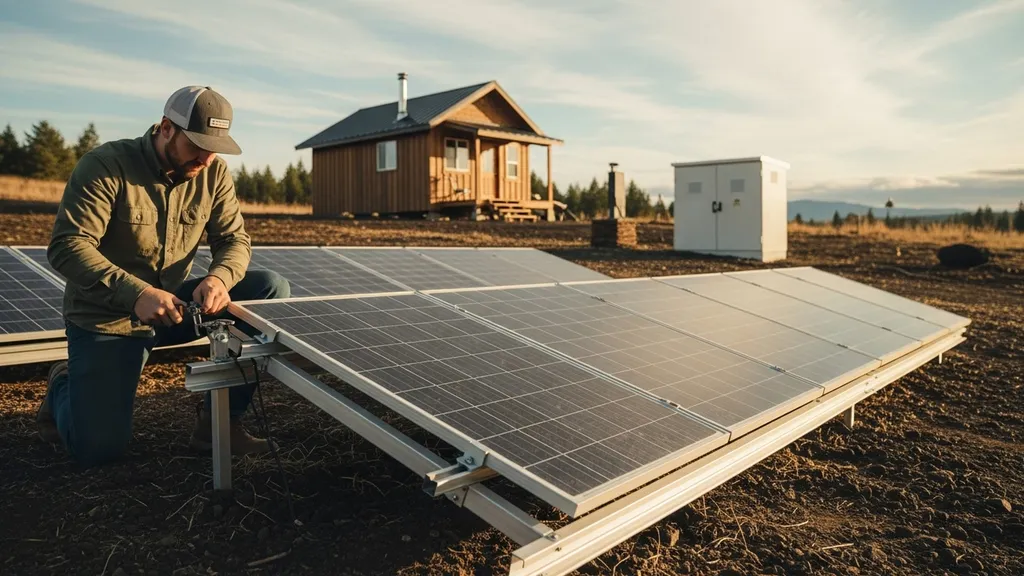
Step-by-step guide to sizing a 5kW off-grid solar system: panels, batteries, inverters, costs, and site considerations for DIY builders.
5KW Solar System for Off Grid Home: Complete Sizing Guide
A 5kw solar system for off grid home is a common choice for small to medium off‑grid dwellings. This guide explains what a 5 kW PV array will realistically deliver, how to size batteries and inverters, and practical trade‑offs DIY builders face when planning autonomy and seasonal shortfalls. Read on to learn daily and annual output estimates, a workbook-style sizing method, battery chemistry comparisons, wiring and mounting tips, and cost-saving measures that lower total system size.
TL;DR:
- A 5 kW array typically produces 12–22 kWh/day after derates (3.5–5.5 peak sun hours and 0.75–0.85 system derate).
- For a 16 kWh daily load, plan battery gross capacity of ~64 kWh for 2 days autonomy at 50% DoD; most DIYers use 1 day autonomy + generator or a smaller LiFePO4 bank.
- Prioritize load reduction (LEDs, efficient fridge, heat‑pump water heater) to shrink battery needs and make 5 kW practical in seasonal climates.
How Much Energy Will a 5kw Solar System Deliver for an Off-grid Home?
A nominal 5 kW PV array rating is a lab number; production in kWh depends on location and real‑world losses. A useful rule is: array nameplate (kW) × peak sun hours (PSH) × system derate = kWh/day.
Daily and Annual Kwh Estimates From a 5kw Array
- Example formula: 5.0 kW × PSH × 0.80 derate = usable kWh/day.
- Typical PSH values: cool northern sites ~3.5, temperate ~4.5, sunny arid ~5.5.
- Using 0.8 derate: 5 × 4.0 × 0.8 = 16 kWh/day; 5 × 5.5 × 0.8 = 22 kWh/day.
- Annual estimate: kWh/day × 365 (e.g., 16 × 365 ≈ 5,840 kWh/year).
Industry tools such as PVWatts and documents from the U.S. Department of Energy on PV system cost benchmarks provide irradiance data and derate guidance that matches these ranges.
Derating Factors: Real-world Losses to Expect
Derates include soiling, temperature, diode/wiring losses, mismatches, and inverter inefficiency. A practical overall derate range is 0.75–0.85. Components:
- Soiling and shading: 1–10% loss depending on cleaning schedule and trees.
- Temperature: hotter modules lose output; certain climates reduce winter gains.
- Wiring and mismatch: typically 2–5%.
- Inverter losses: 2–4% for modern inverters (AC coupling and converter steps add loss).
Example: Expected Output in Three Climate Zones
- Cool northern (3.5 PSH): 5 × 3.5 × 0.8 ≈ 14 kWh/day (≈ 5,110 kWh/yr)
- Temperate (4.5 PSH): 5 × 4.5 × 0.8 ≈ 18 kWh/day (≈ 6,570 kWh/yr)
- Sunny arid (5.5 PSH): 5 × 5.5 × 0.8 ≈ 22 kWh/day (≈ 8,030 kWh/yr)
Compare these outputs to household needs: a modern energy‑efficient off‑grid cabin for two might use 8–15 kWh/day (lights, fridge, small appliances), while a 3–4 person home with electric heating or heavy water heating will use much more. For scale comparisons, see the 3kW system reference.
Step-by-step Sizing Process for a 5kw Off-grid Home System (workbook Approach)
This section gives a reproducible workbook. Use a spreadsheet, or sketch on paper. The embedded video helps visualize wiring and layout.
Watch this step-by-step guide on sizing a solar system for your house! examples and calculations:
1) Calculate Your Real Daily Load in Kwh
- List appliances, rated wattage, and average run hours per day.
- Example: LED lighting 200 W × 5 hours = 1.0 kWh/day
- Refrigerator 150 W average runtime × 8 hours = 1.2 kWh/day
- Water pump 500 W × 0.5 hour = 0.25 kWh/day
- Sum all appliance kWh to get raw daily load.
- Adjust for inverter and battery inefficiencies: divide by round‑trip efficiency (e.g., 0.9 for Li, 0.8 for lead‑acid).
- For lighting help, use the lighting load calculator.
Worked example (2–3 person off‑grid cabin):
- Raw loads = 14.0 kWh/day
- System losses (inverter/battery) = 10% → Required production = 15.6 kWh/day
2) Translate Load to Required Solar Array Size
- Required array kW = required kWh/day / (PSH × derate)
- Example: 15.6 / (4.0 × 0.8) ≈ 4.9 kW → round to 5.0 kW
- If PSH is low or seasonal shortfalls matter, upsize array or accept generator support.
For stepwise guidance and small-scale examples, consult the tiny-house 1kW example and the shed system example.
3) Choose Battery Capacity for Autonomy and Depth of Discharge
- Decide days of autonomy (1–5 days). More days massively increase battery cost and weight.
- Battery gross kWh = daily load × autonomy days / usable DoD
- Example: For 1 day autonomy, 15.6 × 1 / 0.9 (Li at 90% usable) ≈ 17.3 kWh gross (Li). For lead‑acid at 50% usable: 15.6 / 0.5 ≈ 31.2 kWh gross.
- If two days autonomy with lead‑acid: 15.6 × 2 / 0.5 = 62.4 kWh — often impractical for small DIY budgets.
4) Size Inverter and Account for Surge Loads
- Inverter continuous rating ≥ peak continuous AC load (not just average).
- Allow surge capacity for motors (fridge, well pump). Rule of thumb: 1.5–2× continuous for short surges.
- Example: Continuous household peak 3.5 kW → choose 4–6 kW inverter with 8–10 kW surge.
- Consider inverter‑chargers if you plan generator integration and automatic transfer.
5) Choose a Charge Controller and Safety Devices
- MPPT controllers are standard for off‑grid systems; size by array voltage/current and battery voltage.
- For a 5 kW array at 48 V: maximum current ≈ 5,000 W / 48 V ≈ 104 A, so a 150 A MPPT or parallel MPPTs are typical.
- Include fuses, DC disconnects, AC breakers, ground fault protection, and a proper earthing rod system per local code.
- Industry guides like SunGoldPower's off‑grid system overview provide component checklists and configuration examples: best off-grid solar power systems guide.
Battery Bank Sizing and Options for a 5kw Off-grid Home
Batteries are the most weighty cost. Chemistry choice affects usable capacity, lifecycle, and system architecture.
Converting Kwh Needs to Battery Kwh and Ah
- Convert desired battery bank kWh to amp‑hours (Ah) at nominal battery voltage: Ah = (kWh × 1000) / V.
- Example: 20 kWh bank at 48 V → (20,000) / 48 ≈ 417 Ah.
Battery Chemistries Compared: Flooded Lead‑acid, AGM, Lithium (lifepo4)
| Chemistry | Usable DoD | Round‑trip efficiency | Typical cycle life | Notes |
|---|---|---|---|---|
| Flooded lead‑acid | 30–50% | ~75–85% | 500–1,200 cycles | Requires maintenance, ventilation, heavier |
| AGM | 40–50% | ~80% | 600–1,200 cycles | Sealed, less maintenance, higher cost than flooded |
| LiFePO4 | 80–95% | ~90–95% | 2,000–5,000+ cycles | Lighter, higher upfront cost, long life, allowed deeper DoD |
Sources such as academic system analyses illustrate performance differences and lifecycle trade‑offs; see applied studies like the off‑grid system case analyses at PubMed Central: design and performance analysis of an off‑grid system.
Autonomy Days, Depth of Discharge, and Round‑trip Efficiency
- Round‑trip efficiency (battery + inverter losses) adjusts required generation. Use conservative numbers: Li 0.9, lead‑acid 0.8.
- Example: Daily load 16 kWh, 2 days autonomy, 50% DoD (lead‑acid): 16 × 2 / 0.5 = 64 kWh gross. At Li 80% usable: 16 × 2 / 0.8 = 40 kWh gross.
- Many DIY builders compromise: 1 day battery + small generator or fuel‑powered backup for extended cloudy periods.
A compact technical primer on small system wiring and compact battery setups is available in the tiny-house electrical options.
Inverter and Charge Controller Selection for a 5kw Off-grid Home
Selection affects safety, compatibility, and how well the system handles real loads.
Sizing Inverter Continuous vs Surge — Real-world Appliance Examples
- Continuous inverter rating should equal or exceed full load expected at once. Typical surges:
- Fridge starting: 2–4× running watts for 0.5–2 seconds
- Well pump: 3–6× running watts
- Microwave/induction cooktop: high continuous draw (1–2+ kW)
- Example: If simultaneous peak use includes microwave (1.2 kW), fridge compressor (peak 1.0 kW), and lighting (0.5 kW), plan for at least 3.0 kW continuous and ~6 kW surge capacity.
Pure Sine Wave, Inverter Efficiency, and Inverter‑charger Combos
- Choose pure sine wave inverters for motors and sensitive electronics.
- Inverter efficiency matters: 92–96% typical for quality units. Lower efficiency increases battery draw.
- An inverter‑charger simplifies generator integration and automatic transfer switching.
MPPT Charge Controllers: Sizing and Placement
- MPPT vs PWM: MPPT is nearly always preferred for higher efficiency and larger arrays.
- Check controller input voltage limits (VOC cold temp) and current rating. For high array voltages use a single high‑voltage MPPT; otherwise parallel MPPTs.
- For troubleshooting and common fault fixes see our troubleshooting tips.
Follow local electrical code and manufacturer's wiring diagrams; undersized cables or wrong fusing are common DIY errors.
Solar Panel Configuration, Placement and Mounting for a 5kw Off-grid Array
Panel number, tilt, and layout influence daily harvest and seasonal performance.
Panel Count and Wattage Examples (300W–450W Panels)
- 5 kW configurations:
- 300 W panels → 17 panels (5,100 W nominal)
- 360 W panels → 14 panels (5,040 W nominal)
- 450 W panels → 11–12 panels (4,950–5,400 W nominal)
- Higher wattage panels reduce racking and combiner complexity but may cost more and be heavier.
Orientation, Tilt, Shading and String Sizing
- Orientation: true south (Northern Hemisphere) maximizes annual yield; small adjustments help seasonality.
- Tilt: set near latitude for year‑round balance; steepen for winter focus in high latitude.
- String design must respect inverter/MPPT input voltage and panel VOC at cold temperatures; include a margin for cold‑temperature VOC rise.
- Avoid shading on even one panel in a string; consider microinverters or power optimizers if partial shading exists.
Roof vs Ground‑mount and Racking Considerations
- Ground‑mounts allow optimal tilt and easier maintenance; roof mounts save space and can be cheaper if roof angle is suitable.
- In snow zones use steeper tilts or metal racks for snow shedding; design to resist wind uplift to local code standards.
- Panel certifications and warranty details matter for longevity—see the panel [certification guide]( /blog/solar-panel-certifications-explained) for testing standards and IEC/UL markings.
For configuration design tips and common pitfalls, consult system design resources such as Clean Energy Reviews: designing off-grid and hybrid solar systems.
Site, Climate and Hybrid Options That Change How You Size a 5kw Off-grid System
Site and climate may require either more array, more storage, or a hybrid backup.
How Solar Irradiance and Seasonality Change Array and Storage Sizing
- Low winter irradiance can make a 5 kW array insufficient during months with short days. Options:
- Oversize array to capture shoulder months.
- Add more batteries (expensive).
- Use a supplemental generator in winter.
- Use local PV irradiance maps or PVWatts to find PSH for each month and plan accordingly; this often reveals the need for a hybrid approach.
When to Add a Generator or Hybrid Energy Source
- Generators are common for long cloudy stretches or heavy heating loads. A small generator (3–6 kW) paired with an inverter‑charger reduces required battery bank size.
- Wind turbines can complement solar for windy sites—see the solar vs wind comparison and the hybrid cost analysis in the hybrid systems breakdown for trade‑offs.
Microclimate Issues: Trees, Snow, Dust and Temperature Effects
- Trees can cause seasonal shading — a remedy is pruning or relocating panels.
- Snow coverage reduces output; choose tilt and racking to encourage shedding.
- High dust or pollen regions require regular cleaning schedules.
- Cold increases panel Voc; verify cold‑temp VOC against controller specs.
For small cabin planning considerations, see small cabin planning and regional irradiance resources like PRETA Power's practical 5kW analysis: 5kW off-grid system guide.
Cost Breakdown, DIY vs Contractor Options, and Practical Cost-saving Tips for a 5kw Off-grid Home
Costs vary widely by location, labor, and choices in battery chemistry.
Typical Cost Components: Panels, Batteries, Inverter, BOS, Labor
- Cost share (typical percent ranges):
- Panels: 25–35%
- Batteries: 30–45% (chemistry dependent)
- Inverter/charger: 8–15%
- Balance of system (racking, wiring, combiner, MC4s, breakers): 8–15%
- Labor/permits/shipping: 8–20%
- The Department of Energy provides benchmarks to compare system cost trends: solar PV cost benchmarks.
DIY Assembly vs Professional Install: Permit and Inspection Notes
- DIY reduces labor cost but increases responsibility for code compliance and safe wiring.
- Common permit items: structural fastening for roof mounts, electrical permits for inverter disconnects, and local interconnection rules even for off‑grid in some jurisdictions.
- Consider at least a professional electrical inspection or consulting electrician for final tie‑ins and grounding.
Cost-saving and Efficiency Tips That Reduce System Size
- Replace incandescent and CFL lights with high‑efficiency LEDs.
- Choose an Energy Star rated fridge sized for off‑grid use.
- Use a heat‑pump water heater or a point‑of‑use tankless system to reduce standby and element losses.
- Add passive strategies: insulation, airtightness, and south‑facing glazing reduce heating demand and shrink battery needs.
For broader budgeting guidance, see our solar power cost guide and the full off‑grid build primer off-grid home guide. Small, targeted DIY devices—like a solar motion light—offer low‑cost benefits: solar motion light DIY.
Quick Sizing Checklist + Sample 5kw System Specs (comparison Table)
One-page Checklist for Field Use
- Do a load inventory: Convert appliances to kWh/day.
- Find PSH: Use local PV data or PVWatts.
- Decide autonomy days: 1 is common for cabins.
- Choose battery chemistry: Match budget and maintenance.
- Size inverter for continuous + surge: Add 1.5–2× surge headroom.
- Check MPPT and string voltage: Respect VOC at cold temps.
- Plan mounting and tilt: Roof vs ground mount trade‑offs.
- Confirm permits and inspections: Contact local AHJ early.
- Install monitoring: Energy monitoring helps tune usage—see energy monitor setup.
Two Sample System Builds: Conservative and Efficiency-first
| Build | Panel count (360 W) | Usable battery kWh | Inverter size | Typical use-case |
|---|---|---|---|---|
| Conservative | 14 (5.04 kW) | 40 kWh usable (mixed/AGM) | 6 kW with 10 kW surge | 3–4 person off‑grid home, some electric cooking, 2 days autonomy with limited generator |
| Efficiency‑first | 14 (5.04 kW) | 16 kWh usable (LiFePO4) | 5 kW pure sine inverter | 1–2 person energy‑efficient home, efficient appliances, load control enforced, generator backup |
Component Specs Table for Quick Shopping
| Component | Typical spec | Notes |
|---|---|---|
| Panels | 360 W, Voc 46 V, Isc 9.5 A | Check IEC/UL certification |
| Battery (LiFePO4) | 5 kWh module, 48 V | Stackable to desired kWh, high cycles |
| Inverter | 5–6 kW continuous, 48 V DC input | Pure sine, inverter‑charger preferred |
| MPPT | 150 A, 48 V | Use parallel MPPTs for redundancy if needed |
After installation, monitor and calibrate using a metering system; see our energy monitor setup.
The Bottom Line: is a 5kw System Right for Your Off-grid Home?
A 5 kW array is a practical starting point for energy‑efficient 1,000–1,500 ft² off‑grid homes when paired with disciplined load control and correctly sized batteries. Seasonal shortfalls and desired autonomy often force choices: add storage, add a generator, or increase array size. Run the workbook above with your actual loads and local PSH to decide whether to keep 5 kW, upscale, or plan a hybrid backup.
Frequently Asked Questions
Will a 5kW system run heating for my off-grid home?
Short answer: probably not for electric resistance or baseboard heating. Heating loads are large (several kWh per hour) and quickly exceed what a 5 kW array plus sensible battery bank can supply on cold, cloudy days. Heat pumps reduce consumption substantially, and with a highly insulated house a heat pump plus a 5 kW array might cover heating in milder climates. For long cold seasons, include supplemental heat (wood stove or generator) and design for efficiency first.
How many batteries do I need for a 5kW off-grid system?
That depends on daily kWh and desired autonomy. Example: a 16 kWh daily load with 1 day autonomy requires ~18–20 kWh usable (Li) or ~32 kWh usable (lead‑acid at 50% DoD). Practically, many DIY projects choose 10–20 kWh usable Li banks for cabins or 30–60 kWh lead‑acid banks for longer autonomy, or use a smaller bank plus generator backup.
What size inverter do I need for a 5kW array?
Select an inverter sized for your peak simultaneous load, not just the array rating. A 5 kW array commonly pairs with a 4–6 kW inverter for continuous loads and 8–12 kW surge capability for motor starts. If you expect heavy continuous loads (induction cooktop, electric dryer), choose a larger inverter and ensure battery and wiring can handle the current.
How often do batteries and panels need maintenance?
Panels require infrequent maintenance—cleaning once or twice a year in most climates and inspection for damage after storms. Flooded lead‑acid batteries need monthly checks and occasional water topping; AGM and LiFePO4 are low maintenance. Expect to replace lead‑acid in ~5–10 years and LiFePO4 in 10–20+ years depending on cycles and temperature conditions.
Do I need permits and inspections for an off-grid 5kW system?
Yes in many jurisdictions. Permits commonly cover structural mounting, electrical work, and safety disconnects. Even when off‑grid, local building and electrical codes may apply. Contact your local building department early in planning to confirm required permits and inspections and avoid costly rework.