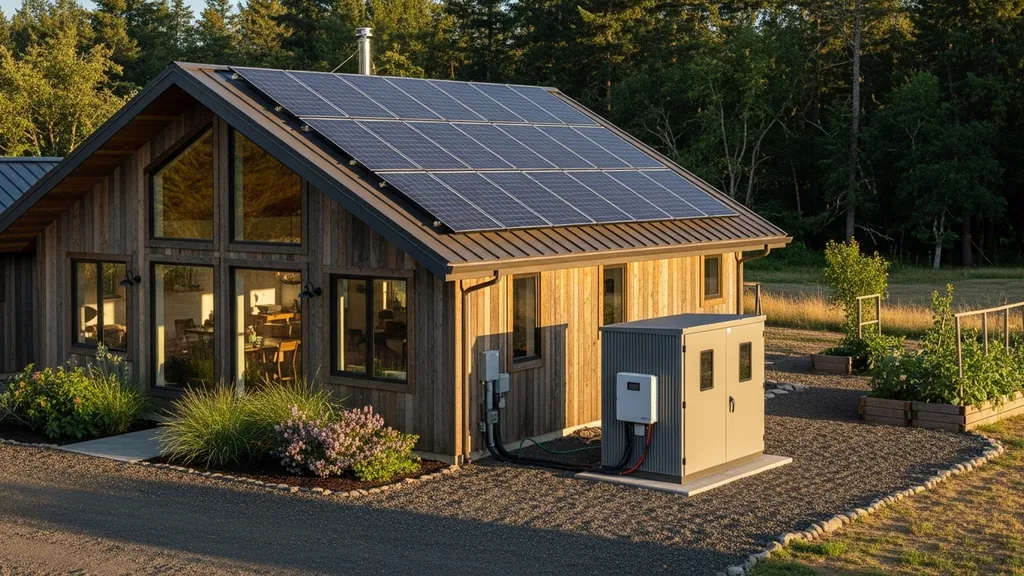
Step-by-step guide to sizing a 7kW off-grid solar system: panels, batteries, inverters, loads, costs, and real-world design scenarios.
7KW Solar System for Off Grid Home: Complete Sizing Guide
A 7kw solar system for off grid home is a realistic starting point for many small households, cabins, and workshops—but its real output depends on sun exposure, battery sizing, and how you use power. This guide shows how to translate a 7 kW nameplate into daily kWh, pick panel counts and roof area, size a battery bank and inverter, and match the system to real load profiles so DIY builders can make confident decisions.
TL;DR:
- A 7 kW array typically produces 21–42 kWh/day depending on 3–6 peak sun hours and 75–85% system efficiency.
- Battery bank sizing: pick target autonomy (1–3 days), then size usable kWh = daily kWh × autonomy ÷ round-trip efficiency; convert to Ah at 48 V for component selection.
- Use a 8–10 kW inverter for most small homes (account for surge), choose MPPT controllers sized to array current, and prioritize LiFePO4 for longer life if budget allows.
How Much Energy Will a 7KW Solar System Produce for an Off-grid Home?
A 7 kW solar array is a nameplate rating under ideal test conditions. To estimate real daily production, multiply 7 kW by local peak-sun-hours (PSH) and a system efficiency factor to account for losses.
Average Daily Kwh Output (sample Math)
- Formula: 7 kW × PSH × system efficiency
- Typical system efficiency (derating) range: 0.75–0.85 (covers inverter losses, temperature, wiring, soiling)
- Examples:
- Low insolation (3 PSH): 7 × 3 × 0.8 = 16.8 kWh/day
- Medium insolation (4.5 PSH): 7 × 4.5 × 0.8 = 25.2 kWh/day
- High insolation (6 PSH): 7 × 6 × 0.8 = 33.6 kWh/day
Real-world factors that reduce production
- Inverter inefficiency: 2–5% for modern inverters at nominal load.
- Temperature: Hot climates lower panel voltage and output; check temperature coefficient on datasheets.
- Soiling and snow: Accumulated dirt or snow can cut daily production by 5–20% until cleaned.
- Shading and orientation: Partial shade on a single string can reduce whole-string output; microinverters or optimizers mitigate this.
- Wiring and mismatch: Long runs and poor connectors add resistive losses.
Research and tools
- For better precision, use maps and models such as NREL PVWatts or local solar insolation tools. A 2021 research paper on off-grid solar performance provides measured load and production patterns useful for rural installs: Estimation of surplus energy in off-grid solar home systems.
Seasonality and expectation management
- Expect 25–40% lower daily kWh in winter months in mid-latitude climates; plan battery autonomy or backup gen accordingly.
- Peak production usually occurs in late spring to early summer; size batteries for worst-case week(s) unless you have a backup generator.
Sizing the 7kw Array: Panel Count, Roof Area, and Orientation
Panel wattage choices determine panel count, area, and mounting decisions. Here are typical configurations to reach ~7 kW:
| Panel wattage | Panels needed (approx) | Total nameplate (kW) | Estimated area (m²) |
|---|---|---|---|
| 300 W | 24 | 7.2 kW | 40–48 m² |
| 350 W | 20 | 7.0 kW | 34–42 m² |
| 400 W | 18 | 7.2 kW | 30–38 m² |
Area assumes 1.6–2.0 m² per panel plus spacing for mounting and maintenance. Allow extra area for string runs, snow slides, and panel access.
Estimated annual kWh (quick reference)
- Low insolation (3 PSH): ~17 kWh/day → ~6,200 kWh/year (system-dependent)
- Medium (4.5 PSH): ~25 kWh/day → ~9,100 kWh/year
- High (6 PSH): ~34 kWh/day → ~12,300 kWh/year
Roof vs ground mounting
- Roof mounts save land and use existing structure, but check roof orientation and structural capacity.
- Ground mounts allow optimal tilt and azimuth, easier cleaning, and better airflow (reduces temperature losses). Leave 0.5–1 m clearance for rooftop arrays, more for snow-prone areas.
- For snowy regions, increase tilt to shed snow and space rows to prevent mutual shading.
Orientation and tilt
- For daily off-grid reliability, favor true south (in northern hemisphere) at latitude tilt or slightly flatter to capture shoulder-season sun. East–west splits can reduce peak power and spread production across the day—useful if you want steadier generation for daytime loads.
- Bifacial panels can recover 5–15% extra energy on reflective surfaces or with proper ground albedo; they help on ground mounts and light-colored roofs.
Panel types and when to choose them
- Monocrystalline: High efficiency, best roof real-estate use.
- Bifacial: Consider for ground mounts and when rear-side gain is likely.
- Thin film: Lower efficiency and larger area; rarely recommended for 7 kW off-grid projects unless cost or shade behavior favors them.
Sizing comparisons for very small systems
- For context on how panels scale down, see a 1kW tiny-house option and a shed system sizing to understand area and mounting trade-offs at smaller scales.
- Cooling panels (improving airflow) can raise yield; practical tips are in the panel cooling tips guide.
Battery Storage: How Big Should the Bank Be for a 7kw Off-grid Setup?
Choose battery size based on daily load, target autonomy (how many days you can go without sun), and usable depth of discharge (DoD). Typical off-grid systems use 48 V battery banks.
Rule-of-thumb Sizing
- Decide target autonomy: 1–3 days is common for small homes (more for remote sites).
- Usable battery kWh = daily kWh × autonomy ÷ system round-trip efficiency
- Round-trip efficiency: 0.85–0.95 for Li-ion, 0.7–0.85 for lead-acid systems
Worked examples
- Example A — Low-use cabin:
- Daily load: 12 kWh/day
- Autonomy: 1 day
- Round-trip efficiency: 0.90
- Required usable capacity = 12 × 1 ÷ 0.90 = 13.3 kWh usable
- At 48 V: Ah = (13.3 kWh × 1000) ÷ 48 = 277 Ah usable
- If using LiFePO4 with 90% DoD usable, needed nominal Ah = 277 ÷ 0.90 ≈ 308 Ah → choose a 48 V, 300–400 Ah pack (~14–19 kWh nominal)
- Example B — Efficient family home:
- Daily load: 30 kWh/day
- Autonomy: 2 days
- Round-trip efficiency: 0.88
- Required usable capacity = 30 × 2 ÷ 0.88 = 68.2 kWh usable
- At 48 V: Ah = (68.2 ×1000) ÷ 48 ≈ 1421 Ah usable
- LiFePO4 at 90% DoD → nominal Ah ≈ 1580 Ah → ~75–80 kWh nominal bank
Conversion reminders
- kWh to Ah at 48 V: Ah = (kWh × 1000) ÷ 48
- Always size for nominal capacity > usable capacity to avoid deep discharges that shorten life.
Battery chemistry comparison
- LiFePO4:
- Usable DoD: 80–95%
- Cycle life: 2,000–5,000+ cycles depending on depth of discharge and temperature
- Maintenance: Low, no watering, built-in BMS recommended
- Cost: Higher upfront cost per kWh but lower lifecycle cost
- Lead-acid (flooded/AGM):
- Usable DoD: 30–50% (flooded typically 50% recommended)
- Cycle life: 300–1,000 cycles depending on use
- Maintenance: Flooded requires watering and ventilation; AGM is maintenance-free but has shorter life
- Cost: Lower upfront but higher replacement frequency
Safety and site considerations
- Batteries need ventilation, rated enclosures, and temperature-controlled locations to maximize life.
- For detailed troubleshooting and common failure modes, see the DIY troubleshooting guide: battery troubleshooting tips.
Watch this step-by-step guide on sizing your off grid battery bank capacity for solar - math warning!:
Inverters and Charge Controllers: Choosing Hardware for a 7kw Off-grid Home
The inverter and charge controller must match array output, battery voltage, and expected loads. Pick continuous and surge ratings to handle common motor starts and household spikes.
Inverter sizing: continuous vs surge
- Continuous rating: Choose an inverter rated at or above the house peak continuous load. For a small home, 6–8 kW continuous often suffices; a 8–10 kW inverter gives headroom.
- Surge rating: Motors (well pumps, refrigerators) can draw 3–8× starting current for brief periods. Ensure inverter surge rating covers those starts or use soft-start pumps/phase converters.
- Parallel inverters: If you expect loads above a single inverter rating, some systems parallel two or more inverters for redundancy and capacity.
Ac-coupled vs Dc-coupled and Hybrid Options
- AC-coupled systems place inverters between battery and AC loads, often easier for retrofits.
- DC-coupled systems feed panels into a charge controller that charges the battery directly; then an inverter exports AC to loads.
- Hybrid inverters combine MPPT charge control and inverter functions. They simplify wiring and allow later grid-tie conversion or generator integration.
- For a primer on coupling choices, review the AC/DC coupling overview.
Charge controller sizing and wiring
- MPPT charge controllers: Use MPPT controllers sized to the maximum PV string current and voltage. For 48 V battery banks, common controller ratings are 60 A, 80 A, 100 A, etc.
- Example: A 7 kW array at Vmp 48 V yields ~145 A max (7000 W / 48 V ≈ 145 A). Use multiple MPPTs or split strings to stay within controller ratings and manufacturer limits.
- Cable sizing: Use low-loss DC runs, oversized conductors where cost-effective, and follow NEC/IEC wiring standards for fusing and overcurrent protection.
Practical hardware choices
- Consider hybrid inverter models from well-known brands (e.g., Victron, SMA, Schneider, OutBack) for documentation and remote monitoring options.
- Review datasheets for continuous/surge curves and recommended MPPT string configurations. For wiring specifics and panel connections to hybrid inverters, see connecting panels to hybrid inverter.
Load Assessment: Matching a 7kw System to Your Home’s Actual Energy Use
Accurate load profiling is the foundation of a reliable off-grid design. Build an hourly profile to size battery kWh and inverter continuous rating.
Step-by-step load assessment
- List appliances, their rated wattage, and duty cycle (hours/day).
- Estimate realistic run times and motor starts (pump frequency).
- Build hourly totals to identify peak and average demand.
- Add margin (10–20%) for unknowns and inefficiencies.
Typical appliance loads (examples)
- Refrigerator: 100–300 W running, 600–1200 W start (cycling reduces average).
- Well pump: 800–2,500 W start, 300–1,200 W run depending on pump type and depth.
- Induction cooktop: 1,200–3,000 W per zone while in use.
- Electric heater: 1,500–4,500 W (heating dominates off-grid requirements).
- Lighting: LED fixtures 5–15 W each.
- EV charging: 3.3–11 kW typical home chargers—this can push a 7 kW system past comfortable limits.
Sample load sheets
- Tiny cabin: 12 kWh/day (LED lighting, small fridge, phone/laptop charging, occasional microwave)
- Efficient family house: 25–35 kWh/day (fridge, washer, heat pump water heater, moderate HVAC)
- Workshop: 20–40 kWh/day with intermittent heavy tools (compressors, welders)
Demand Reduction Strategies
- Choose efficient appliances—see our guide on energy efficient appliance choices.
- Shift heavy loads to daytime when the array is producing solar.
- Use propane or wood for cooking and primary heating to avoid large electrical heating loads.
- For pumps, consider lower-power DC or soft-start options—details are in solar water pump options.
- Improve building envelope via the air sealing guide to reduce heating/cooling needs and therefore required battery capacity.
In practice, reducing even 20% of daily kWh through efficiency and load shifting lowers battery and inverter costs significantly.
Design Scenarios: 4 Realistic Off-grid Homes That Fit a 7kw System
Below are four scenario templates showing when a 7 kW array is an appropriate fit and when upsizing or backup is recommended.
1) Tiny cabin / weekend retreat (low usage)
- Typical daily kWh: 10–15 kWh
- Array: 7 kW
- Battery bank: 15–20 kWh nominal (12–18 kWh usable)
- Inverter: 5 kW continuous, 10 kW surge
- Autonomy: 1 day
- Notes: 7 kW is generous for a weekend cabin; consider a smaller battery if visits are brief. See the tiny house 3kW case for lower-end comparisons.
2) Small energy-efficient family house (moderate usage)
- Typical daily kWh: 25–35 kWh
- Array: 7 kW (may need strict conservation and daytime shifting)
- Battery bank: 40–80 kWh nominal (depending on 1–2 day autonomy)
- Inverter: 8–10 kW continuous
- Autonomy: 1–2 days
- Notes: If electric heating or EV charging is expected, consider moving to a 10 kW system—see the 10kW cabin guide.
3) Homestead with well pump and refrigeration
- Typical daily kWh: 30–45 kWh
- Array: 7 kW (can work with careful load timing)
- Battery bank: 60–90 kWh nominal
- Inverter: 8–12 kW with high surge capacity
- Autonomy: 2 days recommended
- Notes: Pump starting loads and refrigeration cycling push inverter surge needs. Use efficient well pump options from off-grid water filtration and pump guides.
4) Workshop or mixed-use property with intermittent heavy loads
- Typical daily kWh: 20–50 kWh (varies by activity)
- Array: 7 kW (adequate for daytime workshop use; nights need larger battery)
- Battery bank: 30–80 kWh nominal depending on heavy-load timing
- Inverter: 10–15 kW if large tools run simultaneously
- Autonomy: 1–2 days
- Notes: For workshop-focused systems, compare to our workshop 7kW example.
Cost ballparks
- Panels and racking for 7 kW: $4,000–$9,000 (depending on panel price and installer)
- Batteries: $6,000–$30,000+ (LiFePO4 vs lead-acid, capacity)
- Inverter and controllers: $2,000–$8,000
- BOS (wiring, conduit, breakers): $1,000–$4,000
- These are rough ranges—see the hybrid systems cost breakdown for detailed budgeting.
When to upsize beyond 7 kW
- If you plan electric heating, frequent EV charging, or large motors, consider 10 kW or larger arrays. Also upsizing helps in rainy or high-latitude winter months.
Key Points: Quick Sizing Checklist for a 7kw Off-grid System
Essential Numbers to Confirm Before Buying:
- Average daily kWh (measure or tally appliances).
- Target autonomy days (1–3 typical).
- Panel count and roof/ground area required.
- Usable battery kWh and nominal bank voltage (48 V common).
- Inverter continuous rating and surge capacity.
- MPPT charge controller current limits and string configuration.
- Local permitting, interconnection rules (if hybrid), and inspection requirements.
Short on-site assessment checklist:
- Roof azimuth and tilt; shading at solar noon and throughout day.
- Available ground space for a ground-mount array.
- Ventilated, secure location for battery enclosure.
- Distance between panels and inverter/battery (affects wire size and cost).
- Expected motor loads and peak appliance starts.
Quick troubleshooting / red flags
- Underestimated heating load—electric heat will often require upsizing.
- Insufficient inverter surge capacity for well pumps or compressors.
- Battery bank shallow sizing that forces deep cycling—reduces life.
- For full build sequencing, equipment lists, and integration steps, consult the off-grid build checklist in the off-grid home start-to-finish guide and plan costs with the hybrid systems cost breakdown.
The Bottom Line
A 7 kW solar system for off grid home suits cabins, efficient small homes, and workshops when paired with appropriately sized batteries and an inverter sized for peak loads. Start with accurate daily kWh, choose battery autonomy to match risk tolerance, and prioritize efficient appliances and load shifting before upsizing array or battery capacity.
Frequently Asked Questions
Can a 7kW solar system run a whole house off-grid?
Yes—provided the house is energy-efficient and daily consumption stays within the array’s typical daily output (roughly 17–34 kWh/day depending on sun hours). Homes with electric heating, frequent EV charging, or heavy workshop tools will likely need larger arrays or a backup generator. Use a detailed load sheet to confirm whether a 7 kW array plus your chosen battery bank can meet your worst-case day demands.
How many batteries do I need for a 7kW system?
The number of battery modules depends on desired usable kWh, battery chemistry, and system voltage. Example: for 30 kWh/day and 2 days autonomy with LiFePO4 at 90% DoD and 88% round-trip efficiency, you’d need ~75–80 kWh nominal (about 4–6 typical 12–20 kWh battery cabinets depending on brand). Convert kWh to Ah at 48 V with Ah = (kWh × 1000) ÷ 48 to size packs and parallel strings accurately.
Do I need a generator with a 7kW off-grid setup?
A generator is recommended as a backup for extended cloudy periods or unexpected high-demand events unless you oversize battery autonomy. Portable or standby generators sized to charge the battery bank or directly run heavy loads provide resilience and can be sized smaller if you plan conservative load management.
What inverter size works best with a 7kW array?
Choose an inverter based on peak continuous household load and motor start needs. For most small homes, an 8–10 kW inverter with a high short-term surge rating handles typical loads. If multiple heavy appliances run together, consider a larger inverter or parallel units. Always check appliance start currents and include a safety margin.
How does seasonality affect a 7kW off-grid system?
Seasonality can reduce winter daily output by 25–40% in many climates due to shorter days and lower sun angles. Plan battery autonomy or backup generation for winter lows if you need year-round off-grid reliability. Use local insolation data or tools like NREL PVWatts to model monthly production and identify the worst months for capacity planning.