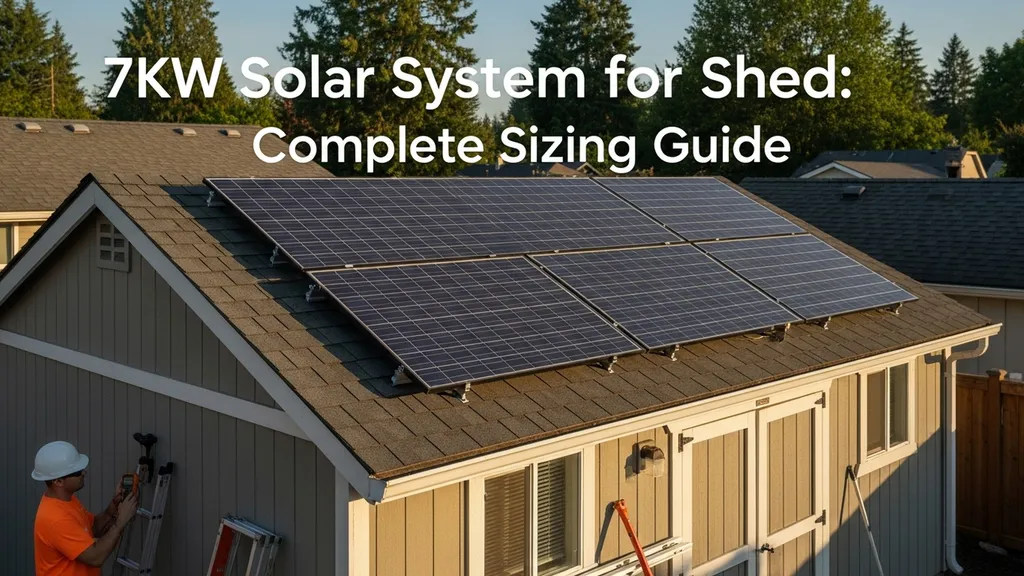
Step-by-step guide to sizing, component selection, costs, and permits for a 7kW solar system on a shed — practical for DIY and off-grid setups.
7KW Solar System for Shed: Complete Sizing Guide
A 7kw solar system for shed projects is large enough to run power tools, lighting, refrigeration, and short-term heating or a small heat pump — or to support partial off-grid capability for a tiny cabin or workshop. This guide explains how to match a 7 kW array to your shed: how much energy you can expect (roughly 20–35 kWh/day depending on sun), how to size panels, inverters and batteries, what the roof and framing must support, permit and interconnection steps, and a shopping checklist so a budget-conscious DIYer can plan next steps.
TL;DR:
- A 7 kW array typically produces about 20–35 kWh/day (PVWatts-style estimate) depending on location and orientation.
- For a DIY install use ~16–20 panels (350–440 W modules), a 6–8 kW inverter or microinverter bank, and 4–8 kWh battery for backup or 40–70 kWh for 2–3 days off-grid.
- Start by metering your loads, run a PVWatts estimate, check shed roof area/structure, and confirm local permit/interconnection rules before buying components.
How a 7KW Solar System Fits a Shed: Quick Overview
A 7 kW rooftop array is a mid-size residential array scaled to a small building. In direct-sun locations (5–6 peak sun hours/day) a 7 kW DC array will produce roughly 30–35 kWh/day. In moderate-sun regions (3–4 peak sun hours) expect closer to 20–25 kWh/day. These are PVWatts-style daily estimates useful for early planning.
Common shed scenarios:
- Workshop/Power Shed: Run stationary tools (table saw, drill press, dust collector) sequentially, LED lighting, and a small fridge. With conservative tool use this fits well as a grid-tied or hybrid system.
- Power shed (charging station): Supply EV/golf cart charging plus lighting and HVAC for a small cabin. Peak draws matter for inverter sizing.
- Tiny habitation/off-grid cabin: A 7 kW array can support modest living if paired with adequate batteries and a heat pump for efficient heating.
System type implications:
- Grid-tied: Lowest battery cost; you can rely on net metering or self-consumption. Utility interconnection steps apply.
- Hybrid: Add battery storage for outage backup and time-shifted usage; requires a hybrid inverter or AC/DC coupling.
- Fully off-grid: Requires significant battery capacity and possibly a generator or second renewables source for multi-day autonomy.
For a technical primer on deciding between grid-tied and off-grid setups, consult the differences between grid-tied and off-grid systems. The Department of Energy offers a homeowner-facing overview of considerations for residential PV sizing and incentives that helps orient planning and permits: the Department of Energy's Homeowner's Guide to Solar.
Step-by-step Sizing: Calculate a 7KW System for Your Shed
1) Inventorying Shed Loads (metered vs Estimated)
Start with a complete appliance and tool list. For each device, record:
- Rated watts (from nameplate)
- Typical run-hours per day
- Duty cycle (continuous or intermittent)
If you have a utility meter nearby or a clamp meter, measure real usage over a week for accuracy. For devices without easy measurement, use nameplate watts and conservative hours.
2) Example Load Worksheet and Sample Calculations
Example table (sample workshop):
| Appliance | Wattage | Hours/day | Daily kWh |
|---|---|---|---|
| Table saw (intermittent) | 2,000 | 0.5 | 1.0 |
| Drill press | 600 | 0.5 | 0.3 |
| Band saw | 1,200 | 0.5 | 0.6 |
| LED lighting | 200 | 6.0 | 1.2 |
| Mini fridge | 120 | 24 (cycle) | 1.0 |
| Misc outlets/chargers | 300 | 4.0 | 1.2 |
| Heater (short bursts) | 1,500 | 0.5 | 0.75 |
| Total estimated daily use | 6.05 kWh |
To convert array capacity to usable AC energy:
- Array kW × peak sun hours/day × system derate = AC kWh/day
- Example: 7 kW × 4.5 sun-hours × 0.80 derate ≈ 25.2 kWh/day
Derate accounts for inverter efficiency, soiling, wiring and temperature losses — typical overall factor 0.75–0.85. Add a design margin of 10–20% for future loads and unexpected losses.
3) Sizing for Seasonal Use, Peak Loads, and Safety Margins
- Peak inverter capacity must handle simultaneous loads. If the largest simultaneous draw is a 2 kW heater plus a 1.5 kW saw, ensure the inverter can supply ~3.5 kW continuous and handle surge currents.
- Seasonal differences: Winter insolation may be 30–60% lower in some locales. Plan battery autonomy or generator backup if winter use is critical.
- Safety margin: Size array to meet worst-month average if off-grid, or size for average production and rely on grid/incentives for deficits.
For scalable examples comparing smaller systems, see the 3kW shed guide and the 1kW tiny-house guide. If you build an energy monitor, follow the energy monitor calibration steps so your metering aligns with nameplate expectations and helps fine-tune battery sizing.
Solar Panels, Inverters and Wiring for a 7KW Shed System
Panel Count and Layout Examples for Shed Roofs
Most modern modules are 350–440 W. A 7 kW DC array needs approximately:
- 350 W modules → 20 modules
- 400 W modules → 18 modules
- 440 W modules → 16 modules
If roof area is tight, portrait mounting typically fits more modules on narrow rafter spacing; landscape may ease wiring and flashings. Consider roof obstructions (vents, chimneys) and shade from trees. If roof area or tilt is inadequate, a small ground-mount or pole mount is a practical alternative.
Inverter Options: String, Microinverter, or Hybrid Inverter
- String inverter: Lower cost for unshaded roofs. Choose inverter rated near or slightly below DC array size (e.g., 6–8 kW AC inverter for a 7 kW DC array) depending on clipping tolerance and local irradiance.
- Microinverters: One per panel (e.g., Enphase IQ series). Good for partial shading and simple panel-level monitoring; higher per-W cost.
- Hybrid inverter (AC- or DC-coupled): If you plan batteries, hybrid inverters from Victron, SMA Sunny Island or SolarEdge (with battery options) manage PV + battery + grid in a single package.
Industry guidance suggests checking inverter MPPT ranges against panel string VOC and operating voltages; the Australian energy office provides useful inverter and array matching guidance: Size your solar system | energy.gov.au.
Basic Wiring, Breakers, and Safety Components
- Strings: Keep each string within inverter input current limits and MPPT voltage window. Typical string size is 8–12 panels depending on module Voc and inverter limits.
- Overcurrent protection: Use DC array fuses or breakers per NEC and inverter maker guidance.
- Combiner box: Useful when multiple strings feed a single inverter; include DC disconnects and surge protection.
- AC side: Inverter output to AC disconnect and meter; ensure appropriately rated breakers for continuous current and startup surges.
- Grounding and rapid shutdown: NEC rapid shutdown rules apply for roof-mounted arrays. Use listed rapid shutdown devices when required.
If troubleshooting underperformance or inverter alarms, consult our solar troubleshooting tips for stepwise diagnostics. Also verify module certifications and listings before purchase with our panel certification guide.
This DIY video shows you the hands-on process:
Battery & Storage Options for a 7KW Shed (off-grid or Hybrid)
How to Size Battery Capacity for Daily Autonomy
Battery sizing formula: Required battery bank (kWh) = Daily usable kWh demand × days of autonomy ÷ (Depth of discharge × round-trip efficiency)
Example scenarios:
- Short backup: 4–8 kWh usable to power lights, fridge, and a few tools for a single evening. If using LFP with 90% DoD and 90% round-trip efficiency: required bank ≈ (6 kWh ÷ (0.9 × 0.9)) ≈ 7.4 kWh nominal.
- Full off-grid (2–3 days autonomy): For 25 kWh/day load, 2 days autonomy → 50 kWh usable. With LFP (80% DoD) and 90% efficiency, battery bank ≈ 50 ÷ (0.8 × 0.9) ≈ 69 kWh nominal.
Battery Chemistry Comparison: Lead-acid, Li‑ion, LFP
- Lead‑acid (flooded/AGM): Lower upfront cost per kWh but shallow recommended DoD (~50%), shorter cycle life (~300–800 cycles), and more maintenance.
- Lithium-ion (NMC) and LiFePO4 (LFP): Higher upfront cost but deeper DoD (80–95%), longer cycle life (LFP often 2,000–5,000 cycles), and higher round-trip efficiency (~88–95%). LFP is preferred for long-term DIY installs due to thermal stability.
- Practical trade-off: For frequent cycling and long life, LFP typically offers lower lifetime cost despite higher initial cost.
For practical battery sizing examples and an off-grid reference, see the 3kW off-grid example. If you consider adding wind or a second generation source to reduce battery bank size, review our solar vs wind comparison and the economics in the hybrid system costs overview.
Inverter‑charger and BMS Considerations
- AC-coupled systems: Easier retrofit — grid-tied inverter with battery-backed inverter/charger (e.g., Tesla Powerwall Gateway, SMA Sunny Boy Storage).
- DC-coupled systems: Higher round-trip efficiency when PV directly charges batteries through a DC charge controller, good for full off-grid design.
- BMS: Required for lithium banks; ensure the BMS supports the current and cell count. Select inverter/charger brands with compatible communication protocols (CAN, Modbus) for reliable system control.
Mounting and Structural Considerations for a 7KW Shed Installation
Assessing Roof Load and Rafter Capacity
Typical modern framed PV panels weigh ~40–50 lb (18–23 kg) each. For 16–20 modules a 7 kW array adds roughly 640–1,000 lb distributed across the roof. This is dead load; wind uplift forces are separate and require proper anchors.
Simple steps:
- Inspect rafter size and spacing. A 2x8 rafter at 16" o.c. spanning under 12–16 ft usually handles extra dead load, but older sheds or 2x6 rafters may need reinforcement.
- Add blocking or sister rafters where mounts will carry concentrated loads.
- If roof framing is marginal, consider a ground-mount or pole mount to avoid expensive roof upgrades.
Use a shed cost calculator to estimate strengthening costs or replacement. If you need to refresh framing, our how to build a shed guide covers basic roof framing details.
Orientation, Tilt, and Shading Analysis for Small Roofs
- Orientation: South-facing in the Northern Hemisphere maximizes annual yield; within ±30° of true south is acceptable.
- Tilt: For fixed mounts on a low-slope shed roof, follow local latitude ±10° as a rule of thumb; a steeper tilt increases winter yield.
- Shading: Even small shading on one panel in a string reduces string output. Microinverters or optimizer-based systems mitigate this.
- Uplift and fastening: Use flashings, rafter bolts or tile hooks rated to local wind loads. Follow manufacturer racking instructions and local code for anchor spacing.
If roof area or shading makes rooftop mounting impractical, a fenced ground array with tilt and more spacing is a strong option.
Cost Breakdown and Payback Estimates for a 7KW Shed System
Component Cost Ranges
Ballpark ranges (DIY vs professional):
- Panels: $0.25–$0.60/W (module retail price), so $1,750–$4,200 for 7 kW of modules.
- Inverter(s): $800–$4,000 depending on type (string inverter to microinverter system or hybrid inverter).
- Racking and hardware: $600–$1,500.
- Balance-of-system (wire, breakers, combiner, conduit): $400–$1,200.
- Batteries: Wide range — small backup batteries 4–10 kWh $2,000–$6,000; full off-grid banks (40–70 kWh) cost substantially more.
- Permits and inspection fees: $100–$1,000 depending on locality.
- Professional installation labor: $3,000–$8,000+ depending on complexity.
For broader context and per-kW comparisons, see the site’s solar cost breakdown.
Example Install Cost and Simple Payback
Example DIY-focused install (no battery):
- Panels: $3,000 (7 kW at $0.43/W)
- Inverter + racking + BOS: $2,500
- Misc and permits: $800
- Total DIY out-of-pocket ≈ $6,300
Example pro-installed (with battery backup 8 kWh usable):
- PV + inverter + racking + BOS + labor: $18,000
- Battery 8 kWh installed: $6,000–$10,000
- Total installed ≈ $24,000–$28,000
Simple payback depends on how much of the system’s output offsets billed electricity. Assume the system yields 25 kWh/day → ≈9,125 kWh/year. If each kWh is worth $0.15 avoided cost, annual value ≈ $1,369. With incentives such as the federal Investment Tax Credit (ITC) at current applicable rates, payback shortens. Check local rebates and net-metering rates to refine payback. Refer to the small cabin guide for comparable energy and cost examples.
Incentives, Rebates, and Tax Credits
Common incentives:
- Federal tax credits (e.g., ITC) — check current percentage and eligibility.
- State or municipal rebates, performance-based incentives, or sales tax exemptions.
- Net metering or time-of-use rates that influence value of exported energy.
Always check with your utility and local building office for current programs.
Permits, Interconnection and Safety for 7KW Shed Solar Systems
Typical Permit Checklist for Shed-mounted PV
- Site plan showing array layout and setbacks
- Electrical single-line diagram with inverter, AC disconnect, and meter location
- Structural attachment details and rafter notes
- Manufacturer spec sheets for modules, inverters, and racking
- Installer or owner information and permit application forms
Grid Interconnection, Net Metering and Disconnect Requirements
Most utilities require an interconnection application, an AC disconnect accessible to utility personnel, and sometimes a meter swap for bidirectional metering. Expect an application, paperwork, and an inspection — timelines vary from days to months. Rapid shutdown and labeling are commonly required for rooftop systems under NEC.
Electrical Safety Best Practices and Code References
- Follow NEC (National Electrical Code) requirements for PV systems (rapid shutdown, grounding, conductor sizing).
- Use UL‑listed inverters (UL 1741) and devices. Check module and inverter listings before purchase.
- Install required signage, array and breaker labeling, and lockable AC disconnects where required.
- For a field example of framing and permit notes for a power-focused shed, see the power shed framing update.
If you’re unsure about code compliance for grid interconnection, consult the AHJ (Authority Having Jurisdiction) or hire a licensed electrician for the final inspection and sign-off.
Shopping Checklist and Specs Table for a 7KW Solar System for a Shed
Quick Shopping Checklist: What to Buy for a DIY Install
- Panels: 16–20 modules (350–440 W each)
- Inverter(s): 6–8 kW string inverter or microinverters/optimizer set
- Racking: Rail or rail-less system sized to roof pitch and module dimensions
- DC combiner, DC disconnects, and AC disconnect
- Breakers for inverter output, AC distribution, and generation circuits
- PV-rated wire, conduit, and grounding equipment
- Batteries (if used): specify chemistry and usable kWh
- BMS and inverter communication cables (if lithium)
- Misc: flashing kits, fasteners, sealant, surge protection
- Permits and inspection fees
Comparison/specs Table: Panels, Inverters, and Battery Options
| Component | Example option | Typical rating | Notes |
|---|---|---|---|
| Panel A | 400 W mono PERC | 400 W, ~20% eff | 18 panels ≈ 7.2 kW |
| Panel B | 440 W high-eff | 440 W, ~21% eff | 16 panels ≈ 7.04 kW, good for small roofs |
| Inverter A | String inverter | 6–8 kW AC | Lower cost; best for unshaded roofs |
| Inverter B | Microinverters | 250–400 W per panel | Good for partial shade; panel-level monitoring |
| Battery A | LFP 10 kWh usable | 10 kWh usable | Deep DoD, high cycle life |
| Battery B | Lead-acid 10 kWh nominal | 5 kWh usable (@50% DoD) | Lower initial cost, more maintenance |
Buying Tips: Warranties, Certifications, and Vendor Selection
- Check module certifications (IEC, UL listings) and inverter UL 1741/IEEE 1547 compliance.
- Prefer panels with 10–12 year product warranty and 25-year performance warranty.
- Confirm inverter warranties and whether they are transferable.
- Buy from reputable vendors with clear RMA and support processes.
- For troubleshooting post-install, see our solar troubleshooting tips.
Key points:
- Confirm roof capacity before purchase.
- Match inverter MPPT ranges to panel strings.
- Buy batteries sized to your autonomy and DoD goals.
- Factor permits and interconnection costs into the budget.
The Bottom Line
A 7kw solar system for shed projects provides substantial on-site energy (roughly 20–35 kWh/day) and suits workshops, power sheds, and small off-grid cabins when paired with the right inverter and battery plan. Start by metering loads, checking roof area/structure, running a PVWatts-style estimate, and confirming permits; then select panels, inverter type, and battery size to match peak loads and autonomy goals.
Frequently Asked Questions
How many panels does a 7kW system need?
Depends on module wattage. With 350 W panels you need about 20 modules; with 400 W panels about 18; with 440 W panels about 16. Choose higher-watt modules when roof area is limited. Also check physical dimensions and shading before finalizing the count.
Can a shed roof handle a 7kW array?
Possibly, but it depends on rafter size, span, and existing loads. A 7 kW array adds roughly 640–1,000 lb of dead load across the roof plus wind uplift forces. Inspect rafters, spacing and connections; reinforce with sistered rafters or blocking if needed. If the roof is inadequate, use a ground-mount array instead. Use the shed cost calculator to estimate upgrade costs.
Do I need batteries if my shed is grid-tied?
No. Grid-tied systems work without batteries and are usually cheaper. Batteries add backup and outage resilience or can shift solar production to evening use. Consider a hybrid inverter if you may add storage later.
What's the real daily energy output of a 7kW system?
Typical ranges are about 20–35 kWh/day depending on location, tilt, orientation and shading. Use a PVWatts-style estimate for your latitude and expected peak sun hours to get a location-specific prediction. For federal and technical guidance see the Department of Energy's homeowner guide: Homeowners guide solar.
Is a 7kW system overkill for a small workshop?
Not necessarily. If you run multiple high-draw tools concurrently or plan to add HVAC or living loads, 7 kW gives headroom and reduces the need to size batteries for large draw events. For strictly light-duty hand tools and lighting, a smaller array might suffice; compare with our 3kW shed guide for scale examples.