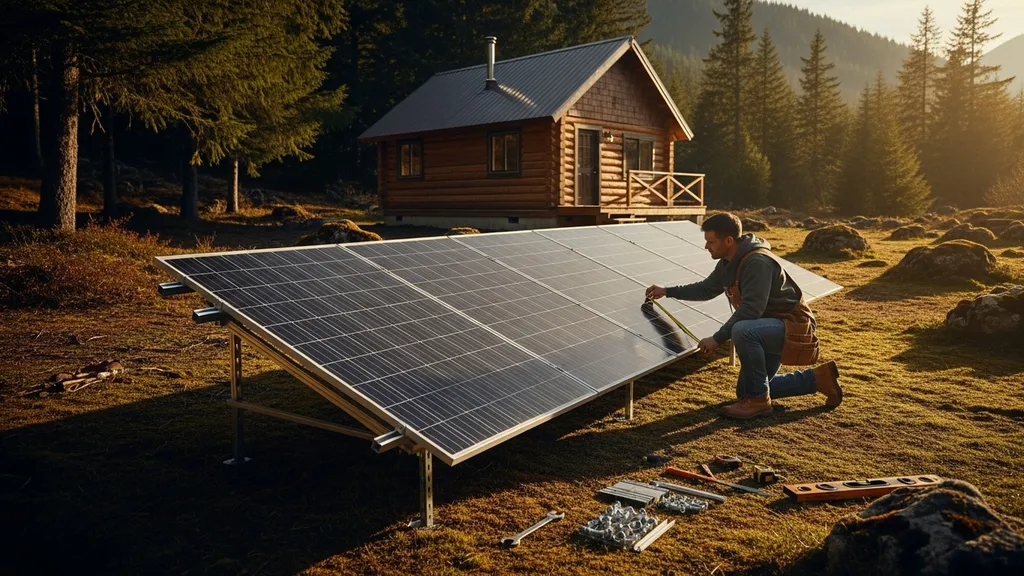
Step-by-step guide to sizing a 7kW solar system for a cabin: loads, panel count, batteries, production estimates, costs, and DIY tips.
7KW Solar System for Cabin: Complete Sizing Guide
A 7kw solar system for cabin can supply most small to mid-size cabins with daytime power and, when paired with batteries, reliable off-grid or hybrid backup. This guide shows step-by-step how to decide whether 7 kW is the right scale, how to calculate loads, how many panels and batteries you’ll need, expected annual production by climate, and practical DIY tips to keep costs down.
TL;DR:
- A 7 kW array typically produces ~6,000–10,500 kWh/year depending on location; expect ~15–30 kWh/day in many temperate sites.
- For 7 kW: plan ~18–24 panels (350–300 W range), roof area ~30–45 m², and battery capacity 10–30 kWh depending on days of autonomy.
- Start by measuring your average daily kWh, run location-specific PVWatts estimates, and decide whether a critical-load subpanel can cut battery costs.
How to Tell If a 7kw Solar System is Right for Your Cabin
A 7 kW solar array is peak DC capacity — not the same as energy produced over time. Typical cabin use cases that match a 7kW cabin solar system include:
- Seasonal weekend cabins with modest appliances: These often use 10–25 kWh/day if heating is propane or wood. A 7 kW array tilted correctly can comfortably cover weekend loads and top up batteries.
- Year-round tiny homes without electric heating: Expect 20–40 kWh/day depending on occupants and appliances; a 7 kW system sized with batteries or grid-tie can work.
- Off-grid homesteads with hybrid power strategies: Use solar for daytime loads and batteries plus a backup generator for extended cloudy stretches.
Research and modeling tools such as NREL PVWatts show that a 7 kW array often produces ~6,000–10,500 kWh/year depending on site tilt, azimuth, and insolation. That range translates to roughly 16–29 kWh/day averaged annually. Location, orientation, and whether you use electric heating are the biggest factors. If heating is electric, a 7 kW array may be insufficient without substantial battery storage or load reduction.
When 7kw is Overkill or Undersized
- Overkill: Small weekend-only cabins that use under 8–10 kWh/day may never see full array utilization; a 3 kW option can be cheaper and easier to mount — compare with our 3kW shed sizing guide.
- Undersized: Cabins relying on electric resistance heat or full electric hot-water tanks will likely need larger arrays and significant battery storage. Consider hybrid designs or supplementing with propane/wood heat.
Use occupancy, heating type, and whether you want multi-day autonomy to choose scale. For off-grid planning, review whole-project timing in our building an off-grid home start-to-finish guide.
Quick Sizing Checklist and Key Points for a 7kw Cabin System
Essential Data to Collect Before Sizing
- Daily energy use in kWh (meter reads or appliance inventory)
- Peak simultaneous load (largest motors, instant start loads)
- Solar resource at your site (hours of useful sun)
- Roof or ground space and unobstructed azimuth
- Budget and whether batteries are required
- Local permitting and interconnection rules
Santa Cruz County and other jurisdictions set minimum design criteria for off-grid systems including winter usage and minimum battery sizing; check local requirements early: see the off-grid solar design requirements in Santa Cruz CountySystemBatteryPermits/Off-GridSolarDesign.aspx)SystemBatteryPermits/Off-GridSolarDesign/Off-GridSolarRequirements.aspx).
Fast Checks to Decide Array vs Hybrid Options
- If daily use < 15 kWh and you only need daytime power, a grid-tied 7 kW is straightforward.
- If you need overnight or multi-day autonomy, plan batteries sized in kWh equal to daily use × days of autonomy × safety factor (1.1–1.25).
- If roof space is limited, consider higher-efficiency panels (see panel comparison below).
Key Points
- Collect at least two weeks of meter or monitored daily kWh before final designs.
- Use PVWatts (or an equivalent) for location-adjusted production estimates.
- Decide critical loads first to potentially reduce battery capacity needs.
- Consult a licensed electrician for final sizing of AC disconnects and breakers; permits are often required.
For a tiny-house comparison that shows how usage scales, see the 1kW tiny-house example.
Estimating Cabin Energy Use: Step-by-step Load Calculation for a 7kw System
Start with an appliance inventory and realistic use schedule. The Department of Energy's homeowner guide provides good background on what to consider when cataloging loads: see the Homeowner’s Guide to Solar from the U.S. Department of Energy.
Create an Appliance Inventory and Daily Use Schedule
- Fridge (small): 100–200 W running, ~2–6 kWh/day depending on efficiency and duty cycle.
- Freezer: 100–300 W running, ~1–6 kWh/day.
- LED lighting: 5–60 W total, ~0.1–2 kWh/day.
- Well pump (12V/AC): 500–1500 W peak, short duty cycles — 0.5–4 kWh/day.
- Mini-split heat pump: 600–1500 W running; seasonal energy varies widely — 5–20 kWh/day.
- Microwave: 900–1,200 W; short use, 0.2–1 kWh/day.
- Electric water heater: 1,500–4,500 W; big load — 3–10+ kWh/day if electric.
Example calculation — 2-person seasonal cabin (day use only)
- Fridge: 3 kWh/day
- LED lights and outlets: 2 kWh/day
- Microwave/coffee: 0.5 kWh/day
- Pump: 1 kWh/day
Total = 6.5 kWh/day → a 7 kW array will generate that easily in many locations.
Example calculation — Year-round tiny home (no electric heat)
- Fridge + freezer: 6 kWh/day
- Mini-split heating/cooling: 8 kWh/day average
- Water heating (tankless or on-demand reduces this): 3 kWh/day
- Lighting, outlets, electronics: 4 kWh/day
Total = 21 kWh/day → require a 7 kW array sized with batteries or grid connection to cover nights.
Heating, Hot Water, and HVAC — How to Treat Big Loads
- Treat electric heating and electric water heating separately from baseline loads. If heating is electric, add the estimated seasonal kWh and consider an off-season production gap. Insulation upgrades (see our exterior foam insulation guide and best roof insulation methods) reduce required PV capacity significantly.
- For HVAC, use seasonal coefficients of performance (COP) for mini-splits to estimate kWh rather than raw heater wattage. Our mini split installation guide explains expected consumption ranges.
Converting Watts and Amps to Daily Kwh
- Formula: Watts × Hours = Wh → divide by 1,000 for kWh.
- Example: 1,200 W microwave used 0.5 hours → 600 Wh = 0.6 kWh.
- For motors, account for duty cycle (percentage of time running). A 1,000 W pump with a 10% duty cycle runs 2.4 hours/day → 2.4 kWh/day.
- Safety margin: round up 10–25% for unknowns and future additions.
For a contrast in off-grid sizing approaches, review our 3kW off-grid case study.
Sizing the PV Array: Panel Count, Roof Area, Orientation for a 7kw Cabin System
A 7 kW target equals 7,000 W of panel nameplate capacity. Panel wattage determines panel count.
Panel Wattage Options and How Many Panels You’ll Need
| Panel Wattage | Panels Needed | Approx. Roof Area per Panel (m²) | Approx. Total Area (m²) |
|---|---|---|---|
| 300 W | 24 | 1.9 | 45.6 |
| 350 W | 20 | 1.8 | 36.0 |
| 400 W | 18 | 1.7 | 30.6 |
| 450 W | 16 | 2.0 | 32.0 |
Panel area varies by cell efficiency; higher-efficiency panels reduce area but cost more. See our guide to how to compare solar panel efficiency ratings and panel certifications explained to select durable, warrantied modules.
Roof-mounted vs Ground-mounted Considerations
- Roof-mounted: Saves ground space, often cheaper for racking when roof is structurally sound. Check roof pitch and load capacity.
- Ground-mounted: Easier to orient and tilt for seasonal optimization, and easier to keep snow-free. Best if roof shading or weak rafters are an issue.
- Ground mounts cost more in materials and labor but can increase annual production by optimizing tilt.
Tilt, Orientation, and Shading Effects
- South-facing in the northern hemisphere is generally best for annual production. East/west trade-offs favor more morning or afternoon energy.
- Tilt equal to latitude gives a good all-season compromise; steeper tilts capture more winter sun.
- Shading reduces output disproportionately; use microinverters or power optimizers when partial shade is unavoidable.
- For location-specific kWh/kW values, run PVWatts or similar tools. The Australian energy advice site provides practical sizing guidance for system design: see Size your solar system | energy.gov.au.
If roof space is tight, prioritize higher-efficiency modules and string them to a microinverter or small-string inverter strategy.
Choosing Inverters, Charge Controllers, and Balance-of-system for a 7kw Cabin Setup
Inverter Types and Sizing for 7kw Arrays
- String inverter: Common for roof systems. Size AC-rated inverter near the inverter’s continuous AC output close to 7 kW. Some designers allow DC-AC oversizing (solar DC > inverter AC) to improve production on cloudy days, but expect occasional clipping.
- Microinverters: One per panel. They handle shading and panel mismatch well and simplify monitoring. Microinverters sized for panel wattage are convenient for arrays with shading or mixed orientations.
- Hybrid inverters: Integrate battery charging with PV and inverter functions; useful for battery-coupled off-grid or backup setups.
Consider surge ratings: pumps and compressors need inverters with high surge capabilities. Check continuous and peak inverter specs.
Charge Controllers and Battery Integration
- For battery-coupled systems with DC-coupled arrays, MPPT charge controllers match array voltage/current and maximize battery charging efficiency. Size controllers so the maximum PV current stays within controller specs.
- AC-coupled batteries pair with an inverter that charges the battery from AC; this can simplify retrofits when adding batteries to an existing grid-tied system.
- Decide DC vs AC coupling by comparing charge efficiency, retrofit complexity, and system costs.
Required BOS: Combiner Boxes, Fusing, Disconnects, Surge Protection
- Essential BOS items: DC combiner (if multiple strings), DC fuses or breakers, PV DC disconnect, AC AC disconnect, AC surge protective device (SPD), ground fault protection, and proper conduit and wiring sized to NEC/ local code.
- For monitoring and safety, include a generation meter and battery monitoring system.
- Energysage’s guide to panel counts and installation basics is a practical reference when comparing inverter strategies: see How many solar panels do i need for my home? 2026 guide.
Avoid undersizing combiner or conductor capacity — undersized wiring increases losses and can fail inspections. Consult a licensed electrician to finalize electrical drawings for permits.
Battery and Backup Options for a 7kw Cabin Solar System
How to Pick Battery Capacity (kwh) to Match a 7kw Array
- Batteries are measured in kWh. A 7 kW array is a power rating (kW). Don’t confuse the two.
- Rule: battery kWh = desired autonomy days × average daily kWh ÷ usable depth-of-discharge factor.
- Example: For 1 day autonomy at 20 kWh/day and LiFePO4 at 90% usable: 20 ÷ 0.9 ≈ 22 kWh nominal.
- For 2 days autonomy: double the figure, but consider seasonal production dips.
- Critical-load paneling reduces battery size: put fridge, essential lights, and comms on a critical subpanel to run fewer kWh from batteries during outages.
Battery Chemistries and Lifecycle Trade-offs
- LiFePO4: Higher upfront cost, long cycle life (2,000–5,000+ cycles), high usable DoD, compact weight, and simpler maintenance.
- Lithium NMC: Higher energy density; often used in residential systems but usually more expensive and slightly shorter cycles than LiFePO4.
- Flooded lead-acid / AGM / gel: Lower upfront cost but heavier, require ventilation, lower usable DoD (50% typical), and shorter life.
- Consider lifecycle cost per kWh delivered rather than just purchase price.
Backup Strategies: Critical Loads Panel vs Whole-house Backup
- Critical loads panel: Keeps only essential circuits powered from batteries. This strategy reduces battery capacity and inverter size.
- Whole-house backup: Batteries must supply full cabin demand — larger and costlier batteries and inverter required.
- Decide based on budget and how long you need to remain powered during cloudy stretches. For hybrid grid-tied cabins, consider a smaller battery (10–15 kWh) for contingency rather than full autonomy. For more on hybrid approaches see our hybrid system options.
Safety and monitoring
- Use battery management systems (BMS) with lithium batteries and include appropriate disconnects and ventilation where required.
- Regularly monitor state-of-charge and cycle counts; many systems include cloud monitoring.
Estimating Production and Real-world Performance for a 7kw Cabin System (includes Comparison/specs Table)
Use PVWatts or similar to turn nameplate capacity into monthly kWh. Before the example, watch a step-by-step PVWatts tutorial applying a 7 kW example: it shows how to get location-specific monthly kWh and seasonal curves.
Use Pvwatts and Simple Formulas to Estimate Monthly and Annual Kwh
- Simple formula: Annual production ≈ System size (kW) × Average kWh/kW/year (site factor) × (1 − losses).
- Typical site factors:
- Cloudy temperate: 800–1,000 kWh/kW/year
- Moderate sun: 1,100–1,400 kWh/kW/year
- Sunny desert: 1,500–1,700 kWh/kW/year
- Apply a system loss factor (inverter, wiring, soiling, mismatch) of 10–20% conservatively.
Seasonal and Location Adjustments with Examples
| Region | Example Annual kWh for 7 kW | Typical Months With Low Output |
|---|---|---|
| Pacific Northwest | 6,000–7,500 kWh/year | Nov–Feb |
| Northeast | 6,500–8,500 kWh/year | Dec–Feb |
| Midwest | 7,000–9,500 kWh/year | Dec–Feb |
| Desert Southwest | 9,000–10,500 kWh/year | Minimal winter dip |
These ranges reflect typical PVWatts outputs when applying conservative losses. Use local PVWatts runs for exact monthly profiles.
Performance Losses to Factor (system Losses, Temperature, Soiling)
- Inverter efficiency: 2–4% loss typical.
- Wiring and mismatch: 1–3%.
- Soiling and snow: 1–5% depending on site.
- Temperature effects: high temperatures reduce panel output, particularly for lower-cost modules.
- Shading: can cause disproportionate losses without panel-level power electronics.
Practical tip: size batteries to cover winter shortfalls if you need winter autonomy. Otherwise design for partial backup and rely on a generator for extended storms.
Costs, Permits, and Budget-friendly Tips for Building a 7kw Cabin Solar System
Typical cost breakdown (ballpark ranges)
- Panels: 20–40% of component cost
- Inverter(s) and BOS: 20–30%
- Battery bank (if used): 20–40% depending on chemistry and capacity
- Racking, wiring, and labor: remaining costs
Total installed cost ranges vary widely by region and whether you DIY. A contractor-installed grid-tied 7 kW system might range broadly; component prices change rapidly. For deeper cost drivers and sample budgets by home size see our solar cost breakdown and the comparative numbers in industry summaries.
Permits, Inspections, and Interconnection Basics
- Permitting is required in most jurisdictions for grid-tied and off-grid systems. Interconnection agreements vary by utility.
- Obtain required electrical and building permits, and schedule inspections. Local rules can mandate battery safety measures for off-grid installations; review local guidelines early.
- For grid interconnection differences and requirements, see grid-tied vs off-grid differences.
Cost-saving Tips for Budget DIY Builders
- Do the site prep yourself: Clear vegetation, build access, or pour simple concrete pads for ground mounts.
- DIY racking and trenching: Save on labor but hire a licensed electrician for final AC hook-up and permits.
- Buy components in bundles: Panel and inverter combos sometimes lower unit costs.
- Prioritize insulation and efficiency first: Reducing heating loads via better insulation (see our wall assembly tips) reduces PV and battery needs.
- Stagger purchases: Start with a grid-tied 7 kW and add batteries later as budget allows.
Warning: Electrical work beyond basic low-voltage tasks should be completed by a licensed electrician. Improper installs risk fire and code violations.
Installation Checklist, Commissioning, and Long-term Maintenance for a 7kw Cabin System
Step-by-step Installation and Commissioning Checklist
- Site survey: Verify shading, roof strength, and azimuth.
- Structural check: Confirm rafter spacing and load capacity for roof mounts.
- Permits: Submit plans and electrical schematics to local authority.
- Racking and mounting: Install rails and mounts per panel layout.
- Panel installation: Secure modules and torque clamps to spec.
- Electrical wiring: Run PV strings, combiner, DC disconnect, inverter, AC disconnect, and AC metering.
- Battery installation (if applicable): Secure batteries, connect BMS, install ventilation where required.
- Commissioning: Verify open-circuit and operating voltages, run inverter self-tests, configure monitoring, and record baseline production.
- Documentation: Keep warranties, one-line diagrams, and inspection certificates.
Monitoring and Performance Verification
- Monitor daily kWh and inverter status. Set alerts for inverter faults and low battery state-of-charge.
- Compare expected PVWatts monthly production to actual output; investigate >15% variance.
- Log a sample week of production each season to assess performance.
Routine Maintenance Tasks and Troubleshooting Tips
- Clean panels when soiled; use soft water and a squeegee if accessible.
- Check fasteners and flashing annually.
- Inspect wiring and enclosures for corrosion or rodent damage.
- Update inverter firmware when recommended.
- If an inverter shows no output or fault codes, refer to our troubleshooting tips for stepwise diagnostics.
For common commissioning issues and fault resolution refer to the troubleshooting guide linked above.
The Bottom Line: is a 7kw Solar System the Right Choice for Your Cabin?
- A 7kw solar system for cabin is a practical middle ground for year-round tiny homes and modest off-grid cabins — it often produces 6,000–10,500 kWh/year depending on location.
- Start by measuring real daily kWh, run PVWatts for your site, and decide if a critical-load approach can reduce battery costs.
- If you plan electric heating or long winter autonomy, plan for larger arrays or robust battery banks and work with licensed pros for the electrical work.
Video: How to Install a Home Solar Energy Storage System, Complete
For a visual walkthrough of these concepts, check out this helpful video:
Frequently Asked Questions
Can a 7kW system run electric heat in a cabin?
Short answer: it depends. A 7 kW array can supply daytime electric heat intermittently, but continuous electric heating greatly increases daily kWh demands. Electric resistance heat can add 30–80+ kWh/day in cold climates, which usually exceeds what a 7 kW system can reliably supply without very large batteries or a generator. For efficient heating, use a heat pump (mini-split) with higher COP and size the system based on seasonal loads.
If you plan electric heating, model winter loads carefully and consider insulation upgrades, a larger PV array, or hybrid strategies with propane/wood backup.
How many panels are needed for a 7kW system?
Panel count depends on panel wattage. Typical counts: about 20 panels at 350 W, 18 at 400 W, or 24 at 300 W. Check panel dimensions and calculate roof area — expect roughly 30–45 m² total. Higher-efficiency panels reduce area but cost more; use our panel table and efficiency guide to match space and budget.
Do I need batteries with a 7kW cabin array?
Not always. If the cabin is grid-tied and you only need daytime power, batteries are optional. For off-grid use or overnight reliability, batteries are needed. Size battery kWh based on desired days of autonomy and usable depth-of-discharge. A 1-day battery for a cabin using 20 kWh/day will be roughly 22–25 kWh nominal if using LiFePO4. For budget savings, consider a critical-load subpanel to reduce required battery capacity.
How much roof space does a 7kW array require?
Expect about 30–45 m² (320–485 ft²) depending on panel wattage and efficiency. For 350 W panels, roughly 36 m²; for 400 W panels, closer to 31 m². Factor space for service access and setbacks from edges. If roof area is limited, consider ground mounting or higher-efficiency modules.
What maintenance does a 7kW cabin system need?
Routine tasks include seasonal panel cleaning, annual hardware and wiring inspections, firmware updates for inverters/optimizers, and battery health checks. Monitor daily kWh to catch production drops early. For inverter faults or unexpected behavior, follow the stepwise checks in our troubleshooting tips.